The Economy
pp. 51-52 · Read in the full issue
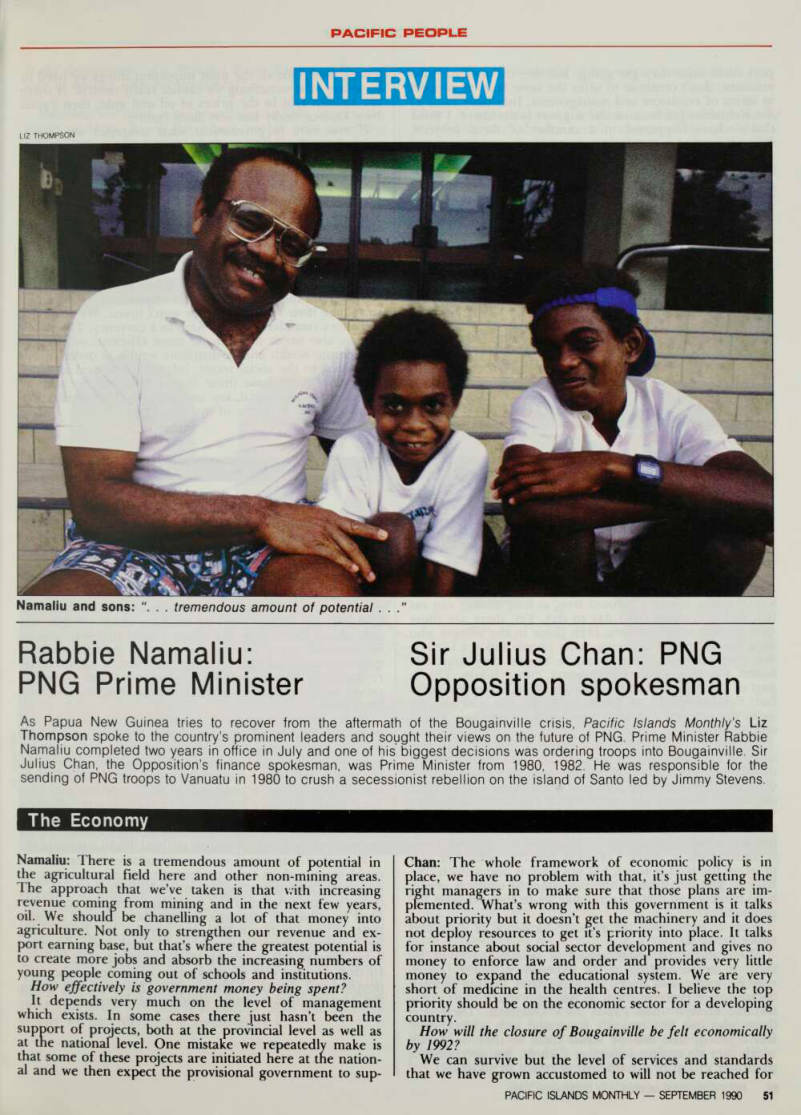
Namaliu: There is a tremendous amount of potential in the agricultural field here and other non-mining areas.
The approach that we’ve taken is that with increasing revenue coming from mining and in the next few years, oil. We should be chanelling a lot of that money into agriculture. Not only to strengthen our revenue and ex port earning base, but that’s where the greatest potential is to create more jobs and absorb the increasing numbers of young people coming out of schools and institutions.
How effectively is government money being spent?
It depends very much on the level of management which exists. In some cases there just hasn’t been the support of projects, both at the provincial level as well as at the national level. One mistake we repeatedly make is that some of these projects are initiated here at tne nation al and we then expect the provisional government to sup-
Chan: The whole framework of economic policy is in place, we have no problem with that, it’s just getting the right managers in to make sure that those plans are im plemented. What’s wrong with this government is it talks about priority but it doesn’t get the machinery and it does not deploy resources to get it’s priority into place. It talks for instance about social sector development and gives no money to enforce law and order and provides very little money to expand the educational system. We are very short of medicine in the health centres. I believe the top priority should be on the economic sector for a developing country.
How will the closure of Bougainville be felt economically by 1992?
We can survive but the level of services and standards that we have grown accustomed to will not be reached for
port them once they get going. But we, the national gov ernment, don’t continue to offer the same level of support in terms of resources and management. Inevitably some of the industries fail because the support is not there. I think that’s what’s happened in a number of these projects.
What is needed is greater government support in terms of management, infrastructure and marketing.
a long time. One of the most important things we need to be aware of is something we cannot really control. If there are sudden falls in the prices of oil and gold, then Papua New Guinea really has very little future.
If you were in government what strategies would you apply immediately?
I’d revise the investment strategies so that we would deploy funds and resources into those areas which, with out too much time can be productive, to generate revenue.
I’d look into our monetary sector to see how much we can improve our liquidity in the banks. That’s one area that’s causing a lot of problems because there’s just simply no money and when you don’t have money it’s too expensive to borrow. We need to see how we can revitalise that sector to see how we can invite investment into PNG in order to improve liquidity. The other area is to see how we liberalise the exchange control regulations, we feel they can’t take their money out they won’t invest. We also have to restore confidence in the Kina as a currency. The public service also needs to be made more efficient, we need to regenerate wealth and re-distribute wealth in order of our priorities, to the social sector, infrastructure and adminis tration. I would have those four sectors only in a broad sense, economic, social, law and order and administration, in that order, in terms of my priority.