A recipe for Fijian growth
p. 34 · Read in the full issue
FIJI needs to expose itself to more competition, both on the domestic and international levels, according
to Westpac Banking Corporation’s man
aging director Stuart Fowler. Speaking to the Australia-Fiji Business Council in Sydney, he said the island nation must involve itself in international trade if it is to enjoy an improved standard of living.
Quoting a recent book on comparative advantage, Fowler said some nations such as Switzerland with chocolate and Holland with cut flowers had been able to turn certain conditions into a spe cialised advantage. The problem for the South Pacific island countries was that they had small populations and econo mies, distance from the large markets
was exacerbated by inadequate shipping
and air services, and there were shor tages in natural resources, technological and educational skills.
“The challenge is to rise above these disadvantages, not to allow parochialism and paternalism to gain the upper hand,” said Fowler. “It means, in the case of the South Pacific, a commitment to build up new industries, based on new assets, which can be developed in the islands.”
He said that Fiji, with its developed industrial sector, had the potential to serve as a catalyst for economic develop ment throughout the South Pacific. The country, which is a leader regionally in terms of infrastructural and educational sophistication, can attract foreign invest ment and provide some of the infras tructure which other countries could not hope to develop, he said.
Fowler argued that the region could look to the services sector for growth, but it had to be at the level of succeed
ing amongst international competition.
The island economies needed to be sensitive to developments and changes in comparative advatage in the Western Pacific and global economies if they were to compete effectively. In the case of Fiji, the future lay in expanding the export base international competitiveness must be the driving force in the South Pacific.
And Fiji would play a major part in restructuring the economies of the re
gion.
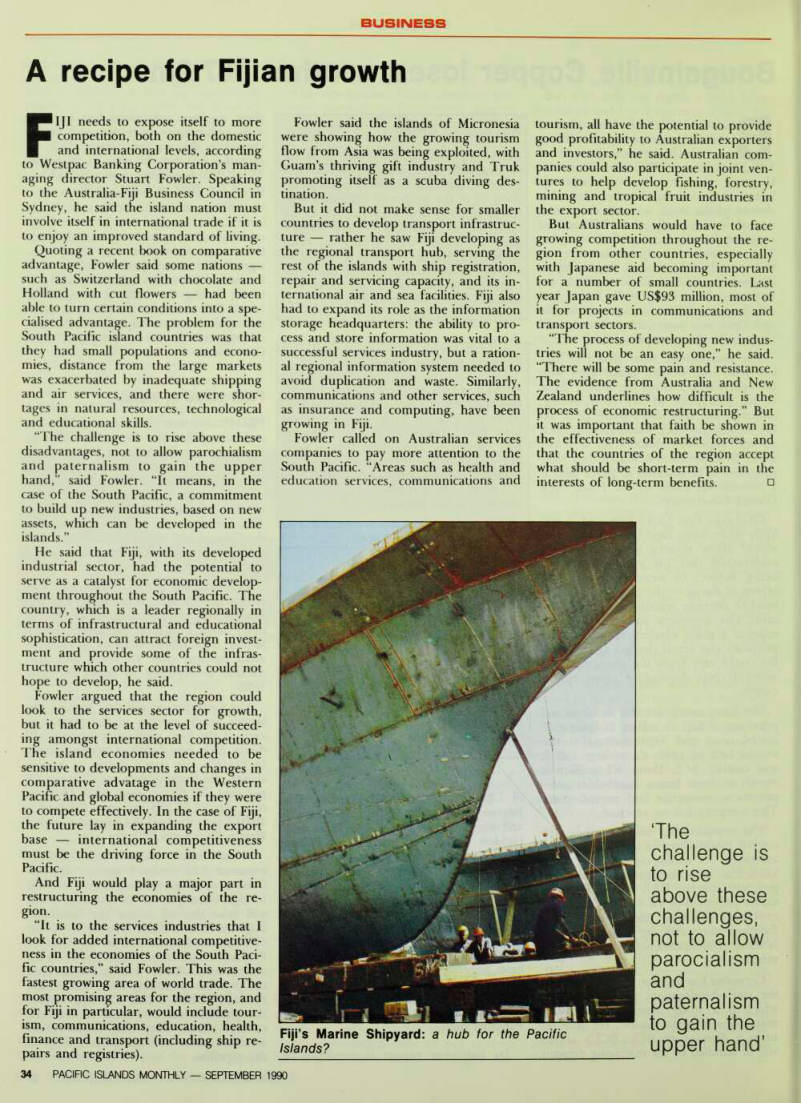
“It is to the services industries that I look for added international competitive ness in the economies of the South Paci fic countries,” said Fowler. This was the fastest growing area of world trade. The most promising areas for the region, and for Fiji in particular, would include tour ism, communications, education, health, finance and transport (including ship re
pairs and registries).
Fowler said the islands of Micronesia were showing how the growing tourism flow from Asia was being exploited, with
Guam’s thriving gift industry and Truk
promoting itself as a scuba diving des tination.
But it did not make sense for smaller countries to develop transport infrastruc ture rather he saw Fiji developing as the regional transport hub, serving the rest of the islands with ship registration, repair and servicing capacity, and its in ternational air and sea facilities. Fiji also had to expand its role as the information storage headquarters: the ability to pro cess and store information was vital to a successful services industry, but a ration al regional information system needed to avoid duplication and waste. Similarly, communications and other services, such as insurance and computing, have been
growing in Fiji.
Fowler called on Australian services companies to pay more attention to the South Pacific. “Areas such as health and education services, communications and
tourism, all have the potential to provide good profitability to Australian exporters and investors,” he said. Australian com panies could also participate in joint ven
tures to help develop fishing, forestry,
mining and tropical fruit industries in the export sector.
But Australians would have to face growing competition throughout the re gion from other countries, especially with Japanese aid becoming important for a number of small countries. Last year Japan gave US$93 million, most of it for projects in communications and transport sectors.
“The process of developing new indus tries will not be an easy one,” he said.
“There will be some pain and resistance.
The evidence from Australia and New Zealand underlines how difficult is the process of economic restructuring.” But it was important that faith be shown in the effectiveness of market forces and that the countries of the region accept what should be short-term pain in the interests of long-term benefits. □
Fiji’s Marine Shipyard: a hub for the Pacific Islands?
'The challenge is to rise " above these challenges, not to allow parocialism and paternalism to gain the upper hand’