Pacific
pp. 31-32 · Read in the full issue

Islands
Monthly
Business
Paradise Lost?
Tahiti tourism figures BHEontinue to drop
By Al Prince
Editor, Tahiti Sun Press
NE of the most frequently de- M M bated tourist industry subjects over the years has been whether Tahiti should be primarily a destination or a stopover for tourists.
Like the debate itself, the yearly prevail ing tendency among tourists has swung back and forth between Tahiti being a single destination vacation site or one of two or more stopovers on a South Pacific vacation. But whereas only a few years ago when Tahiti was a stopover for roughly 60 per cent of all tourists and a destination for only 40 per cent of all tourists, the pendulum has recently been swinging in the opposite direction.
The most startling results of this new swing, occurred during May when what is believed to have been a record 72.72 per cent of all tourists visited Tahiti as a single destination vacation site, while only 27.28 per cent visited on a stopover to one or more other places in the South Pacific. That means that of the 10,041 tourists who visited Tahiti during May, 7302 were destination tourists and 2739 were stopover tourists. But these latest figures from the French Polynesia Tour ism Department reportedly do not tell the endre story about this new trend in
destination versus stopover tourists.
Because of a limited computer
The face of Tahi tian tourism
programme, the share of destination tourists is reportedly bigger than the current method of treating statistics is capable of showing, while the share of stopover tourists is reportedly even smaller. This phenomenon reportedly exists because the Tourism Department’s computer programme treats as stopover tourists those visitors who fly to Tahiti from San Francisco via Los Angeles, from Sydney via Auckland and from Tokyo via Honolulu and / or New Caledonia.
Although such tourists are technically destination visitors, the computer reportedly counts them as stopover visitors because their flights land at some place in between their origin and Tahiti, However, for the destination Tahiti passengers aboard those flights, the stops at Los Angeles, Auckland, Honolulu and New Caledonia are strictly transit stops.
But changing a computer programme to correct the monthly statistics is easier said than done. Although the limitations imposed by the current computer programme have reportedly been known for
the airline’s Australian and American traffic had been stopover tourists, The destination Tahiti business pre viously handled by Continental appears to have been shifted to other regularly scheduled carriers witout any difficulty, The problem is that there has not been an airline to pick up the stopover busi ness previously handled by Continental and Qantas.
In January, the volume of destination tourists to Tahiti represented 52.94 per cent of all tourists, compared to 44.78 per cent a year ago, while stopover volume dropped from 55.22 per cent in January 1989 to 47.06 per cent a year later. The subsequent changes in this year’s percentages were not that much until April, when the volume of destina tion tourists jumped to 62.11 per cent of all tourists, compared to 49.40 per cent a year ago, while stopover business drop ped to 37.89 per cent compared to 50.60 per cent a year ago. And then came May’s very distorted mix of 72.72 per cent destination business, compared to 62.27 per cent a year ago, and 27.28 per
several months, the pressure to modify the programme to produce more accurate statistics did not become glaringly obvious until the May tourism statistics were made public on June 15. What the May statistics clearly show is what some tourist industry officials have been fearing since last October a gradual drying up of southbound and northbound stopover tourist traffic to Tahiti, Those fears were based on decisions made by two international airlines oper-
ating regularly schedule stopover flights
through Tahiti.
The first decision involved Continental Airlines, which last October 1 stopped operating its two weekly flights to Tahiti from Los Angeles and Auckland.
The second decision involved Qantas Airways, which later last October reduced from three to two the number of its weekly flights to Tahiti from Los
Angeles and Sydney. Qantas also
changed aircraft, putting Boeing 747 s
with a smaller passenger capacity on its Tahiti routes. Then early this year Qantas began promoting Tahiti as a destination, whereas in the past the majority of
cent stopover business, compared to 37.73 per cent a year ago.
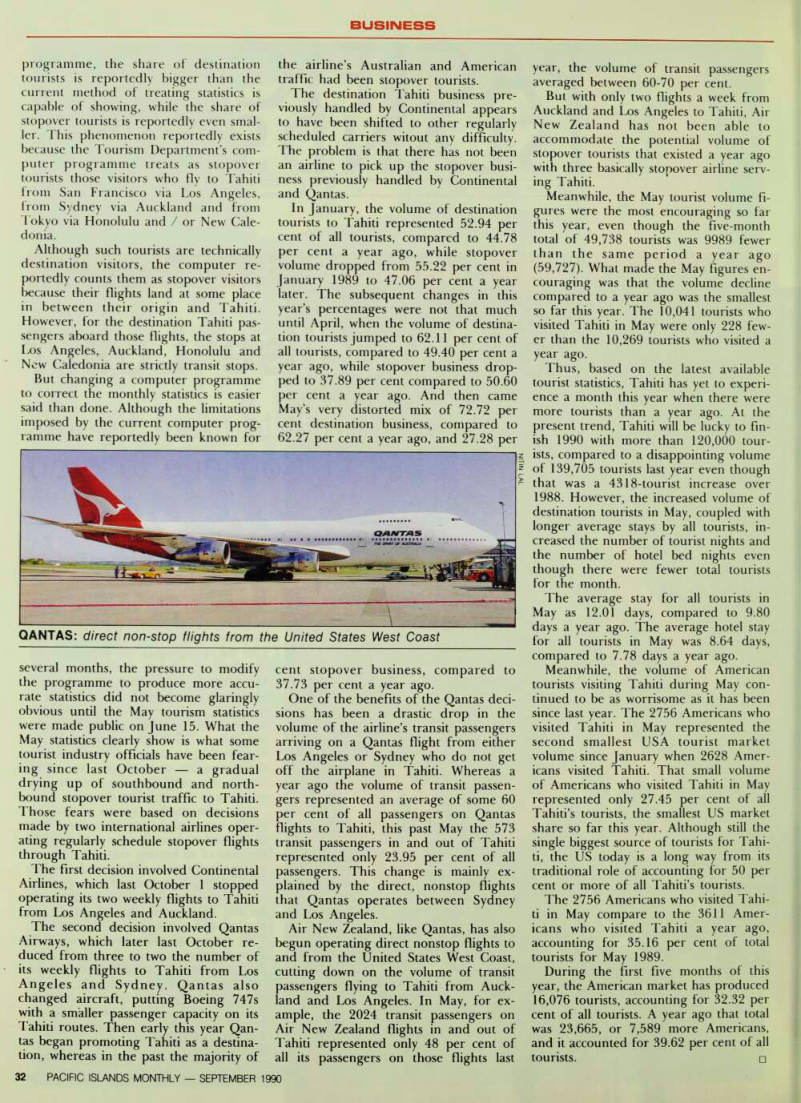
One of the benefits of the Qantas deci sions has been a drastic drop in the volume of the airline’s transit passengers arriving on a Qantas flight from either Los Angeles or Sydney who do not get off the airplane in Tahiti. Whereas a year ago the volume of transit passen gers represented an average of some 60 per cent of all passengers on Qantas flights to Tahiti, this past May the 573 transit passengers in and out of Tahiti represented only 23.95 per cent of all passengers. This change is mainly ex
plained by the direct, nonstop flights
that Qantas operates between Sydney and Los Angeles.
Air New Zealand, like Qantas, has also
begun operating direct nonstop flights to
and from the United States West Coast, cutting down on the volume of transit passengers flying to Tahiti from Auck land and Los Angeles. In May, for ex ample, the 2024 transit passengers on Air New Zealand flights in and out of Tahiti represented only 48 per cent of all its passengers on those flights last
year, the volume of transit passengers averaged between 60-70 per cent.
But with only two flights a week from Auckland and Los Angeles to Tahiti, Air New Zealand has not been able to accommodate the potential volume of stopover tourists that existed a year ago with three basically stopover airline serv
ing Tahiti.
Meanwhile, the May tourist volume fi gures were the most encouraging so far this year, even though the five-month total of 49,738 tourists was 9989 fewer than the same period a year ago (59,727). What made the May figures en couraging was that the volume decline compared to a year ago was the smallest so far this year. The 10,041 tourists who visited Tahiti in May were only 228 few er than the 10,269 tourists who visited a year ago.
Thus, based on the latest available tourist statistics, Tahiti has yet to experi ence a month this year when there were more tourists than a year ago. At the present trend, Tahiti will be lucky to fin ish 1990 with more than 120,000 tour ists, compared to a disappointing volume of 139,705 tourists last year even though that was a 4318-tourist increase over 1988. However, the increased volume of destination tourists in May, coupled with longer average stays by all tourists, in creased the number of tourist nights and the number of hotel bed nights even though there were fewer total tourists for the month.
The average stay for all tourists in May as 12.01 days, compared to 9.80 days a year ago. The average hotel stay for all tourists in May was 8.64 days, compared to 7.78 days a year ago.
Meanwhile, the volume of American tourists visiting Tahiti during May con tinued to be as worrisome as it has been since last year. The 2756 Americans who visited Tahiti in May represented the second smallest USA tourist market volume since January when 2628 Amer icans visited Tahiti. That small volume of Americans who visited Tahiti in May represented only 27.45 per cent of all Tahiti’s tourists, the smallest US market share so far this year. Although still the single biggest source of tourists for Tahi ti, the US today is a long way from its traditional role of accounting for 50 per cent or more of all Tahiti’s tourists.
The 2756 Americans who visited Tahi ti in May compare to the 3611 Amer icans who visited Tahiti a year ago, accounting for 35.16 per cent of total tourists for May 1989.
During the first five months of this year, the American market has produced 16,076 tourists, accounting for 32.32 per cent of all tourists. A year ago that total was 23,665, or 7,589 more Americans, and it accounted for 39.62 per cent of all tourists. n
QANTAS: direct non-stop flights from the United States West Coast