delayed again
Tuna hearing delayed again
UNITED States Secretary of
Labor Elizabeth Dole has, again, postponed scheduled minimum wage hearings in American Samoa. Originally set for June, they were postponed until September, and then, late in August postponed again un til January 14.
T his was good news for Governor Tali Coleman and to the tuna canneries neither wants to raise wages. The raises would add to Coleman’s deficit, and cut into the canners’ profits.
The Secretary’s decision was doubly bad news for the territorial and cannery workers (most of the latter are from Western Samoa), beause if any increases are voted by Dole’s appointed Industry Committee, they will not be retroactive.
Dole postponed this round of hearings at the request of the tuna industry and
of Congressman Faleomaveaga and eight
other Democratic members of the US House of Representatives. They argued that Congress is about to pass a bill which will allow the hearings to continue without the managers of the StarKist and Chicken of the Sea plants having to show the extent of their profits in Amer ican Samoa; the tuna industry argues that this open-books provision was a technical error made by the Congress when it last revised the minimum wage law.
Both the tuna canneries and the Ter ritorial Government ask that they be ex cused from the minimum wage of US$3.BO which applies to all other US workers. There are currently several different minimum wages in effect in American Samoa, varying from about US$2 to about US$3 an hour. The tuna wage is US$2.B7 an hour. □ Stop the tests THE environmental organisation Green peace has called for an immediate end to French nuclear tests in French Polynesia.
This latest call came after the publication of a new scientific report indicating that
radioactivity from nuclear explosions
under Mururoa Atoll is likely to reach the surface in six years or sooner.
The report was made by United States scientist Norma Burke and published in the British journal New Scientists. It says that a re-evaluation of sampling data col lected by French marine explorer Jac ques Cousteau in 1987 shows water in the lagoon contaminated with Cesium
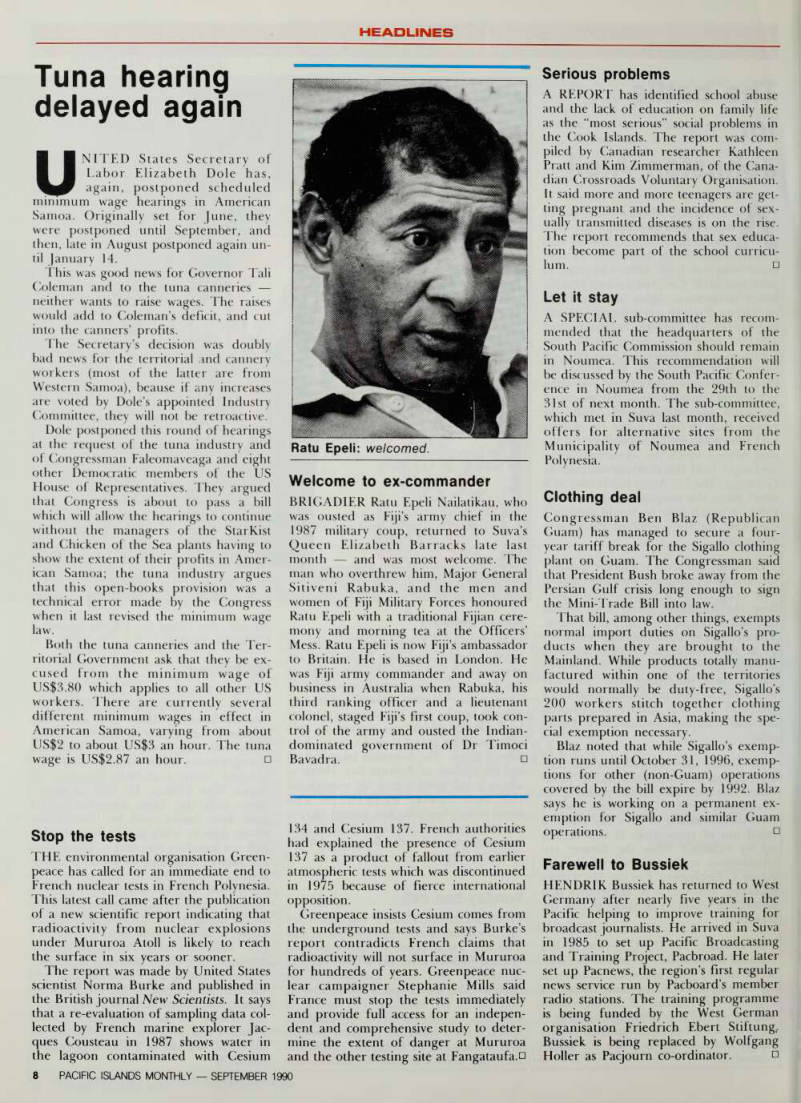
Welcome to ex-commander BRIGADIER Ratu Epeli Nailatikau, who was ousted as Fiji’s army chief in the 1987 military coup, returned to Suva’s Queen Elizabeth Barracks late last month and was most welcome. The man who overthrew him, Major General Sitiveni Rabuka, and the men and women of Fiji Military Forces honoured Ratu Epeli with a traditional Fijian cere mony and morning tea at the Officers’
Mess. Ratu Epeli is now Fiji’s ambassador to Britain. He is based in London. He was Fiji army commander and away on business in Australia when Rabuka, his third ranking officer and a lieutenant colonel, staged Fiji’s first coup, took con trol of the army and ousted the Indian dominated government of Dr Timoci Bavadra. □
134 and Cesium 137. French authorities had explained the presence of Cesium 137 as a product of fallout from earlier atmospheric tests which was discontinued in 1975 because of fierce international
opposition.
Greenpeace insists Cesium comes from the underground tests and says Burke’s report contradicts French claims that radioactivity will not surface in Mururoa for hundreds of years. Greenpeace nuc lear campaigner Stephanie Mills said France must stop the tests immediately and provide full access for an indepen dent and comprehensive study to deter mine the extent of danger at Mururoa and the other testing site at Fangataufa.D
Serious problems
A REPORT has identified school abuse and the lack of education on family life as the “most serious” social problems in the Cook Islands. The report was com piled by Canadian researcher Kathleen Pratt and Kim Zimmerman, of the Cana
dian Crossroads Voluntary Organisation.
It said more and more teenagers are get ting pregnant and the incidence of sex ually transmitted diseases is on the rise.
The report recommends that sex educa tion become part of the school curricu lum. □ Let it stay A SPECIAL sub-committee has recom mended that the headquarters of the South Pacific Commission should remain in Noumea. This recommendation will be discussed by the South Pacific Confer ence in Noumea from the 29th to the 31st of next month. The sub-committee, which met in Suva last month, received offers for alternative sites from the Municipality of Noumea and French
Polynesia.
Clothing deal
Congressman Ben Blaz (Republican
Guam) has managed to secure a four year tariff break for the Sigallo clothing plant on Guam. The Congressman said that President Bush broke away from the Persian Gulf crisis long enough to sign the Mini-Trade Bill into law.
That bill, among other things, exempts normal import duties on Sigallo’s pro ducts when they are brought to the Mainland. While products totally manu factured within one of the territories
would normally be duty-free, Sigallo’s
200 workers stitch together clothing parts prepared in Asia, making the spe cial exemption necessary.
Blaz noted that while Sigallo’s exemp tion runs until October 31, 1996, exemp tions for other (non-Guam) operations covered by the bill expire by 1992. Blaz says he is working on a permanent ex emption for Sigallo and similar Guam
operations. □
Farewell to Bussiek HENDRIK Bussiek has returned to West Germany after nearly five years in the
Pacific helping to improve training for
broadcast journalists. He arrived in Suva in 1985 to set up Pacific Broadcasting and Training Project, Pacbroad. He later set up Pacnews, the region’s first regular news service run by Pacboard’s member radio stations. The training programme is being funded by the West German
organisation Friedrich Ebert Stiftung,
Bussiek is being replaced by Wolfgang
Holler as Pacjourn co-ordinator. □
Ratu Epeli: welcomed.