Songs of the islands
p. 47 · Read in the full issue
Books
Songs and stories of Tokelau. An introduction to the cultural heritage. Edited by Allan Thomas, Ineleo Tuia and Judith Huntsman, Victoria University Press, Wellington, NZ514.95 (book), NZ$B (cassette tape).
Reviewed by Wendy Pond
His teeth shining like a split frond His body like the morning sunrise His legs like bonito fresh from the sea Oh Lulu, that’s the one I love, [song 39] People in Polynesia use English as a common language for communication and mobility, but their technological and
musical accomplishments remain largely
untranslatable. The authors have met this by further explicting the song texts with drawings and photographs. We see youths observed by Wilkes in 1848 tat tooed with turtle images; elders dancing on the beach, their heads haloed with coconut leaf pale, like the sun’s rays; a kalele trap for fish. The songs similarly retain images from the distant past (a burial beneath the shell of a turtle), the near past (movie themes during the American occupation of Atafu), and the present (a waving handkerchief).
This book appears then as a treasury of songs presented in the social and technological matrix which makes the texts meaningful.
On an accompanying cassette tape, the songs are arranged in their musical types. Thus yet another dimension is added to the texts. We hear the exten sion of language into music, the high lighting of rhyming phrases, the embel-
THE authors of this work are a musicologist, a Tokelau leader, and an ethnographer. They set the songs of Tokelau in the lived real life. A copra cutter sailing across the lagoon sings to whistle up the wind. Women fatigued by weaving call for singers to enliven their minds. A man gathering toddy sings a love song to sweeten the juice. A parent whose children are late for bed wheedles them home with a song. The genius with which Tokelau composers snatch the whiff of an event in four-lined songs, is opened to us of
other cultures through graphic descrip
tions of the historical and daily contexts in which the songs are performed.
Maori society has won renown for ora tory, Tonga for dance-poetry, Samoa for fine mats. The distinguishing mark of Tokelau is the interplay between lan guage and song, the dexterity with which an elder emphasises his speech with a song, or dramatises the plot of his tale with cryptic refrains. (The songs can be heard on the cassette). / saw a man in the pool His head is like the ripe pandanus fruit His eyes like an open flower
lishment of text with melodic structures.
With some courage perhaps, and some spirit, the translators have matched the sardonic brevity of the Tokelau songs with succinct texts in English. Thus a navigator, having tired of enticing the fickle breeze to blow with the strength of a storm, turns from flattery to scorn: O kae fiafia atu kita 0 kae fakauliuli kae ni tae feke! 1 like you, I like you Black but only octopus ink! [song 20] It is a decision I find pleasing, since it assumes the ability of a multicultural
readership to appreciate the give-and
take between text and translation. Early European explorers in the Pacific re sponded to Polynesian entertainments with performances of their own fifes and jigs, as these translators have responded in kind to the Tokelau texts. The artful ness of the Tokelau songs reaches us through the endeavour of these three editors.
Equally important, the songs make public Tokelau perspectives on Euro pean colonisation. The “Valedictory for Pou” demonstrates that Olohenga should rightfully be included with the three Tokelau islands. Notwithstanding know ledge of this song, the New Zealand Government in 1980 effectively ceded Olohenga to the United States.
Te fafine Ko Hinaolo e tagi tu ma momoko e The woman Hinaolo stands wailing and
pleading . . . [song 26].
The Biblical myths get a wry telling from these adroit seamen: Talofa ia Noa kua kasa i te mauga Poor Noah grounded on the mountain . .
[song 7]
Almost nothing has been published in the Tokelau language. Official com munication has been in Samoan and En glish. In 1986 the first dictionary was published by the Office of Tokelau Affairs (Apia). Our authors had a task: to support the vernacular language; to alert scholars to the genius of the Toke lau song-and-story tradition; to return to Tokelau people the results of 20 years of scholarship; to inaugurate the textual presentation of an oral tradition. They have succeeded admirably, capturing the energy of the language in metaphors of ancient dirges, in dance songs with suc cinct summations of historical events, in magical formulas and vernacular insults of seamen, in the obstacle-strewn path of a traditional tale, in actions of characters beyond the social pale. These are people who wrestle with life, and at last we can
admire their poetic strength.
Haea he fiflli he papani he tulaga mo aliki I te tuai mai o he vagana kia te kita Wisdom is the mark of chiefs Why do you explain to me so late? [song 42] □
Irene Nisbet
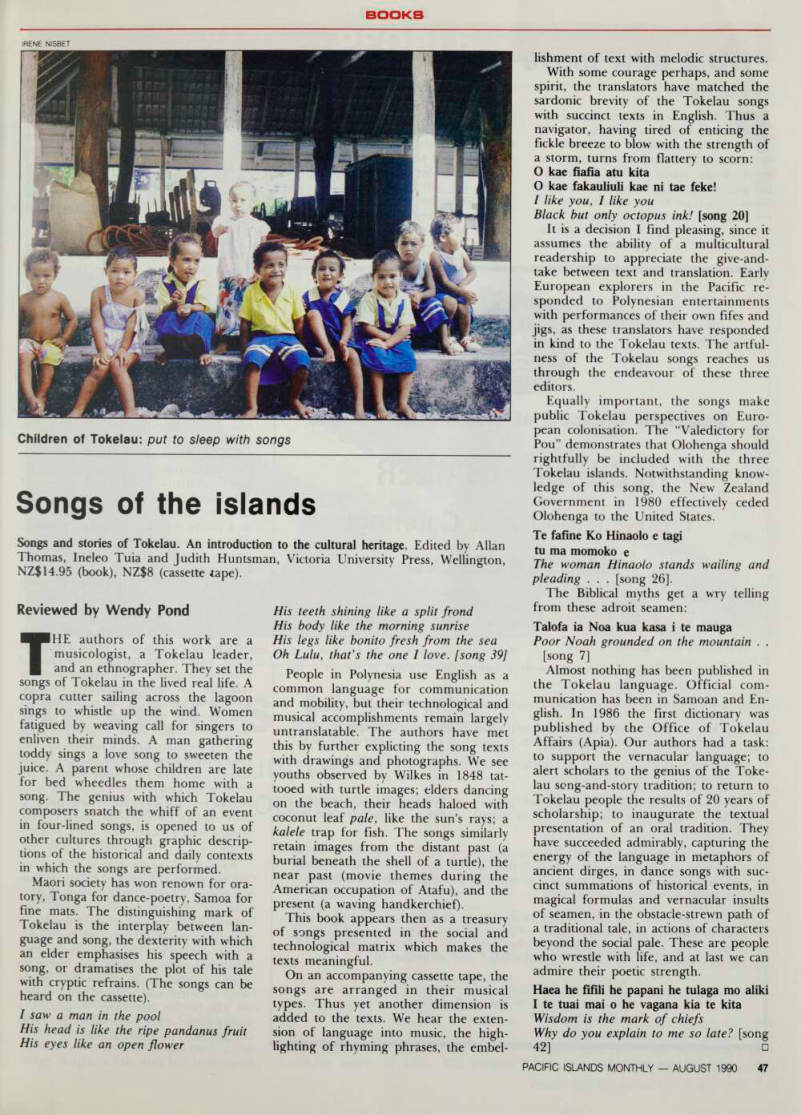
Children of Tokelau: put to sleep with songs