Show me a way to Kerema
pp. 33-35 · Read in the full issue
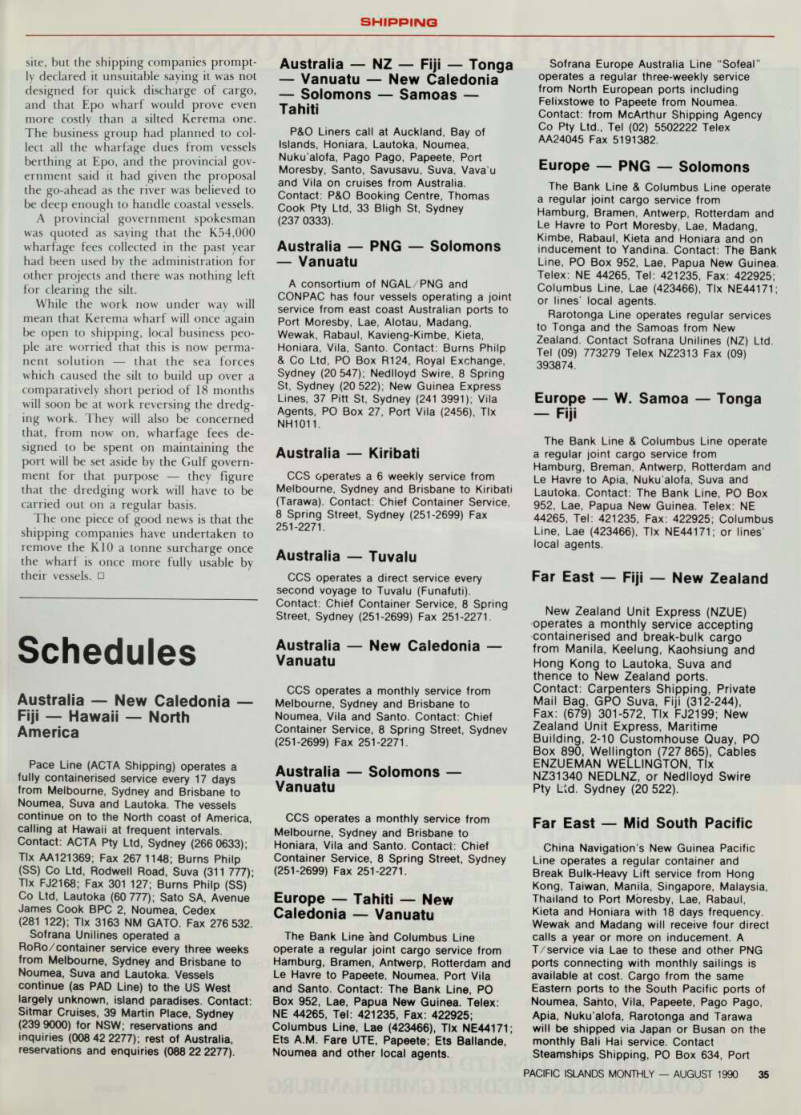
WORK has begun at last on re moving silt which has closed the Papua New Guinea port at Kerema, in the Gulf Province. A large digger has as this issue went to press started removing the silt which has made it impossible for conventional coas tal ships to berth at the town’s wharf.
The silting problem has led to occasional shortages in Kerema and to local traders having to charter a barge to bring in food and other supplies.
Even if the wharf is brought back into service soon, two questions remain: first, why the K 1 per tonne of cargo levy that has been paid for years to the local pro vincial government was apparently not used to maintain the port, and secondly how long it will be before the silt builds up again.
The silting became so bad that, at low tide, it was possible for locals to walk around the wharf. Initially, the coastal ships judged the time of their arrivals and departures to coincide with high tide, but this inevitably meant extra costs
Papua New Guinea
to the owners. The companies concerned Burns Philp Coastal Shipping, PNG
Shipping Corporation and Rabia Ship-
ping Pty Ltd tried to force the provin-
cial government’s hand by threatening to raise their charges. They argued that the sandbank forced vessels to berth about two metres off the wharf, causing what
they claimed was danger and also exces sive delays in discharging cargo.
The result was a surcharge of KlO a tonne which came into effect in mid- May. The companies also said that while they would try to ensure that all cargo was discharged safely, they would not accept any responsibility for loss or dam age from cargo falling into the water between the vessel and the wharf. The shipping companies had written to the provincial government several months earlier asking for action on the silting problem and had held off the surcharge to allow time for action, but they acted when it became clear no action was ab out to take place.
Reaction to the surcharge was predict able, with Gulf Premier Sepoe Karava
criticising the shipping companies and
saying that it would be the local people who would suffer from increases in prices in the local stores.
But not only were goods more expen sive, they were already in short supply.
By mid-May the two main shopowners in Kerema were facing the situation where much of their cargo was being held in Port Moresby.
The companies stopped running to Kerema when the Burns Philp vessel
Purari Chief became temporarily grounded at Kerema. The shopkeepers were accustomed to weekly freight deliveries by sea the only method of
bringing large consignments to the town
but things began to be stretched when the gaps between vessels became more like a month in duration. One of the two
large traders in Kerema, Ning’s Trading,
did experiment with air freighting food, but it was found that the aircraft could not even manage an order of 35 cartons of groceries and they were delivered over four separate flights. While Peter Ning said he was prepared to go to the
expensive lengths of airfreighting, there
was only one Talair flight each day into Kerema and the aircraft had little spare
freight capacity.
Reports were received in Port Moresby that panic buying was taking place in Kerema once local residents heard that shipping services had been cut. Meanwhile, frozen food, fresh meat, bags of rice, cartons of tinned fish and other goods were sitting in storerooms at Port Moresby. Ning’s shop at one stage ran out of basic food items such as rice, flour, bread, biscuits and frozen meat and chicken. Fuel was also running low in the town.
The two major traders in Kerema were forced to charter a barge to bring consignments into the town to avert a major dislocation to normal life. But this cost them a charter fee of KlB5O a day, which the businesses could sustain only in the very short term. But at least food and fuel supplies were topped up.
The national Government had to step into the crisis and promise to hand over to the provincial authorities K 40,000 to pay for dredging around the wharf.
Their hand was forced by the shipping companies saying that, even with the KlO a tonne surcharge, it was not econo mical for the owners to send their ships to Kerema. The provincial government had made a half-hearted attempt to address the crisis. It had offered to pay a local construction company K4OOO but they did not have any dredging equipment; then villagers were hired to remove the silt using spades and shovels, but this was not a practical proposal.
Then a local business group suggested a new tack: they proposed clearing a site at Epo, just Bkm up from the main wharf along the Aravure River, where a berth had once been in service for ves sels calling at the old Epo Plantation.
The group set to work to clear the old
site, but the shipping companies prompt ly declared it unsuitable saying it was not designed for quick discharge of cargo, and that Epo wharf would prove even more costly than a silted Kerema one.
The business group had planned to col lect all the wharfage dues from vessels berthing at Epo, and the provincial gov ernment said it had given the proposal the go-ahead as the river was believed to be deep enough to handle coastal vessels.
A provincial government spokesman was quoted as saying that the K 54,000 wharfage fees collected in the past year had been used by the administration for other projects and there was nothing left for clearing the silt.
While the work now under way will mean that Kerema wharf will once again be open to shipping, local business peo ple are worried that this is now perma nent solution that the sea forces which caused the silt to build up over a comparatively short period of 18 months will soon be at work reversing the dredg ing work. They will also be concerned that, from now on, wharfage fees de signed to be spent on maintaining the port will be set aside by the Gulf govern ment for that purpose they figure that the dredging work will have to be carried out on a regular basis.
The one piece of good news is that the shipping companies have undertaken to remove the KlO a tonne surcharge once the wharf is once more fully usable by their vessels. □