Dolca chocolate launched
pp. 25-26 · Read in the full issue
in Fiji deal with Nestle
CHOCOLATE blocks are being
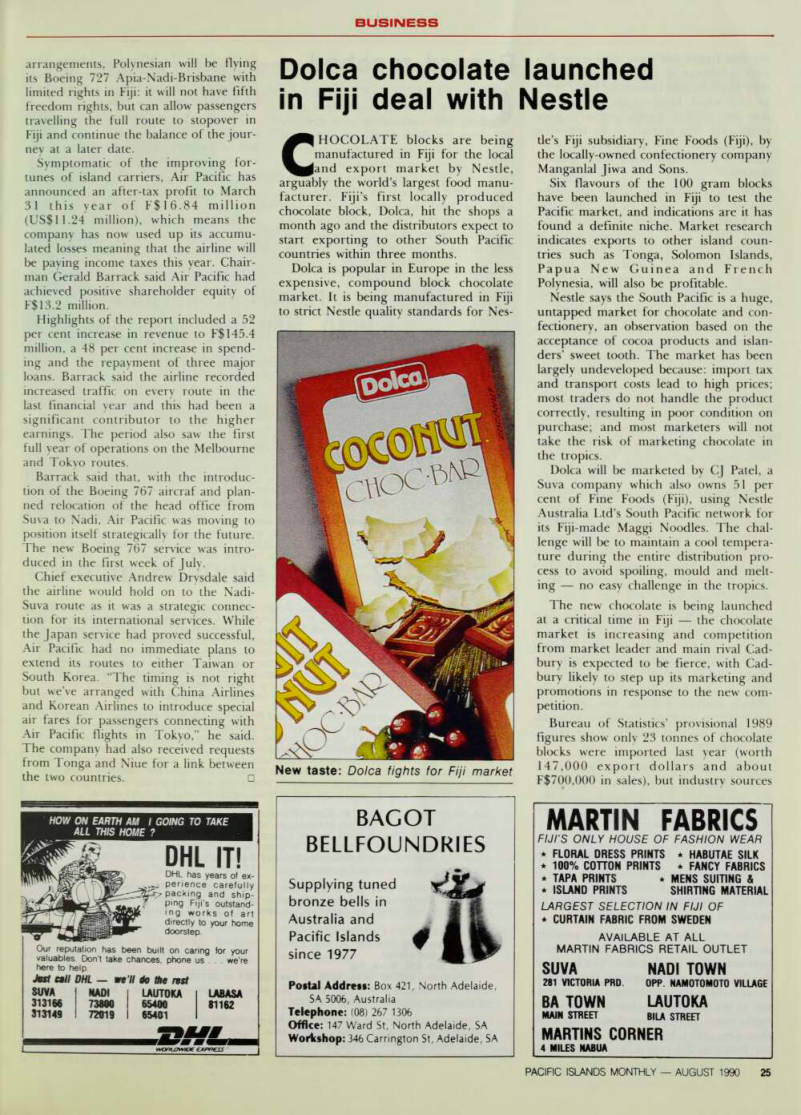
manufactured in Fiji for the local and export market by Nestle, arguably the world’s largest food manu facturer. Fiji’s first locally produced chocolate block, Dolca, hit the shops a month ago and the distributors expect to start exporting to other South Pacific countries within three months.
Dolca is popular in Europe in the less expensive, compound block chocolate market. It is being manufactured in Fiji to strict Nestle quality standards for Nes-
tie’s Fiji subsidiary, Fine Foods (Fiji), by
the locally-owned confectionery company
Manganlal Jiwa and Sons.
Six flavours of the 100 gram blocks have been launched in Fiji to test the Pacific market, and indications are it has found a definite niche. Market research indicates exports to other island coun tries such as Tonga, Solomon Islands, Papua New Guinea and French Polynesia, will also be profitable.
Nestle says the South Pacific is a huge, untapped market for chocolate and con fectionery, an observation based on the acceptance of cocoa products and islan ders’ sweet tooth. The market has been
largely undeveloped because: import tax
and transport costs lead to high prices; most traders do not handle the product correctly, resulting in poor condition on purchase; and most marketers will not take the risk of marketing chocolate in
the tropics.
Dolca will be marketed by CJ Patel, a Suva company which also owns 51 per cent of Fine Foods (Fiji), using Nestle Australia Ltd’s South Pacific network for its Fiji-made Maggi Noodles. The chal lenge will be to maintain a cool tempera ture during the entire distribution pro cess to avoid spoiling, mould and melt ing no easy challenge in the tropics.
The new chocolate is being launched at a critical time in Fiji the chocolate market is increasing and competition from market leader and main rival Cad bury is expected to be fierce, with Cad bury likely to step up its marketing and promotions in response to the new com petition.
Bureau of Statistics’ provisional 1989 figures show only 23 tonnes of chocolate blocks were imported last year (worth 147,000 export dollars and about F 5700,000 in sales), but industry sources
New taste: Dolca fights for Fiji market
say that figure will more than triple this year following a reduction of import duty over the last 12 months from 120% to 55% which has brought the product into the average income earner’s price range. Fiji also appears to be following the Australian trend to eat chocolate in stead of lollies and other sugar confec
tionery.
The duty reduction means consumers pay an average of $2.20 for 100 gram blocks of imported chocolate, giving Dol ca a slight price advantage with its launch price of $1.79. Market research shows price is not a vital factor around the $2 range, so competition will be based on quality and freshness, with Dol ca having the advantage in the latter.
CJ Patel initially aim to get Dolca into 80 per cent of Fiji’s retail outlets through their extensive marketing network then extend it to all outlets. They have laun ched a dynamic media and point-of-sale campaign with display material in all ma jor supermarkets, snack bars and grocery outlets, and public relations and prom otional activities such as give-away sam ples, posters and stickers. Dolca will also sponsor sporting and other events.
Nestle’s decision to manufacture in Fiji was based on evaluation and considera tion of the market potential, investment environment, cost and efficient of work ers, geographic position of the factory in the region, financial and port facilities and confidence in local partners Man ganlal Jiwa and CJ Patel.
Manganlal Jiwa, the confectionery and snack manufacturer of Ba that exports to over 20 countries, bought Nestle’s New Zealand equipment to produce 100 gram blocks. The 100 gram block is vi able in the islands, where Cadbury already markets a similar size block, but no longer has a good market in Australia and New Zealand, where larger blocks are preferred.
Nestle have a co-packing agreement
with Manganlal Jiwa whereby Nestle set
the parameters for operation, provides all the raw materials and packaging and monitors quality control.
The machinery can produce one tonne of chocolate an hour 10,000 x 100 gram blocks over twenty times the Fiji domestic market. It is anticipated that a 10-day production run will supply the predicted market for three months.
The venture may also be the prelude to producing the higher quality, more expensive Nestle chocolate blocks. Fine Foods, Nestle and Manganlal Jiwa expect to introduce the technology and exper tise to produce Nestle chocolate, which is made from cocoa rather than compound chocolate, after building up the market for Dolca in the region. □