Whew! made it
pp. 15-17 · Read in the full issue
The Region
Namaliu survives his first two years and eyes the future
By Wally Hiambohn
//I WILL provide honest,
I responsible and decisive
I political leadership to
strengthen national unity and prosperity.
Any leadership is no easy task. I’m not afraid, however, to lead nor am I so naive as to swerve from responsibilities of firm and decisive leadership. I believe in the democratic participatory govern ment, and that is exactly what the people of Papua New Guinea will get.” These were the words of PNG’s fourth Prime Minister, Rabbie Namaliu, when he was first voted into office on July 4, 1988. In the event he took over the toughest job in the Pacific Islands. In his two years he has continually been threatened by votes of no-confidence, and seen his resource rich country embroiled in ethnic violence and economic upheavals.
In the beginning, Namaliu’s plan of action was to bring about constitutional reforms to achieve political stability; tackle the law and order problem head on to-provide peace and harmony; pro vide a climate for economic growth and job creation; and educate and train the human resource. This month, as he be gins his third year in office, the 44-year old Namaliu can look back at a very long and arduous two years, a period full of drama and probably the most challeng ing in Papua New Guinean post
independence history.
Namaliu’s government was fighting on many frontiers: unemployment, law and order, industrial unrests, political chal
lenges, declining commodity prices, a re
bellion on Bougainville, and with all these put together, a spiralling economic crisis. All these threatened the stability of Namaliu’s government and that of the nation. He was required to act, and to act in accordance with the values with which he first set out: honesty, responsi bility and decisiveness in order to achieve unity and prosperity. Without doubt, the Bougainville crisis would have been the most prominent, time consum ing and determining issue in Namaliu’s
leadership.
He had hardly had time to settle into office when the issue over land own ership, economic benefit and participa-
tion of the giant Bougainville copper mine blew its top. It left Namaliu’s gov ernment little time and resources to deal effectively with other issues, which, while considered of smaller magnitude, were nevertheless critical. To fight crime
Namaliu, immediately upon taking
office, appointed a ministerial law and order committee and allocated KlO mil lion to also achieve integral human de
velopment. An anti-corruption squad
was set up. Again, the Bougainville crisis, which cost so many lives and revenue to PNG, took away most of the police force’s resources, leaving the rest of the country vulnerable to criminals. Crowds rioted and rampaged in towns. There were big and prominent riots in Port Moresby, Lae, Goroka, Mount Hagen and Wewak.
Only quite recently, as Bougainville
more or less took a back stage, the gov ernment took a decisive step to intro duce capital punishment, and also to im pose curfews in selected crime-ridden towns. Namaliu’s Cabinet has agreed in
principle for the drafting of legislation
seeking Parliament’s approval for serious crimes such as rapes and wilful intruders to be punishable by death. As with education and training, the government decided to use a lot of Australian aid money (currently at K2OO million a year) to improve on the capacity of its public sector manpower, particularly those in technical fields, whilst at the same time encouraging the private sector to follow suit. Most of the training and improve ment was directed at revenue generating areas including taxation and customs.
To address increasing industrial un rests, the government appointed a tri partite council consisting of union, em ployer and government representatives.
Within that time major strikes were staged at Ok Tedi mine and Burns Philp. The worst of the industrial un rests in Namaliu’s past two years was that of disgruntled soldiers who took to the streets in February last year, terrorising people and smashing glasses at Parlia ment House. It led to an immediate re view into the salaries and conditions of soldiers.
As with Constitutional Reforms the government had particularly wanted to change the present practice with motions of no-confidence. Requiring a two-thirds majority in three consecutive Parliament sessions to make these changes, the gov ernment has not had the numbers. Only notices of the government’s intention to move these amendments have been
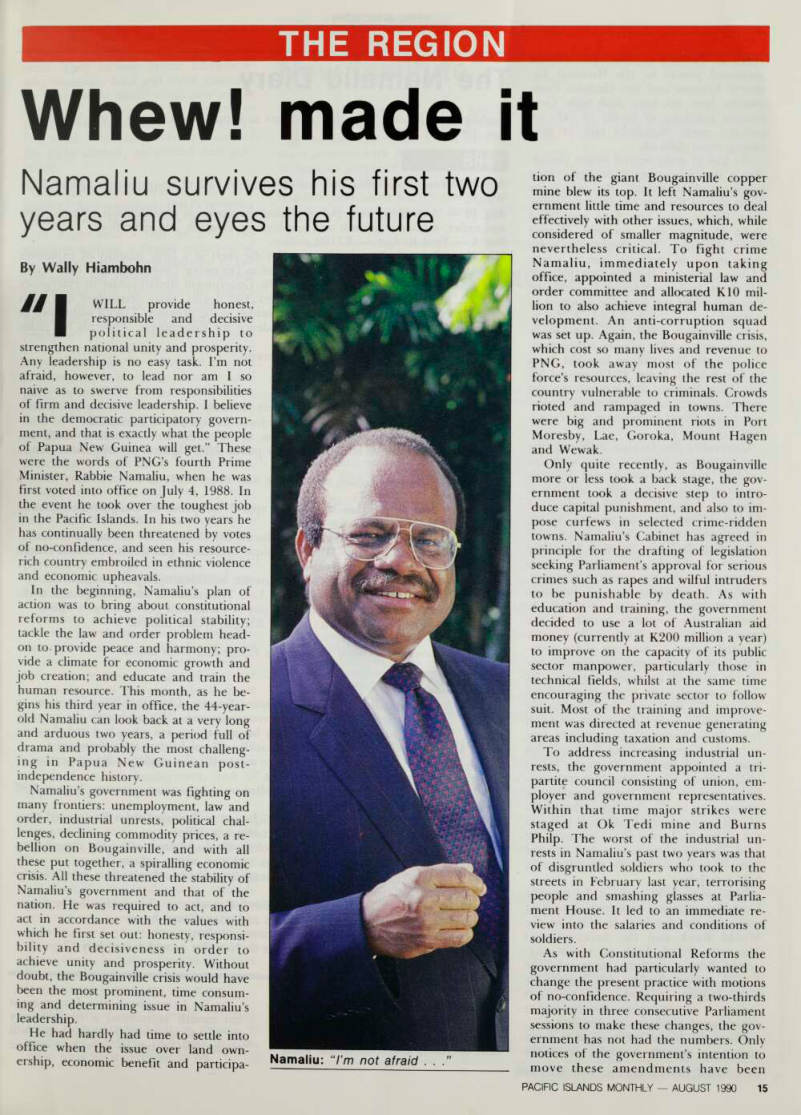
Namaliu: "I'm not afraid..."
given in Parliament. Electoral reforms
proposed jointly by the National Re
search Institute and the Electoral Com mission have not been dealt with. Con tinuous switching of loyalty of MPs to and-fro made Namaliu’s task of gov erning more difficult.
He had to make several minor reshuf fles in that time to accommodate certain groups and individuals, the prominent being that of Peoples Acting Party leader Ted Diro’s, who was first appointed State Minister, and, recently, Deputy Prime Minister. The Opposition made three moves to challenge him in a vote of no-confidence, the latest on July 12.
All three were withdrawn because the Opposition did not have the numbers to succeed.
In November, 1988 as the Bougainvil le crisis was quickly gaining momentum, the Namaliu Government brought down its first Budget. It was PNG’s second bil lion kina budget, and was geared for growth and tax reforms, to go from nar row-based direct taxation to the broad based indirect tax.
Generally, the budget reflected the government’s policies and, with in creased funding, was geared towards priorities areas. In November last year, it brought down the 1990 Budget of K 1250 million but the closure of the Bougainville copper mine, a major con tributor to the economy, took a big bite out of it. As the Bougainville crisis worsened, so did the country’s earnings.
When the Panguna mine was forced to close on May 15 last year, it closed the books to the country’s benefit to the mine. Before then Bougainville Copper Limited earned 17 per cent of the coun try’s total revenue and constituted over 40 per cent of its export earnings. Its closure meant a loss in the hundreds of millions. To deal with the Bougainville militants who were fighting for secession from PNG, Namaliu’s Government sent in troops. They pulled out in March this year and left Bougainville in the hands of the rebels. Heavy casualties were suf fered on both sides. Despite continuous
negotiations mostly through a third par
ty, a solution to the problem is still way out of reach. In the latest attempt, the New Zealand Government had offered three of its naval ships for the talks to be held late July.
The government, without the revenue from Bougainville, took urgent step to make up for the loss. It called in the World Bank and the International Monetary Fund, both of whom sug gested drastic austerity measures. The K 1250 million Budget was slashed by KlOO million. Its cost-saving measures include a retrenchment exercise and a trimming of public sector divisions.
Many aid donors were asked to help, and more recently Namaliu personally
attended the World Bank Consultative Group Meeting in Singapore, and returned with K7lO million in aid money, most in grants and concessional loans.
In its latest move the Government last month announced a revolutionary set of policies which Namaliu hopes will rescue PNG from its present economic
crisis. They include drastic administra tive, economic, legal and social measures his government would adopt now and in the future. It opened up the economy to foreign investment and gave it a very free hand, while the government created the right climate, monitored and gov erned.
Namaliu fearlessly predicted that as a result of these measures, PNG’s economy would recover fast and grow at a rate of 7 to 9 per cent a year by 1995. His measures include a drastic reduction of the public service; improvement in law and order; the abolition of the National Investment and Development Agency (NIDA); reclassification of foreign enter prises from 75 per cent national own ership to 50 per cent national own ership; levy for training and localisation; increase in Papua New Guinean business involvement; a mortgage finance com
pany to provide long-term housing
loans; disposal of all surplus government land to businesses; a joint government business committee to simplify regula tions; rural industry diversification, com mercialise all agriculture extension ser vices; eradicate compensation claims; change in visa fees and allow a perma nent resident status to investors investing more than K 250,000; a tax holiday to pioneer industries; remove duty on im ports required by manufacturers for im port creation; wage restraints; and ba lance resource development and en
vironment protection.
He said then that his government’s role was merely to create and maintain the right economic, political and social environment for private sector growth.
“We are creating the right climate for investment, and for real private sector growth. I am confident you will respond positively to the challenges we are now issuing. “We must also use the opportun ity to cut public service waste and ineffi ciency, and to bring about a real transfer of resources, of employment, and of opportunity to the private sector.
“The days of a bloated, inefficient and
irresponsible public sector were not just
numbered, they are finished. I can no longer depend on the public sector to create jobs, and its roles in job creation will diminish considerably in the immedi ate period ahead. That means smaller government, more accountable for its spending and more responsive to the changing needs of a young nation, rich in resources, including human resources.
It most certainly means less government involvement in business, not more.”
The future for Namaliu remains, again unpredictable. But to remain in control he needs to find time to com plete what he started out to do. □