Days Later
pp. 10-11 · Read in the full issue
Cover Stories
A Thousand
A new Constitution and the promise of elections in '91
THE President’s voice shook a little as he spoke. “I speak to you tonight at the moment in our country’s destiny,” he said as he started to read a
23-page statement announcing the
promulgation of Fiji’s new Constitution, Present at this live broadcast on July 25 on all stations of the state-owned Radio Fiji was the Prime Minister, Ratu Sir Kamisese Mara, and his Cabinet. The
only one missing was Major General
Sitiveni Rabuka, whose two military
10 Pacific Islands Monthly August 1990
coups in 1987 changed the path of Fiji’s
history.
The promulgation of a Constitution weighted in favour of the indigenous Fijians has brought the events of 1987 around to a full circle. Now the Government, invited into office on December 5, 1987 by Rabuka, is preparing for new elections and the return to parliamentary government. For Rabuka, nearly a thousand days after he staged his second coup, his final objective is being reached,
Rabuka’s Thousand Days have been marked by a remarkable recovery prog ramme in Fiji, from the brink of disaster in 1987 to the current healthy economic growth. Much of this growth have been attributed to the adventurism of the In terim Government and a well-trained civil service. The question now is the leadership of Government after elections are held, now likely by the end of next year. Rabuka, who said in 1987 that all he wanted was to return to barracks and continue being a soldier, now wants to be the next Prime Minister. Why? “To fulfil my objectives and my promises of 1987,” he said. One key senior civil servant sup ported the idea of Rabuka returning.
“We need a strong leader,” he said.
“Don’t believe in all this talk about the economy being threatened. We will do the work for him. All Rabuka has to do is to keep people in line.”
While the promulgation of the new Constitution may have drawn Fiji closer to parliamentary democracy, it continues to aggravate hardline attitudes in the camp of the deposed Coalition govern ment. In a decision last month, the Coali tion announced it would boycott the general elections, thus threatening to subject nearly half the population to another five years without parliamentary
Nitin Lal
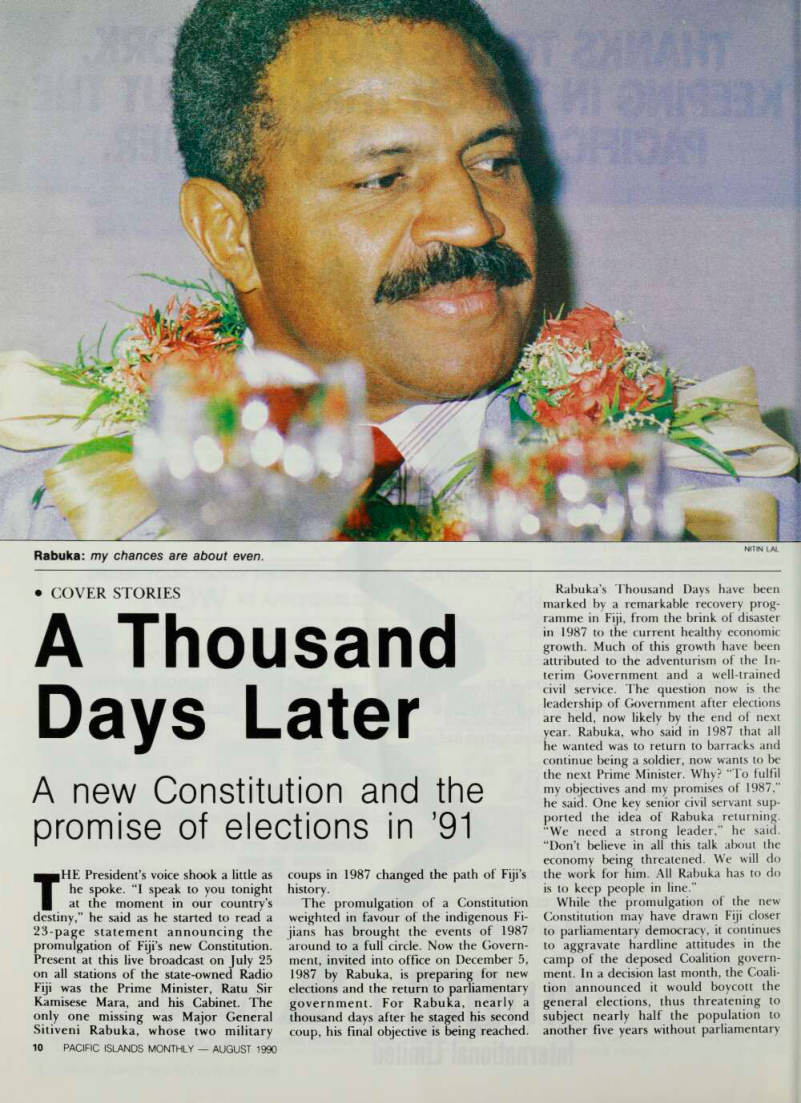
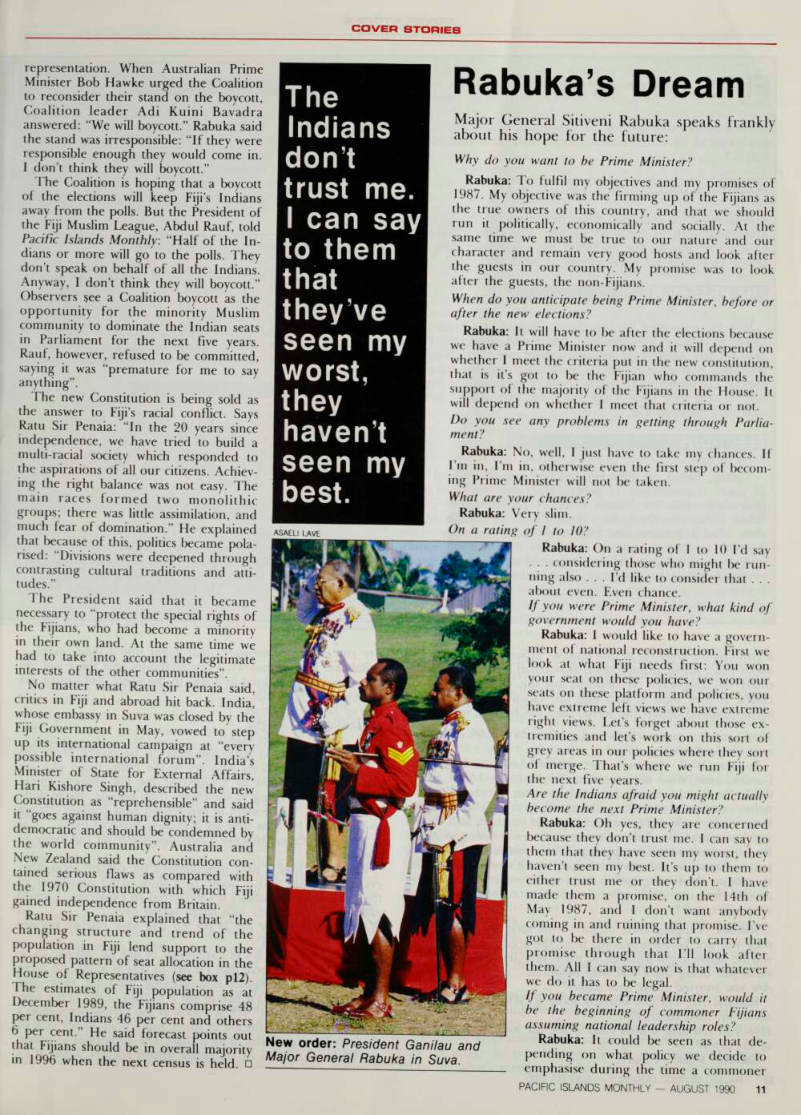
Rabuka: my chances are about even.
representation. When Australian Prime Minister Bob Hawke urged the Coalition to reconsider their stand on the boycott, Coalition leader Adi Kuini Bavadra answered: “We will boycott.” Rabuka said the stand was irresponsible: “If they were responsible enough they would come in.
I don’t think they will boycott.”
The Coalition is hoping that a boycott of the elections will keep Fiji’s Indians away from the polls. But the President of the Fiji Muslim League, Abdul Rauf, told Pacific Islands Monthly : “Half of the In dians or more will go to the polls. They don’t speak on behalf of all the Indians.
Anyway, I don’t think they will boycott.”
Observers see a Coalition boycott as the opportunity for the minority Muslim community to dominate the Indian seats in Parliament for the next five years.
Rauf, however, refused to be committed, saying it was “premature for me to say
anything”.
The new Constitution is being sold as the answer to Fiji’s racial conflict. Says Ratu Sir Penaia: “In the 20 years since independence, we have tried to build a multi-racial society which responded to the aspirations of all our citizens. Achiev ing the right balance was not easy. The main races formed two monolithic groups; there was little assimilation, and much fear of domination.” He explained that because of this, politics became pola rised: “Divisions were deepened through contrasting cultural traditions and atti tudes.”
The President said that it became necessary to “protect the special rights of the Fijians, who had become a minority in their own land. At the same time we had to take into account the legitimate interests of the other communities”.
No matter what Ratu Sir Penaia said, critics in Fiji and abroad hit back. India, whose embassy in Suva was closed by the Fiji Government in May, vowed to step up its international campaign at “every possible international forum”. India’s Minister of State for External Affairs, Hari Kishore Singh, described the new Constitution as “reprehensible” and said it “goes against human dignity; it is anti democratic and should be condemned by the world community”. Australia and New Zealand said the Constitution con tained serious flaws as compared with the 1970 Constitution with which Fiji gained independence from Britain.
Ratu Sir Penaia explained that “the changing structure and trend of the population in Fiji lend support to the proposed pattern of seat allocation in the House of Representatives (see box p!2).
The estimates of Fiji population as at December 1989, the Fijians comprise 48 per cent, Indians 46 per cent and others 6 per cent.” He said forecast points out that Fijians should be in overall majority in 1996 when the next census is held. □