Geoffrey Henry: Prime Minister, Cook Islands
pp. 51-53 · Read in the full issue
Interview
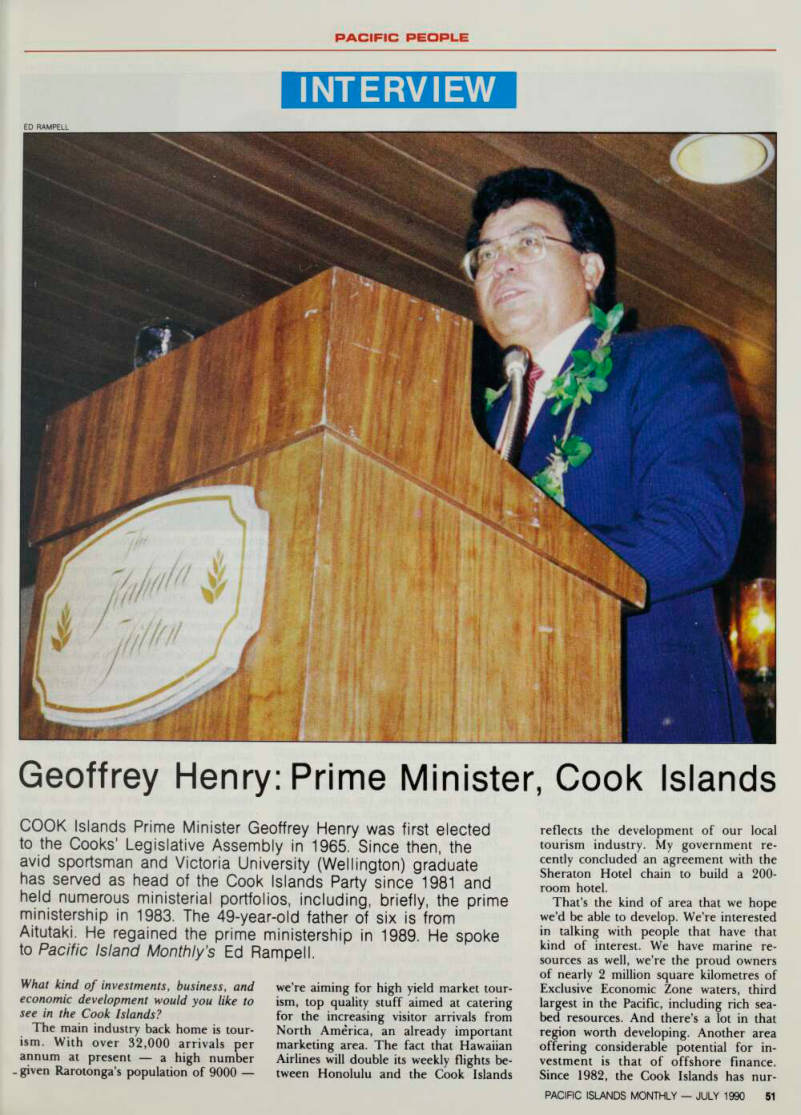
COOK Islands Prime Minister Geoffrey Henry was first elected to the Cooks’ Legislative Assembly in 1965. Since then, the avid sportsman and Victoria University (Wellington) graduate has served as head of the Cook Islands Party since 1981 and held numerous ministerial portfolios, including, briefly, the prime ministership in 1983. The 49-year-old father of six is from Aitutaki. He regained the prime ministership in 1989. He spoke to Pacific Island Monthly’s Ed Rampell.
What kina of investments, business, and economic development would you like to see in the Cook Islands?
The main industry back home is tourism. With over 32,000 arrivals per annum at present a high number given Rarotonga’s population of 9000
we’re aiming for high yield market tour ism, top quality stuff aimed at catering for the increasing visitor arrivals from North America, an already important marketing area. The fact that Hawaiian Airlines will double its weekly flights be tween Honolulu and the Cook Islands
reflects the development of our local tourism industry. My government re cently concluded an agreement with the Sheraton Hotel chain to build a 200room hotel.
That’s the kind of area that we hope we’d be able to develop. We’re interested in talking with people that have that kind of interest. We have marine re sources as well, we’re the proud owners of nearly 2 million square kilometres of Exclusive Economic Zone waters, third largest in the Pacific, including rich sea bed resources. And there’s a lot in that region worth developing. Another area offering considerable potential for in vestment is that of offshore finance.
Since 1982, the Cook Islands has nur-
Ed Rampell
tured a strong, reputable and innovative
industry, with exciting developments
occurring regularly.
It is my government’s policy to en courage reputable investment in the in dustry, and the potential in such new areas as the development of venture capital markets is limited only by the limits of one’s imaginations. The Cook Islands already has first class telecom munications facilities on the main island and a programme is being implemented to link almost all 15 islands in the coun try by satellite communication in the next three years.
We’d be interested to talk to people who have these kinds of interest as well.
And there are small markets, special type of marketing activities, investment activities that are available in agriculture, in horticulture, and so forth. For exam ple, the Cook Islands was one of the major suppliers of ballet shoes to Austra lia [and] one of our outer islands exports a particular type of leaf Maire (Maile), for use in making [Hawaii] leis.
Although the trade in Maire is relatively small at present, some C 1552,000 per annum, it is, nevertheless, significant in local terms especially for an island which exports Maire and which has a popula tion of approximately 500, and indicative of what can be done through imaginative investment.
However, investment [in general] must
be to the mutual advantage of all con cerned, not investment at any price.
Those interested only in a quick return on their investment profit will no longer be welcomed with an open arms recep tion in our region. There are many opportunities in the Pacific Islands for those with innovative ideas willing to
forge a long-lasting partnership with is
land governments and they will be tre ated as friends, in the true spirit of Paci
fic peoples everywhere.
Will the Cook Islands receive support from the United States government’s Overseas Private Investment Corp?
This is one area that I’m interested in.
A project was raised with me . . . which could be ideal for an OPIC cooperation.
The Cook Islands and New Zealand have a unique relationship that has been a trendsetter, “free association” How does it operate?
It’s an association that has floored all international jurists and lawyers because they’re not able to go to the shelf, pull out the text book, and turn to the chap ter on free association. It was a model devised by the Cook Islands and advisers from New Zealand. It was built around our own needs, our own desires, not so much the desires of the Committee of 24 of the United Nations, or even the de sires of some groups in New Zealand who wanted to see the Cook Islands be
come either fully independent or fully
integrated with New Zealand.
What we have, in fact, is a relationship that is in between full integration and full independence, but much closer to full independence, because the ties we have with New Zealand are in areas of defense, our constitution vests that re sponsibility in New Zealand. In foreign affairs they are given a responsibility in that area. We also have the same head of state, the Queen of England . . . Annual
ly, Wellington provides us with NZ$B.9
million. Those are basically the ties.
But free association really means that either one of the parties in this rela tionship can walk away from it at any time. So, if we wanted to become fully independent, in terms of not having the same head of state as New Zealand, not having New Zealand look after our de fense, not having New Zealand as a part ner in external affairs or foreign affairs, we can walk away from that relationship if we wanted to, and so can New Zea land. Except in our case, the manner in which we walk away from that rela tionship is actually determined by the provisions of our constitution. We can’t just simply say tomorrow we’re going to become independent. We need to comp ly with the provisions of the constititu tion, which require that we have to obtain a two thirds support from the people, and then two thirds vote in par liament twice in favour of breaking the
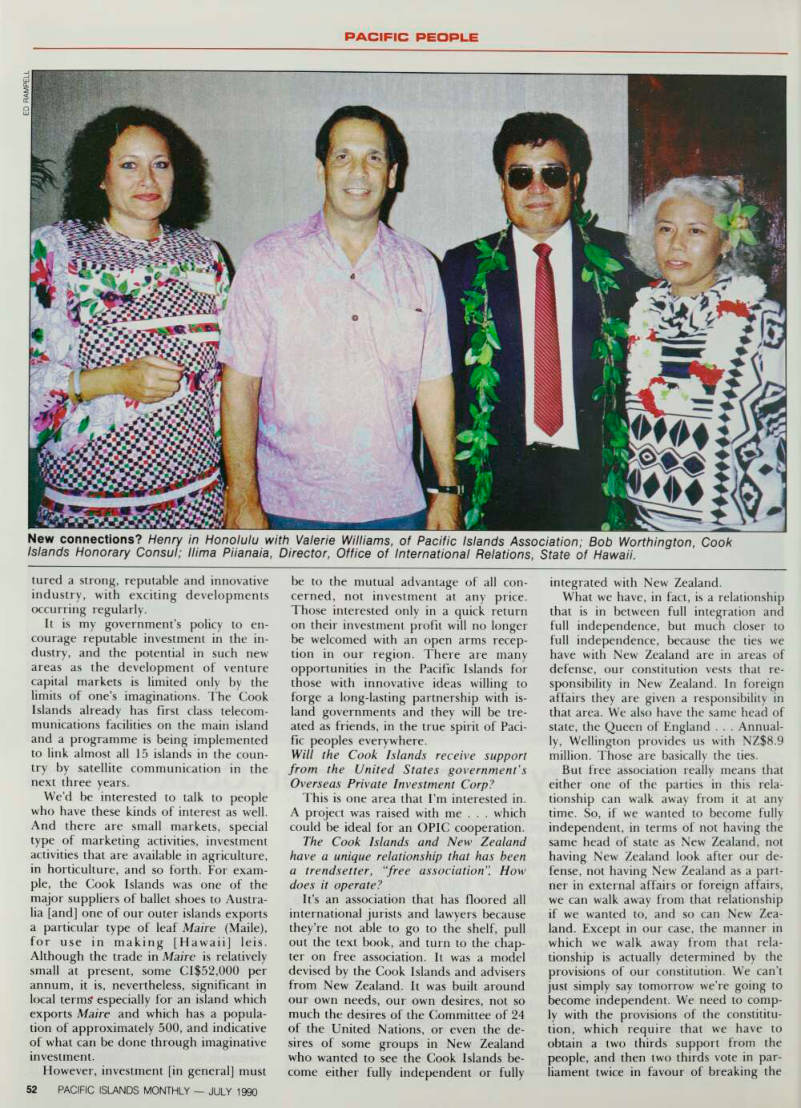
New connections? Henry in Honolulu with Valerie Williams, of Pacific Islands Association; Bob Worthington, Cook Islands Honorary Consul; llima Piianaia, Director, Office of International Relations, State of Hawaii.
relationship with New Zealand.
There has been disagreement between Wellington and Avarua over the defense aspects, because of New Zealand’s nuc lear free policy. Does this difference still exist?
The differences were really more poli tical or personality-bound than anything else. The fact of the matter, however, is that since New Zealand has found itself in the position where it’s not longer a fully active participant in the ANZUS treaty, questions of our security must arise. Because quite clearly, when the constitution was drafted back in the early sixties, and our defense was vested in New Zealand, ANZUS was very much in existence, and must have been very much in the minds of the lord draftsmen at the time. Because let’s face it, New Zealand can’t defend itself, how could it possibly defend us? It had to be part of an umbrella security scheme, of which ANZUS was.
Since New Zealand has been either pushed, or it has withdrawn from ANZUS, the question of our security, of course, becomes very important. I’ve had a discussion with the Prime Minister of New Zealand, the Honourable Geoffrey Palmer, and he is intent on ensuring that we in the Pacific, particularly ourselves, Tokelau, and Niue, should not feel afraid in terms of security.
The Pentagon has a policy that it will neither confirm nor deny whether its ships are nuclear armed or capable, which conflicts with Wellington’s anti nuclear posture. Have US Naval boats been to the Cooks?
We have no problem with U.S. milit ary ship visits. The Salvador has already visited and (last month) another boat will pay a call. There’s a new situation down south.
Isn’t this a breach of New Zealand policy and law?
It’s definitely against New Zealand law.
But New Zealand law doesn’t apply to the Cook Islands. Only the laws accepted by the Cooks’ parliament apply, but we have not accepted New Zealand’s nuclear free stance.
Is independence on the agenda right now in the Cooks?
I can think of independence any time.
Whatever any of us politicians may think, independence might prove to be an attractive road to go down. But the fact of the matter is, it’s not on anyone’s agenda, for the reason we cannot move unless the people, themselves, have that
subject on their agenda.
The Cooks is neighbour to a superpower, France, which has a major presence right next door to you at French Polynesia.
What’s your relationship with Paris and Papeete?
The fact of the matter, of course, is that French Polynesians are our cousins,
and have always been that way.
The indigenous people?
Yes, indeed. The Tahitians are, in fact, part of the same stock of race, Polynesian people. We speak the same language, sing the same songs, dance ab out the same way, and enjoy life just as much. What has happened is, a political system has come between us. We’re Brit ish on the one hand, they’re French on the other. We speak English, they speak French. And the relationship has been the languages, English and French, and their political systems, have tended to serve as a wedge that tended to widen the relationship between our two peoples
and countries. Well, I made a step to close that gap dramatically, I’ve spoken with the president of French Polynesia and the prime minister of France, and told them it’s my intention to revive the close Polynesian connections of our two peoples and countries. The language is not going to make any difference to me.
What are your views on the nuclear test ing at Moruroa?
The same as that reported by the Tahitians themselves: they are upset with it, and so are we.
Have nuclear fallout, radioactivity, etc., from the atmospheric and underwater French tests, impacted on the health of Cook Islanders?
We have no medical evidence to indi cate that such a thing has happened. No one has conducted a factual scientific study to show whether, in fact, whether
the diseases that have been the problem in the Cook Islands are directly related to nuclear testing in Moruroa.
There’s talk of fish and food poison ing, but we have no scientific evidence that relates that directly to nuclear test ing in the Pacific. Writers and thinkers such as Bengt Danielsson and his wife tend to draw those connections, the sci entists that were sent there by New Zea land, together with Australians about 10 years ago didn’t find that connection.
Others have been to conduct their own tests and have not found the connection themselves. But that doesn’t mean to say that the connection doesn’t exist, all I’m saying, is we have no irrefutable data.
Does the Cook Islands receive aid from France?
We’re about to conclude a treaty of cooperation. We’re keen to conclude that, and I understand that President Mitterand himself is also keen to make that treaty come into existence fairly soon. We are, in fact, talking aid with France, grants, as well as concessional loans.
Do you have a fishing surveillance treaty with France?
We’re about to conclude an arrange ment with the French government whereby the surveillance activities be tween French Polynesia and the Cook Islands can be coordinated and inte grated by using our one patrol boat and their three patrol boats, as well as over
flying surveillance provided by their
planes.
Any last thoughts?
We are now in The Pacific Age. The people of the Pacific Islands are deter mined not to be what some have called “the hole in the doughnut of the Pacific Rim” . . . Government and the private sector are in the process of making money: one is for accumulation and further investments, the other for equit able distribution. The region is ready for a joint venture between the two in order that each may in their separate efforts find a better place in the sun for the peoples of our region. □
Ed Rampell
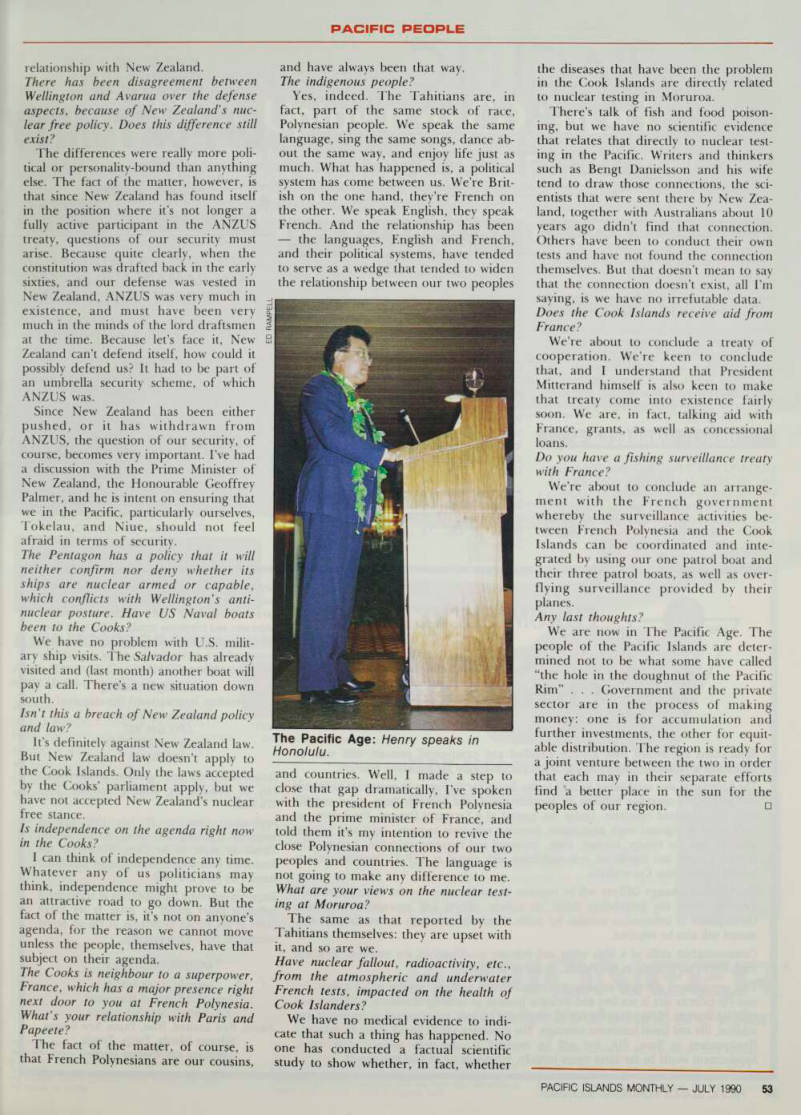
The Pacific Age: Henry speaks in Honolulu.