West Point’s only Samoan
pp. 49-50 · Read in the full issue
Pacific People
A Pacific Island woman breaks into America’s male-dominated military academy.
By David North
WEST Point, America’s tough-as
nails military academy, is a his torically male institution. Amer ican Samoa’s is a male-dominated society.
So the first Samoan graduate of West Point is likely to be a male, right?
Wrong. She’s Second Lieutenant Leafaina Olive Tavai, and she’s in charge of fixing trucks and guns for a unit of
the US Army stationed in West Ger many, While a few American Samoan men have made it through other US service academies, no Samoan woman had done so, and, to the best of anyone’s memory, no previous Samoan of either sex had graduated from the US Military Academy at West Point. This is the in stitution which produced President Dwight D. Eisenhower and General
Douglas McArthur, among others.
Lt. Tavai, now a career US Army officer, said she was born in Apia in 1966 to a Western Samoan mother, Lauolive Tavai, and her American Sa moan father, High Chief Kaleopa Tavai. (The three of them have three different
citizenship statuses, incidentally; her
father is a US national, her mother a citizen of Western Samoa, and she is a US citizen, because the Army demanded it.) The future Lieutenant lived in Apia through first grade, and then moved with her parents to Pago Pago. Third in
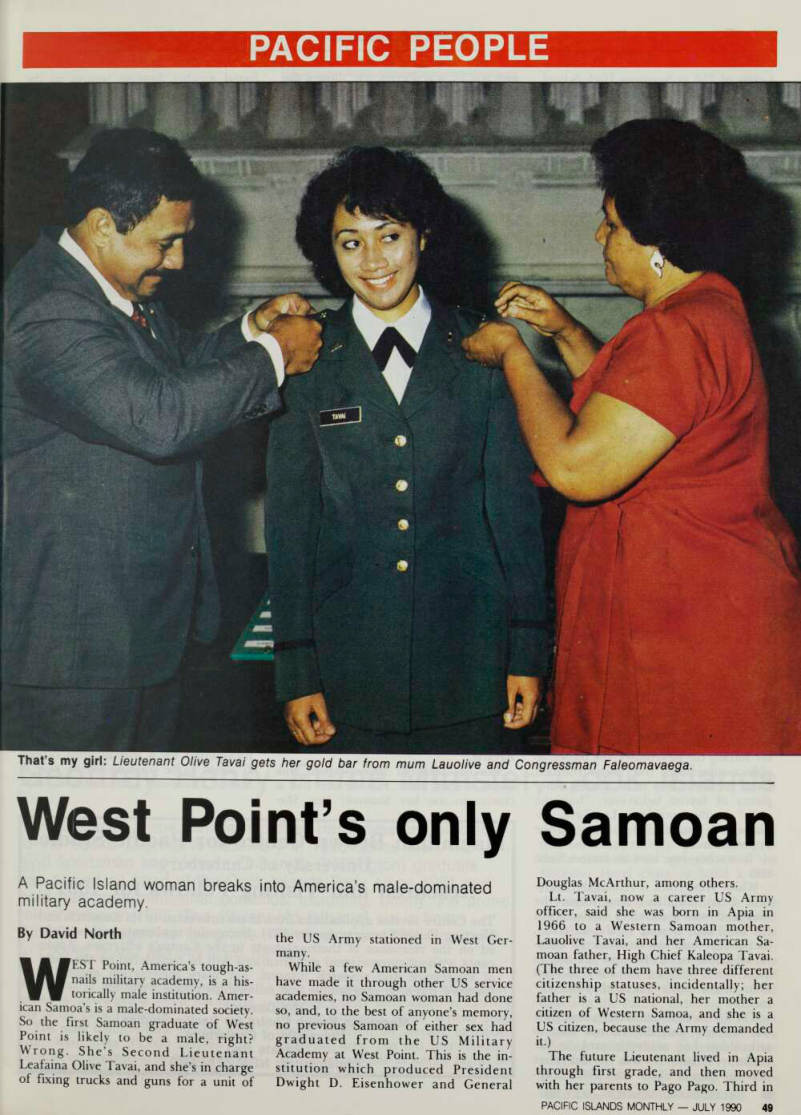
That’s my girl: Lieutenant Olive Tavai gets her gold bar from mum Lauolive and Congressman Faleomavaega.
a class of 250 at Somoana High School, she decided in her senior year there to apply to several Mainland colleges. She sent off applications to Lewis and Clark in Oregon, to Auburn in Alabama and to Brigham Young in Utah. They all
accepted her.
But the high school student had heard from then Congressman Fofo Sunia that his office was looking for applicants to the military academies, so she had ap plied to them as well, sending off the results of her aptitude tests, and the physical examinations demanded by the academies.
She had almost forgotten about the academies, and had all but decided to attend Lewis and Clark, which had offered her a good scholarship and a pre-law course she wanted to follow, when the word came that she had been accepted by West Point. She learnt about her good fortune in an odd way she heard about it while listening to the local television news. The Congressman’s Pago Pago office, informed of her selection by
Washington, had passed the good news
on to the TV station, but had not yet called her about it. (Ever the diplomat, she would not be drawn into a conversa tion about what she thought of that noti fication process.) The first step was a year at the West Point prep school, at Fort Monmouth, New Jersey, where she got ready for the rigors of West Point. Then, in the au tumn of 1985 she became a plebe (fresh man) at the big grey institution on the Hudson, a hundred miles north of New
York City.
All Americans attending West Point encounter the cultural shock of the place, with its intense schedule, its high demands (both academic and physical), its military discipline and the first year of hazing. The hazing, which sometimes gets out of hand, is routinely a technique for forcing the newcomers, the plebes, to play a subservient role under constant social pressure; they must, among other pieces of forced behaviour, “hug the walls” in the corridors, Lt. Tavai ex plained, to stay out of the way of the
upperclassmen.
“It teaches you how to survive,” she said.
Whilst West Point is remarkably diffe rent from Mainland Americans, the Mainland was a different environment for Lt. Tavai, as well, so she, in effect, had to cope with two simultaneous cultu ral adjustments, to Mainland life and to West Point. (The ice and snow of West Point in the winter was another new ele ment).
The Lieutenant did survive, though it was not easy, and she did not want to talk about her academic rank at the academy. Whatever it was, she did better than the quarter of the class which drop
ped out, or was forced out, during the
four-year grind.
“It was not so much the level of diffi culty at West Point, it was the amount of work piled on you; we all had seven courses; you had to learn to manage your time and your priorities,” she said.
When she graduated, in the summer of 1989, her mother made the 10,000 mile trip to the academy to pin her second lieutenant’s golden bars on her shoulders; her father, being ill at the time, asked Congressman Eni F.H.
Faleomavaega, to fill in for him at the ceremony.
After a welcome period of leave in Samoa, and a four-month course at the maintenance and logistics training prog ramme at Fort Aberdeen, Maryland, the new officer was shipped out to her first assignment in the “real army”, a job with the Third Infantry Division in southern Germany, where she arrived in January.
She is in charge of the Automotive and Armament Platoon, (consisting of three women and 67 men) in Company B, of the 3rd Support Battalion of the Di visional Support Command of the 3rd Infantry Division. The 3rd Infantry is posted near what used to be the Iron Curtain, and would be instantly in the heat of battle were there an East-West war.
Her company is charged with provid ing maintenance services to the First Bri gade of the 3rd Infantry. Her platoon,
working in a huge garage-like facility
(“motor pool” is the military term), re pairs M-16 rifles, .50 calibre machine guns, jeeps, trucks and tanks. When we talked she and her platoon were working long hours, trying to get everything in shape for summer manoeuvres.
Lt. Tavai likes Germany, but has not seen much of it yet, becase “I usually have to work weekends”. She is stationed in Schweinfurt, a small city in Northern Bavaria.
She has learnt a little German and wants to learn more. Has she ever had a chance to use her Samoan? Yes. She
found another Samoan woman in the American Army, a non-commissioned officer in a communications unit is sta tioned nearby. She was also born in Western Samoa.
Lt. Tavai has opted to live off-base, “in the local economy” as the military say, and has rented an apartment for herself from a German family. She is getting used to German food, as she got used to West Point food, but looks backs fondly on a diet dominated by pork (available in Germany), bananas (a few varieties are imported) and taro (unknown in Ger many).
What’s next for Lt. Tavai? She is hap py in the Army, and plans to make her career in the military. In May, 1991, if all goes as planned, she will become a First Lieutenant, and at some point a little later will move into the second ranking job at Company B, when she will become the shop officer. (She will succeed another woman; both of them report to the company commander, another woman.) At the end of 1992 her three-year tour of duty in Germany will end, and she will go on to another assignment, probably in the Mainland.
Would she suggest that other women other Samoans go into the armed forces? “Yes, it’s a good idea, if you like what you are doing,” she said, adding that she adapts easily, and that this has helped her both in West Point and in
Germany.
There is something of a military tradi tion in the family. Her father, during a 10-year-period before she was born, served in the US Navy, and one of her younger brothers, Fa’agi a 22-year-old E -5 (non-commissioner officer) in the Army, has just returned to Pago Pago after a tour of duty in Korea.
Maybe, coming from a family with a military history and being the eldest sis ter, with four little brothers, is good background for a woman army officer.
It seems to be working in the case of Second Lieutenant Leafaina Olive Tavai. □