new image
pp. 10-11 · Read in the full issue
Pushing the new image
GREENPEACE has been a popu lar name across the Pacific ever since 1972 when Canadian David McTaggart sailed the Vega to pro test against French nuclear tests. But for most of the past two decades the interna tional environmental movement has been seen as just a palagi group, and perhaps
rather patronising.
This image began to change in the 1980 s. By the middle of the decade, Greenpeace offices were opening in Third World countries such as Argenti na and Costa Rica.
In 1985 the original Rainbow Warrior helped the irradiated islanders of Ronge lap Atoll move to a new home. And then it took on board a ni-Vanuatu crewman, Charles Rara (an official in the Prime Minister’s Office), before being bombed by French secret agents in Auckland har bour.
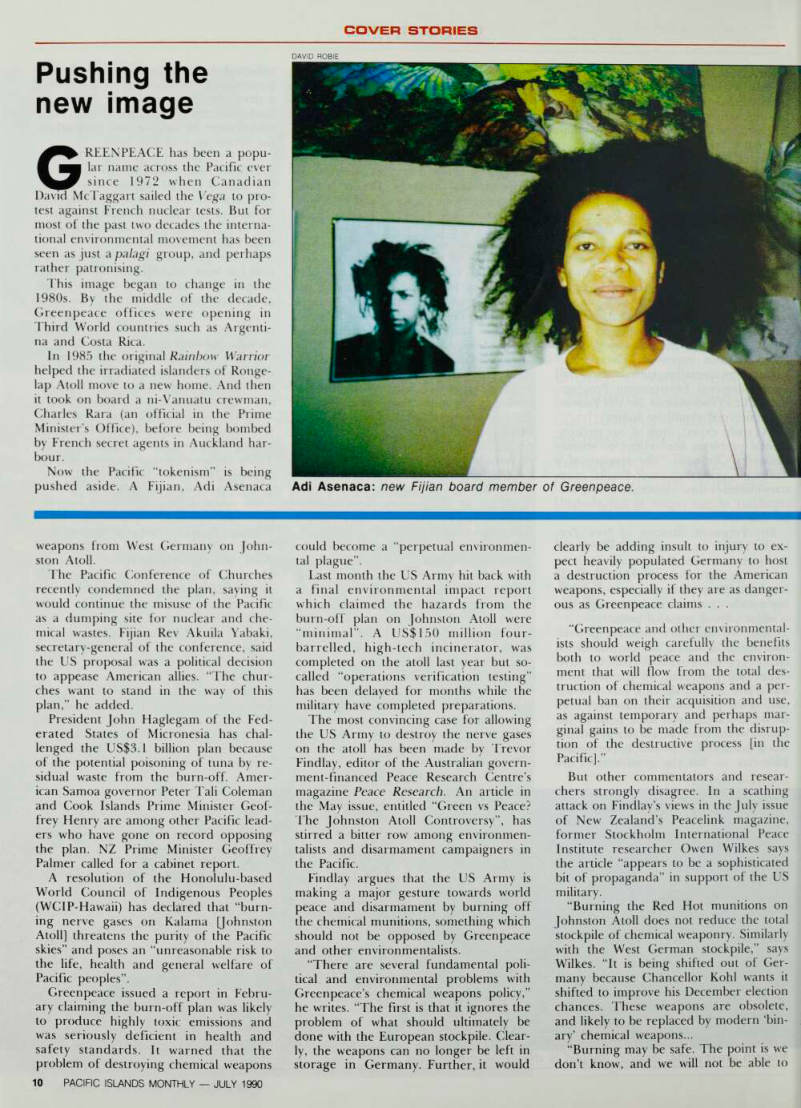
Now the Pacific “tokenism” is being pushed aside. A Fijian, Adi Asenaca
David Robie
Adi Asenaca: new Fijian board member of Greenpeace.
Uluiviti, has recently been selected to the five-member policy-making board of Greenpeace NZ Inc and several other Pacific Islanders have been involved with environmental campaigns by the new Rainbow Warrior.
Adi Asenaca, a 31-year-old postgradu ate scholar in politics and law at Auck land University, believes it won’t be long before there are homegrown Greenpeace offices in Pacific countries.
“I’m facing a big challenge,” she says, “Greenpeace has been seen to have a Eurocentric bias. The best way to get rid of the big brother image is for us to set up Greenpeace branches in countries like Fiji and Vanuatu. Well, perhaps not Fiji, because it has too big a share of
regional offices already.”
Long active in New Zealand student affairs and local politics she was until recently Pacific affairs spokesperson for the New Labour Party Adi Asenaca
was approached by two Greenpeace Paci
fic campaigners to join the board. She is the first Pacific Islander to be elected and the organisation recently celebrated 100,000 members in New Zealand.
A Solomon Islander, Philip Rupuka, and Marshallese, Bake Anta have been
crewmembers on the new Rainbow War rior during its Pacific campaigns this year. A Tahitian is expected to become a crewman shortly and a Western Samoan is joining Greenpeace as an atmosphere and energy campaigner.
The way Greenpeace operates in the Pacific is significantliy different from how it works in Europe and North America. “There are fewer of the high profile direct actions the organisation is known for internationally,” says Pacific campaigns coordinator Bunny McDiar mid, one of the crewmembers on the Rainbow Warrior at the time of the bombing. “Instead, in the last three years our campaigners have been establishing and building contacts in the region at governmental and grassroots level and learning the most appropriate ways to address regional issues such as the waste trade, climate change, driftnets and ocean dumping.”
McDiarmid believes there is currently a “renaissance” of non-government orga nisations in the Pacific and, unlike else where in the world, Greenpeace is directing a lot of its campaign work and information through such groups. NGOs such as the Wau Ecology Institute, in
Papua New Guinea, Solomon Islands De velopment Trust and SPACHEE (South Pacific Action Committee for Human Ecology and Education) at the University of the South Pacific, Suva, rate high among its contacts.
But Adi Asenaca isn’t convinced this is enough. “Greenpeace does very good things in the Pacific and it provides ex cellent information. However, resources would be better used if Greenpeace is actually in island nations. And we need to do it ourselves. Greenpeace needs to listen to island people. We need to set up our own branches from the gras sroots. It would be more effective politi cally with our own people talking to Pacific governments.”
She believes that many environmental problems in the region are caused by the “economic and political weakness” of governments failing to stand up to poli tical pressures. And she warns that Paci fic governments need to treat the issues with urgency.
“Pacific people still depend on our en vironment and resources,” she says. “If we’re not able to curb our problems now when there are only five million of us then there isn’t much hope.” □