Paradise
pp. 8-13 · Read in the full issue
Cover Stories
Paradise in Peril
Global environmental problems are now confronting Pacific nations with a vengeance. The South Pacific Forum ponders the future.
By David Robie
WHILE much of the world de bates the mounting environ mental crisis with growing pleas for urgent solutions, the South Pacific is discovering the region isn’t immune.
Pacific nations also have thorny environ mental issues to confront.
Although global problems such as the
greenhouse effect and ozone depletion have mainly been caused by the indust rial world, it is the low-lying atoll nations and other territories in the Pacific that face the worst consequences. It is a ques tion of survival.
Industrial neo-colonialism has under mined and harmed the harmony tradi tional Pacific communities have enjoyed with nature. But now paradise is in peril.
The region is a mosaic of serious actual
or potential environmental problems
hazardous waste dumping, driftnet
fishing, ocean dumping, greenhouse
effect, ozone depletion, nuclear tests, de forestation, nerve gas burn-offs, coral reef damage, mining devastation and pollution. And the list is growing.
Some of these issues will be discussed when the region’s heads of government
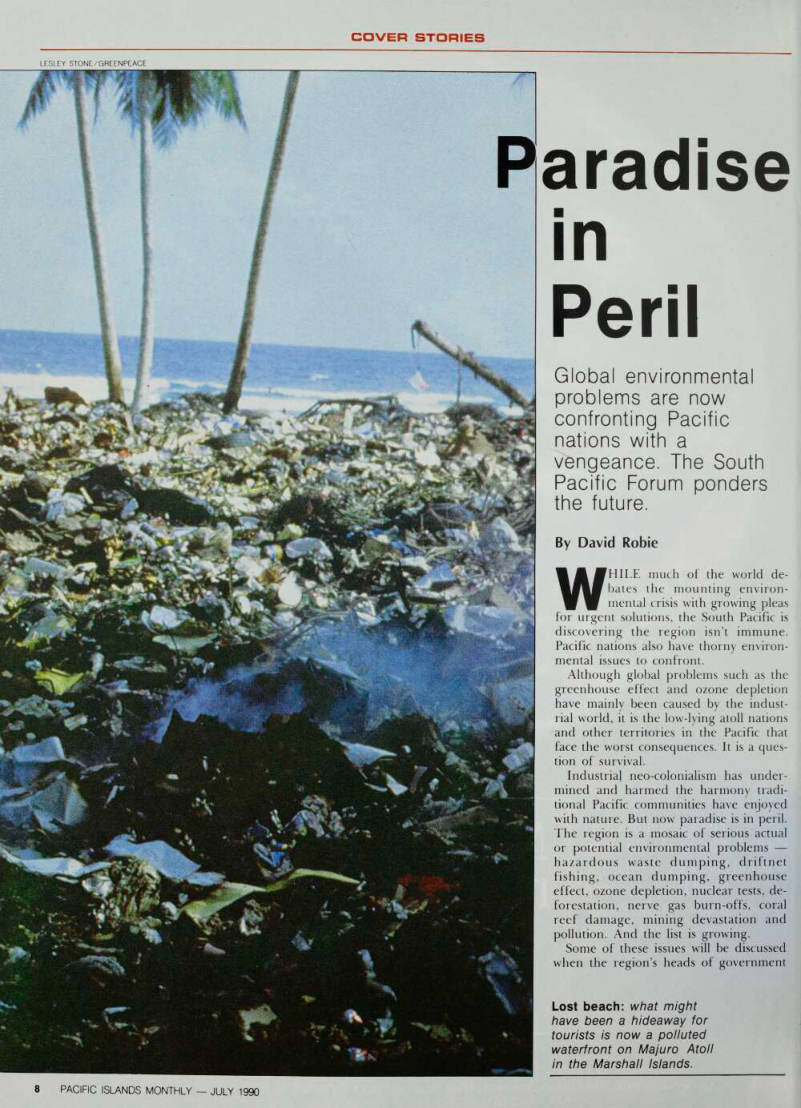
Lesley Stone/Greenpeace
Lost beach: what might have been a hideaway for tourists is now a polluted waterfront on Majuro Atoll in the Marshall Islands.
gather at the 21st South Pacific Forum in Port Vila from July 23 to August 5, but there are unlikely to be many easy or instant solutions. And it is debatable whether some of the more contentious issues will even be discussed frankly.
Australian and New Zealand officials are cautious. Although the environmen tal debate looms large in both countries, they don’t want to be seen as pushing their concerns onto island leaders too forcibly or too quickly. “It has taken three decades for the environmental de bate to get where it is New Zealand,” said one senior External Affairs official.
“But it is only just beginning in many Pacific nations.”
Few observers believe the Pacific en vironment has been managed on a sus tainable basis over the past two decades, let alone been improved. The region’s few ecology specialists, such as the South
Pacific Regional Environment Program
me (SPREP) coordinator Dr Vili Fuavao, are concerned about the future.
“As you’d expect, most of our environ mental problems are related to marine resources,” he says. “The absence of a ‘fallback’ option for small Pacific coun tries increases their vulnerability and sus ceptibility of our region to environmen tal disasters”.
Roy Ferguson, director of New Zea land’s MERT environment division, be lieves environmental issues are likely to be among major domestic challenges for South Pacific governments over the com ing decade as well as continuing to be
a major part of regional politics.
“And we shouldn’t overlook popula tion pressures among the environmental challenges the region faces,” he says.
“The total population of the region at about five million appears low. But not only is the population density very high by world standards in some parts of the Pacific for example Tarawa in Kiribati has a density of 2190 people per square kilometre but the growth rates are
high.”
Among politicians with a high profile
in the region is French Polynesia’s Health and Environment Minister Jacqui Drollet, who is pushing for a “local con sultation” among Tahitians over the fu ture of nuclear testing at Moruroa and Fangataufa atolls. Long an advocate of environmental concerns, Drollet is now concerned about the social and economic implications for Tahiti if France “pulls
the plug”.
Opposition to nuclear testing in the region was an issue that unified nations when the South Pacific Forum was founded in 1971, and eventually led to the singing of the South Pacific Nuclear Free Zone Treaty in 1985.
Twelve years of United States atmos pheric testing in the Marshall Islands atolls of Bikini and Enewetak and its legacy of radiation-linked illnesses and dislocated people, followed by French testing in the atmosphere from 1966 to 1974 and underground since then, have helped make Pacific governments and people sensitive to environmental abuse by outside powers.
Environmental pressure groups are now lobbying for greater priority and resources to be given to environmental issues in the Pacific but they too are
treading warily.
Blaming industrialised nations for the problems now facing the Pacific, Green peace Pacific campaigns coordinator Bunny McDiarmid says: “It’s hardly fair to us to turn around to the developing world and tell them they cannot have
refrigerators, they cannot have cars, they
cannot have what we have because it is destroying our environment.
“This means that information, re sources and clean technology have to be made accessible to the developing world so that its peoples can choose develop ment options which are informed and
environmentally-sustainable. Up-to-date
information, especially on recent tech
nological developments, is especially im portant and often hard to obtain within a developing region like the Pacific Is lands. Greenpeace can often contribute information to balance and strengthen the debate on a certain issue.”
But Greenpeace is playing a low-key role. And Pacific islanders are taking an increasingly crucial responsibility in the New Zealand branch of an international movement that has five million suppor ters in 25 countries and turns over more than US$5O million a year.
For the past three years the organisa tion has been establishing and building contacts in the region at government and grassroots level, and learning the most appropriate ways to address regional issues such as the waste trade, climate change, driftnets and ocean dumping.
Unlike its gung-ho style of direct ac tion protests elsewhere in the world, Greenpeace’s new Pacific flagship Rain bow Warrior has been deployed on a relatively modest campaigns in the past few months. It has targetted driftnet fishing boats in the South Pacific, visited Tahiti on an education mission, teamed up with Vaomatua environmental action group in American Samoa to protect coral reefs, delivered building supplies and solar panels to the Rongelap Islan
ders on Mejalo, protested against Star
Wars and missile testing on Kwajalein Atoll, demonstrated offshore against the nerve gas burn-off plans on Johnston
Atoll, and protested against a geoth
ermal power plant on Hawaii’s Island which threatens the last significant low land rainforest in the US. Now the ship is seeking out Japanese, Taiwanese and South Korean driftnet fleets in the North Pacific.
Environmentalists, church leaders and politicians, fearing the risk of “another Bhopal or Chernobyl” as some critics claim —.have stepped up a campaign to block the US military plans to store and
destroy a huge stockpile of chemical
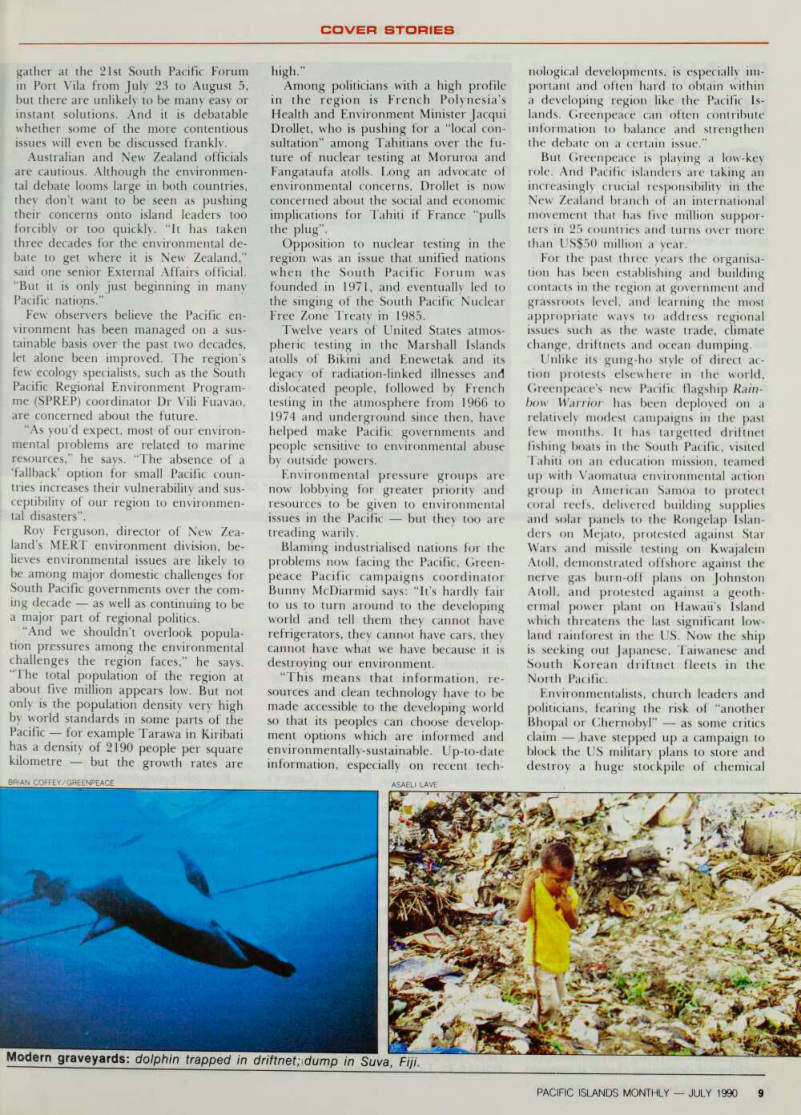
Brian Coffey/Greenpeace
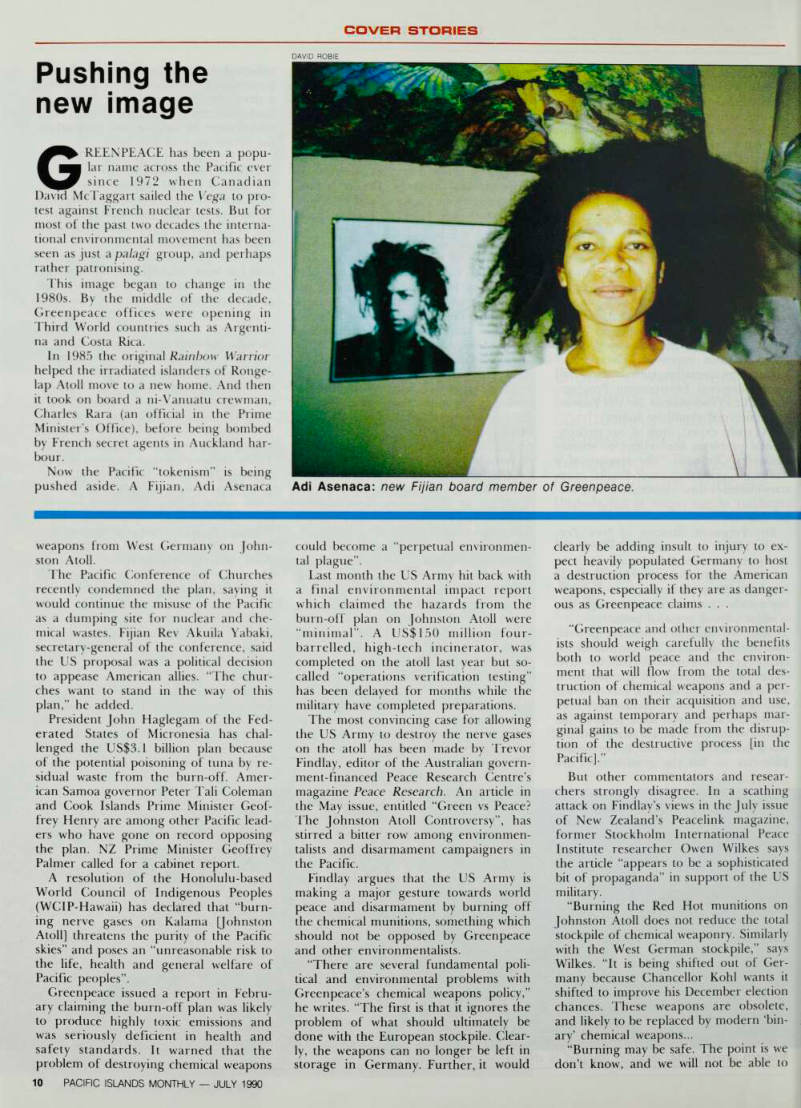
Modern graveyards: dolphin trapped in driftnet; dump in Suva, Fiji.
Asaeli Lave
weapons from West Germany on John ston Atoll.
The Pacific Conference of Churches
recently condemned the plan, saying it
would continue the misuse of the Pacific as a dumping site for nuclear and che mical wastes. Fijian Rev Akuila Yabaki, secretary-general of the conference, said the US proposal was a political decision to appease American allies. “The chur ches want to stand in the way of this plan,” he added.
President John Haglegam of the Fed erated States of Micronesia has chal lenged the USs3.l billion plan because of the potential poisoning of tuna by re sidual waste from the burn-off. Amer ican Samoa governor Peter Tali Coleman and Cook Islands Prime Minister Geof frey Henry are among other Pacific lead ers who have gone on record opposing the plan. NZ Prime Minister Geoffrey Palmer called for a cabinet report.
A resolution of the Honolulu-based World Council of Indigenous Peoples (WCIP-Hawaii) has declared that “burn ing nerve gases on Kalama [Johnston Atoll] threatens the purity of the Pacific skies” and poses an “unreasonable risk to the life, health and general welfare of Pacific peoples”.
Greenpeace issued a report in Febru ary claiming the burn-off plan was likely to produce highly toxic emissions and was seriously deficient in health and safety standards. It warned that the problem of destroying chemical weapons
could become a “perpetual environmen-
tal plague”.
Last month the US Army hit back with a final environmental impact report which claimed the hazards from the burn-off plan on Johnston Atoll were ■■minimal". A US$l5O million fourbarrelled, high-tech incinerator, was completed on the atoll last year but so-
called “operations verification testing”
has been delayed for months while the
military have completed preparations.
The most convincing case for allowing the US Army to destroy the nerve gases on the atoll has been made by Trevor Findlay, editor of the Australian government-fmanced Peace Research Centre’s magazine Peace Research. An article in the May issue, entitled “Green vs Peace?
The Johnston Atoll Controversy”, has stirred a bitter row among environmentalists and disarmament campaigners in the Pacific.
Findlay argues that the US Army is making a major gesture towards world peace and disarmament by burning off the chemical munitions, something which should not be opposed by Greenpeace and other environmentalists.
“There are several fundamental political and environmental problems with
Greenpeace’s chemical weapons policy,”
he writes. “The first is that it ignores the problem of what should ultimately be done with the European stockpile. Clearly, the weapons can no longer be left in storage in Germany. Further, it would
clearly be adding insult to injury to ex pect heavily populated Germany to host a destruction process for the American weapons, especially if they are as danger ous as Greenpeace claims . . . . “Greenpeace and other environmental sts s hould weigh carefully the benefits botb to woldd peace and the enyiron ment that wlll flow from the des ‘ tructlon of chemical weapons and a per- P etual ban on their acquisition and use, as a g amst temporary and perhaps mar- S mal S ams to be made from the dlsru P‘ tion of „ the destructive process [m the Pacific].
But other commentators and resear
chers strongly disagree. In a scathing
attack on Findlay’s views in the July issue of New Zealand’s Peacelink magazine, former Stockholm International Peace Institute researcher Owen Wilkes says the article “appears to be a sophisticated bit of propaganda” in support of the US military.
“Burning the Red Hot munitions on Johnston Atoll does not reduce the total stockpile of chemical weaponry. Similarly with the West German stockpile,” says Wilkes. “It is being shifted out of Ger many because Chancellor Kohl wants it shifted to improve his December election chances. These weapons are obsolete, and likely to be replaced by modern ‘bin ary’ chemical weapons...
“Burning may be safe. The point is we don’t know, and we will not be able to
afford an environmental monitoring net work in the Central Pacific to keep tabs on any little problems the army has in getting the kinks out of the system.
“If it is as safe as the US Army says it is then they should do it in Germany in the Ruhr Valley perhaps where a little bit of extra pollution will hardly be noticed. Which is more important get ting Helmut Kohl re-elected, or keeping the Pacific safe for its inhabitants?”
Sebia Hawkins, Greenpeace’s Washing ton-based Pacific campaign coordinator, said: “Of course Greenpeace applauds efforts to rid the world of chemical weapons, but incineration isn’t the
answer, more appropriate technology
must be found. Greenpeace will not sit by and watch Johnston Atoll become a permanent mid-ocean toxic waste dump in the Pacific.”
Greenpeace has opposed the Johnston
Atoll plans since 1983. In its 101-page February report circulated among Pacific governments, the movement said that the military’s three studies so far in 1983, 1988 and 1990 were obsolete and ignored recent scientific evidence on the creation of toxins in similar high temperature incinerators. It cites scien tific data showing that toxic polychlorin ated dibenzo dioxins (PCDD) and polychlorinated dibenzo furans (PCDF) are always among the products of incom plete combustion generated by inciner ators of the Johnston Atoll type.
It describes the military environmental
impact report as “inadequate to meet the criteria set down in the US National En vironmental Policy Act and subsequent
court interpretations”.
Poka Laenui (Hayden Burgess), presi dent of the WCIP-Hawaii, asked in a letter to Cook Islands Prime Minister Geoffrey Henry: “If the army is so cer tain about the safety of the incineration of such gases, why not incinerate it in Germany where it is now? Why not ship it to the closest American port and in cinerate it there? Why are they com pounding the dangers of incineration with the dangers of shipping these gases halfway around the world?”
Five years ago, says Laenui, when the US Army proposed the transfer of nerve gases from Okinawa to Johnson Atoll, “a few of us insisted they conduct hearings in other Pacific Island nations. Their re sponse was that those islands were beyond the required scope of the law and not part of the environmental con sideration”.
According to Wilkes, the US Army en vironmental impact statement on the West German munitions makes “even more scary reading” than the Green peace critiques of it. “The munitions will be brought in shipping containers, and the containers will be stacked on a nar row strip of land between the sea and the 3km runway which dominates John ston Atoll,” says Wilkes. “Numerous air craft use that runway every day, and it only needs one aircraft to go off course
and plough through those stacked con tainers, and we will have thousands of nerve gas grenades and bombs bobbing around in the Pacific Ocean for de cades.”
The nearest Pacific nation to Johnston Atoll is the Marshall Islands and it is embroiled in its own controversy over plans by two American companies to ex port “non toxic” waste to the atolls. Last month Greenpeace handed the Marshal lese government copies of a damning re port about the waste traders, citing cri minal records and alleged securities fraud involving several of the key men involved.
Greenpeace’s report, hand delivered during the visit of the Rainbow Warrior, also claimed to expose the environmental flaws in the proposals of the two rival companies, Admiralty Pacific and Mic romar.
“Their plans are thinly disguised
attempts by waste traders to make money out of the waste crisis,” says Greenpeace toxic wastes campaigner Les ley Stone. “They won’t solve the US waste problems nor will they benefit the Pacific. They will just dump the problems and the responsibility on the laps of the Marshallese people.”
The Greenpeace report said Jim
Thompson, president of Admiralty Paci
fic, spent four months in prison in 1975 after pleading guilty to a charge of securities fraud. Investigators had disco
vered that “Thompson has a history of financial deception and other alleged illegal activities for which he has received criminal charges more than once,” the report said. Several court records, letters from prosecutors and a prosecution affi davit are cited in support of the claims.
Admiralty Pacific has proposed schemes for garbage landfill on Ebeye, Kwajalein and other atolls and to dump used tires in lagoons, and Thompson re portedly tried to secretly negotiate a plan for nuclear waste dumping in the Mar shalls.
Micromar’s president Dan Fleming, who split with Thompson last year, is
currently preparing an engineering
study on the feasibility of exporting US garbage to create almost 100 hectares of landfill at Kwajalein Atoll. He promises no garbage will be dumped in lagoons or the ocean and no toxic waste will be shipped in to the Marshalls.
Fleming also claims “landfill will be protected by massive seawalls, dikes and will be sealed and leak proof’. But, says Greenpeace in its detailed critique of the Micromar proposals, claims that there
will be no toxics and the surrounding environment would not be contaminated “are impossible to fulfill”.
While most other Pacific nations have
rejected waste dumping proposals or put
them on hold, a California-based com pany has also come back into the reckon ing. Global Telesis is trying to arrange a long-term deal that could send millions of tonnes of US hazardous waste to in cinerators throughout Asia and the Paci fic. The same company tried unsuccess fully to export US waste to Papua New Guinea and the Solomon Islands in
1988.
Although Global Telesis has not yet followed US law by filing a notice of intent to export waste with the US En vironmental Protection Agency, the com pany claims to have agreements with several Asian and Pacific countries. It already has an agreement with China to build a factory for the “processing of toxic and non-toxic chemical materials and wastes” at the Basuo Development Zone in Hainan province.
Also, Global Telesis claims to have a deal with Papua New Guinea to con
struct an incinerator for hazardous wastes. However, Papua New Guinea is a signature to the Lome Convention and consequently prohibits the import of
foreign waste.
The company is also reported to be trying to build an incinerator in Vanuatu, another Lome convention
signatory.
Meanwhile, Taiwan is reported to have low-level nuclear waste stored on a small Pacific island, reviving fears of ocean dumping after the Japanese plans in the 1970 s were abandoned. According to a
report in Radioactive Waste Manage ment magazine, the waste, mainly from nuclear power plants, has been regularly shipped to a storage site on Lan-Yu islet since 1982.
Among several alternatives to the final disposal of radioactive waste, in particu lar low-level radwaste, ocean dumping will probably prove the most feasible method,” said the report. It added that 270 shipments of radioactive waste had been shipped to the island until the end of 1988. D