cruise ships gone?
pp. 45-47 · Read in the full issue
Where have all the cruise ships gone?
In the Pacific, cruising is not a boom industry anymore.
By David North
THE good news is the cruise busi ness is booming. The bad news is that most of the boom is on every body of the water in the world, except the South Pacific.
The New York Times recently devoted
more than a dozen pages to its semi annual, worldwide listing of cruises, tell ing of eleven brand new cruise vessels, much more business for the existing ships, and many new places to visit in this way, particularly in Eastern Europe, The section covered the period March 1 through October 30, 1990.
The Times had 323 listings, covering well over 1000 cruises, but exactly nine of the listings were in the South Pacific, and some of those were small-scale acti vities, dealing with as few as 30 to 40 passengers at a time. (The nine listings do not include the numerous cruises to, or within, Hawaiian waters).
Cruise ships are big business for the ports they visit. While some of the largest ones carry as many as 1900 pas sengers, as does the Queen Elizabeth 2, let’s focus on a more typically-sized one, the Royal Viking Sea. It has a 710passenger capacity. To be conservative, let’s say that each passenger spends an average of US$4O for drinks, meals, taxis, souvenirs and gifts on a typical day in a typical port. That’s a $28,400 shot in-the-arm for that port’s economy on that day.
In the United States Virgin Islands, on St Thomas, recently, the question was not would there be a cruise ship in town today, but would there be eight or ten of them? These were, if our estimates are about right; quarter of-a-million dollar a day for St Thomas.
The previously-mentioned Royal Vik ing Sea, one of the nine ships listed as sailing into Pacific waters, makes only a cameo appearance here. While spending most of its time in Australian, Indone sian and Far Eastern regions, it will have one day in Guam in May on its way from Hong Kong to Hawaii. And then the ship is off to Alaska, for summer-time
sailing among the glaciers.
It is probable that the Times listing is not only not complete (surely the case in such a big, diverse field), but it is fo cused unconsciously on cruises for American customers. Japan-based cruises may not have made the list, and many of these may come into the South Pacific.
For example, we gather that there is an unlisted Guam-based cruise-ship most of whose customers typically fly in from Japan. Further, the trips of the Fairstar, which cruises fulltime in the Suva-Vila- Sydney area, and those of the Madang based Melanesian Explorer, were not listed in Times.
But whether the Times listing is a good random sample or not, there are some frequent found in the Caribbean or the Mediterranean rather than in the South Pacific. The ideal home port for a cruise is one which is, at most, a couple of hours by air way from a densely populated, affluent region say Miami, or Naples. And the ideal cruising area is one in which you can sail the ship each night from one interesting port to another, such as in the Caribbean or the Black Sea. Long periods at sea are not favoured when one is dealing with the typical seven-to-fifteen day cruise.
One of the charms of the South Paci fic, of course, is that it meets neither of these criteria the world’s population centres are distant from this body of wa ter, and the islands are often long dis tances from each other.
Hence, if there is to be a substantial increase in cruising the South Pacific it will have to come from passengers will ing to spend more time, and more
money, getting to the cruiseship’s home port; generally the potential customers will be people who have already done the Caribbean or Indonesian cruise, and are now looking for something more exciting. Stated another way, perhaps the most likely South Pacific cruise passenger will be someone seeking more contact with nature, and the quiet island life, and less exposure to the glitz of the usual cruise elsewhere in the world.
These are exactly the approaches of several of the cruise operators listed as working in the South Pacific. The lure of the Melanesian Discoverer, the 40passenger catamaran, is not the traditional organised drinking and gambling and the gift shops, but the thrill of the Sepik. Its sister ship, the Melanesian Explorer, offers, among other things, “an extensive library of PNG books.” Similar-
ly, the Galapagos cruises presumably are
particularly attractive to students of nature who want to see, among other attractions, the place where Darwin first conceived the theory of evolution.
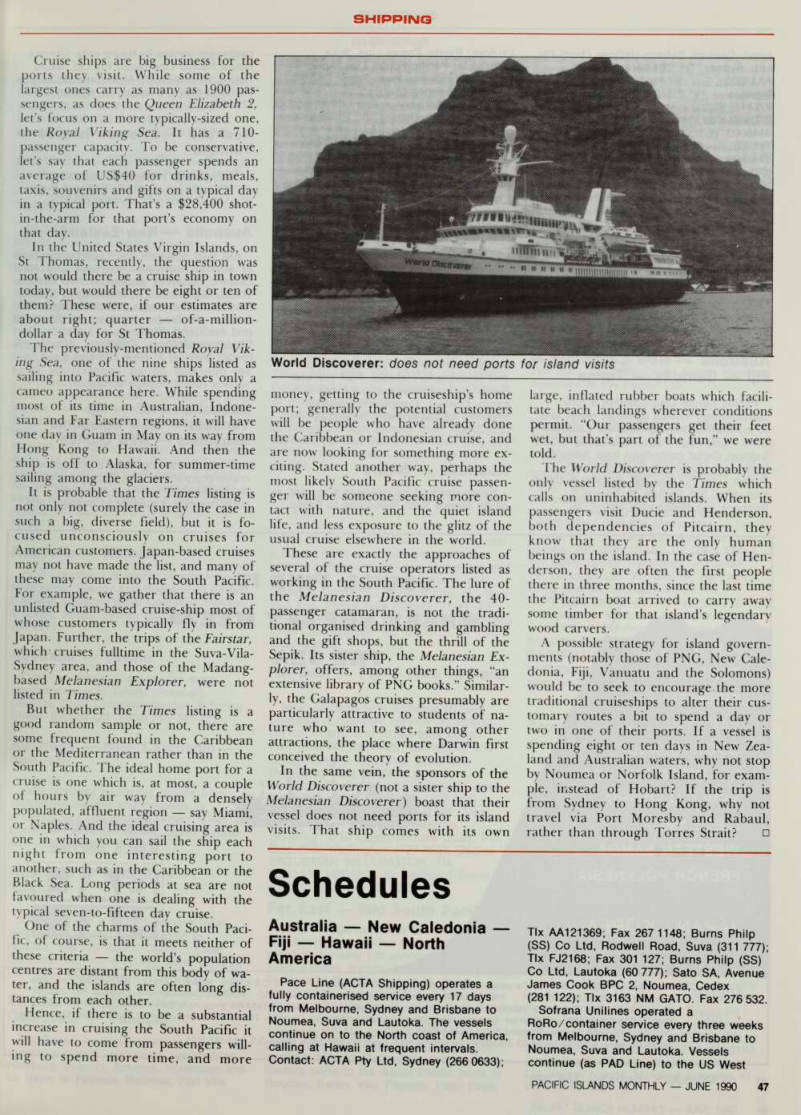
In the same vein, the sponsors of the World Discoverer (not a sister ship to the Melanesian Discoverer) boast that their vessel does not need ports for its island visits. That ship comes with its own
large, inflated rubber boats which facili tate beach landings wherever conditions permit. “Our passengers get their feet wet, but that’s part of the fun,” we were told.
The World Discoverer is probably the only vessel listed by the Times which calls on uninhabited islands. When its passengers visit Ducie and Henderson, both dependencies of Pitcairn, they know that they are the only human beings on the island. In the case of Hen derson, they are often the first people there in three months, since the last time the Pitcairn boat arrived to carry away some timber for that island’s legendary wood carvers.
A possible strategy for island govern ments (notably those of PNG, New Cale donia, Fiji, Vanuatu and the Solomons) would be to seek to encourage the more traditional cruiseships to alter their cus tomary routes a bit to spend a day or two in one of their ports. If a vessel is spending eight or ten days in New Zea land and Australian waters, why not stop by Noumea or Norfolk Island, for exam ple, instead of Hobart? If the trip is from Sydney to Hong Kong, why not travel via Port Moresby and Rabaul, rather than through Torres Strait? □
World Discoverer: does not need ports for island visits