Bank pins hope on private sector
p. 25 · Read in the full issue
A MORE diversified private sector should be allowed to develop and take some of the economic bur den now being shouldered bv the Gov ernment, says the Central Bank of Solo mon Islands in its newly-released 1989 annual report. The bank said the posi tive lone of much of its report “derives partly from the fact that intelligent and
hard-working people in the private sec
tor can and do make significant progress despite dificult circumstances, and partly from the bank’s belief that the intrinsic potential of the Solomon Islands eco nomv is still attainable, without social up heaval or fragmentation of the nation stale”.
The report identified what is consi dered were the four key problems bede villing attempts in the private and public sectors to lay firmer foundations for eco nomic growth. They were: • Unsustainable levels of domestic
Ixirrowing by the government to bridge
the worsening gap between revenue and spending, a gap which could only be
narrowed by cutting spending trying
to rectify the revenue side would involve
crippling the private sector by increasing
taxation. • A chronic deterioration in the country’s terms of trade; this required a realistic exchange rate policy and compe tent diversification.
• A pervasive psychological depend
ence on foreign aid to bridge the domes tic savings and foreign exchange gaps leading to excessive government involve ment in resource allocation. • A persistant failure within the pub lic sector to recognise the private sector’s need for a competitive structure of costs and revenues. file Central Bank nails its colours to the argument that sustainable growth comes largely from successful, competi tive private enterprise. “The authorities cannot force the private sector to be competitive if it does not wish to be; but they can make competitiveness extremely hard to attain by espousing inappropri ate pricing of a range of key inputs to domestic production and incomes,” the annual report said.
The bank said the public must ask less of the government. “The community cannot keep its public sector cake and eat it as well,” the report said.
Hie community and private sector had to lake on increasing responsibility for education, health, transport and other utilities. The Solomon Islands needed a government sector (both national and provincial) which absorbed less of the national income, a more diversified and profitable private sector run by better trained Solomon Islanders, a domestic monetary system that stimulates savings, and an external account that is broadly sustainable with a realistic exchange rate and a comfortable level of official over seas reserves.
“If an appropriate set of adjustment policies is not adopted soon, the com munity will continue to be exposed to the risk of a crisis in the balance of pay ments and government financing that would put a considerable strain on socie ty as painfully rapid economic adjust ment is imposed by financial reality,” the Central Bank’s annual report said.
In 1989 the Solomon Islands economy continued to grow a rate of more than five per cent, but the bank said the year was also marked by a growing degree of instability in the domestic and external accounts, with fiscal policy and develop ment strategy issues remaining unre solved.
During the year the country’s external reserves fell from SIS 185 million (US$35.l million) to SISbl million (U 5525.2 million) and still falling, with the Central Bank providing sub stantial funds to the banks to support their loan portfolios and avoid commer cial failures. Commodity prices, particu larly vegetable oils and timber, went into a sleep decline during the year.
But the Government brought down in 1989 budget which included a substantial increase in the deficit to be financed domestically. The bank re)M>rt said there was general agreement about the under- Iving problems in the Solomon Island economy but less agreement on what should be done about them. □
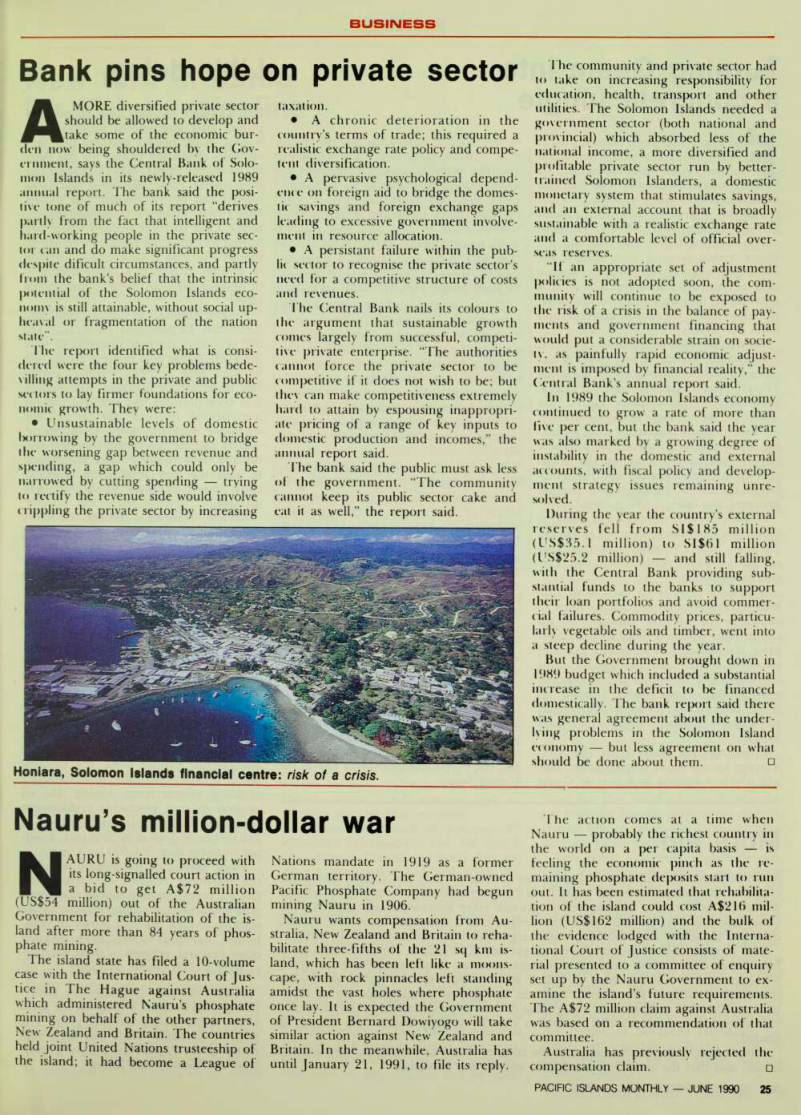
Honiara, Solomon Islands financial centre: risk of a crisis.