Palau’s slsom deal
pp. 23-24 · Read in the full issue
opens new frontiers
Palau
By David North
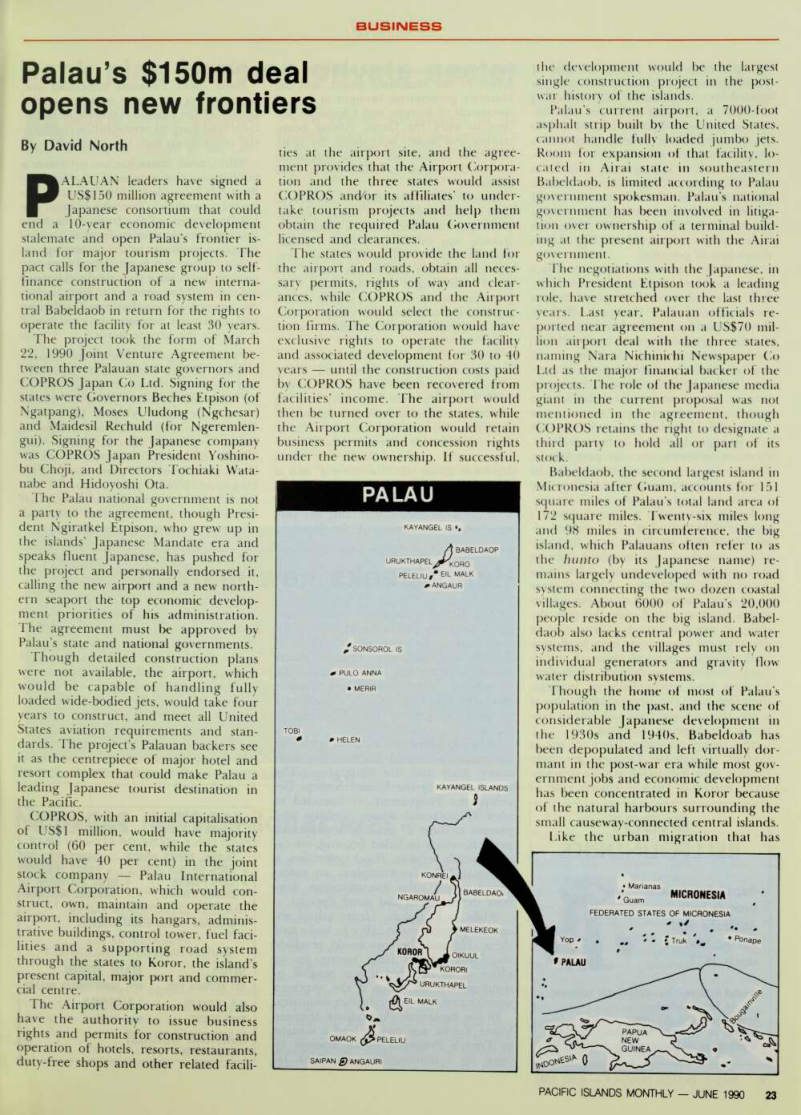
PALAUAN leaders have signed a US$l5O million agreement with a Japanese consortium that could end a 10-year economic development stalemate and open Palau’s frontier is land for major tourism projects. The pact calls for the Japanese group to self finance construction of a new' interna tional airport and a road system in cen tral Babeldaob in return for the rights to operate the facility for at least 30 years.
The project took the form of March 22, 1990 Joint Venture Agreement be tween three Palauan state governors and COPROS Japan Co Ltd. Signing for the states were Governors Beches Etpison (of Ngatpang), Moses Uludong (Ngchesar) and Maidesil Rechuld (for Ngeremlen gui). Signing for the Japanese company was COPROS Japan President Yoshino bu Choji, and Directors Tochiaki Wata nabe and Hidoyoshi Ota.
The Palau national government is not a party to the agreement, though Presi dent Ngiratkel Etpison, who grew up in the islands’ Japanese Mandate era and speaks fluent Japanese, has pushed for the project and personally endorsed it, calling the new airport and a new north ern seaport the top economic develop ment priorities of his administration.
The agreement must be approved by Palau’s state and national governments.
Though detailed construction plans
were not available, the airport, which
would be capable of handling fully
loaded wide-bodied jets, would take four years to construct, and meet all United States aviation requirements and stan dards. The project’s Palauan backers see it as the centrepiece of major hotel and resort complex that could make Palau a leading Japanese tourist destination in the Pacific.
COPROS, with an initial capitalisation of US$l million, would have majority control (60 per cent, while the states would have 40 per cent) in the joint stock company Palau International Airport Corporation, which would con struct, own, maintain and operate the
airport, including its hangars, adminis
trative buildings, control tower, fuel faci lities and a supporting road system through the states to Koror, the island’s present capital, major port and commer cial centre.
The Airport Corporation would also have the authority to issue business rights and permits for construction and operation of hotels, resorts, restaurants, duty-free shops and other related facili
ties at the airport site, and the agree
ment provides that the Airport Corpora
tion and the three slates would assist COPROS anchor its affiliates' to under take tourism projects and help them obtain the required Palau Government licensed and clearances.
The states would provide the land for the airport and roads, obtain all neces sary permits, rights of way and clear ances, while COPROS and the Airport Corporation would select the construc tion firms. The Corporation would have exclusive rights to operate the facility and associated development for 30 to 40 years until the construction costs paid by COPROS have been recovered from facilities’ income. The airport would then be turned over to the states, while the Airport Corporation would retain business permits and concession rights under the new ownership. If successful.
the development would be the largest single construction project in the post war history of the islands.
Palau’s current airport, a 7000-foot asphalt strip built by the United States, cannot handle fullv loaded jumbo jets.
Room for expansion of that facility, lo cated in Airai stale in southeastern Babeldaob, is limited according to Palau government spokesman. Palau’s national government has been involved in litiga tion over ownership of a terminal build ing at the present airport with the Airai government.
The negotiations with the Japanese, in which President Etpison took a leading role, have stretched over the last three years. Last year, Palauan officials re ported near agreement on a US$7O mil lion airport deal with the three slates, naming Nara Nichinichi Newspaper Co Ltd as the major financial backer of the projects. The role of the Japanese media giant in the current proposal was not mentioned in the agreement, though COPROS retains the right to designate a third party to hold all or part of its stock.
Babeldaob, the second largest island in Micronesia after Guam, accounts for 151 square miles of Palau’s total land area of 172 square miles. Twenty-six miles long and 98 miles in circumference, the big island, which Palauans often refer to as the hunto (by its Japanese name) re mains largely undeveloped with no road system connecting the two dozen coastal villages. About 6000 of Palau’s 20,000 people reside on the big island. Babel daob also lacks central power and water systems, and the villages must rely on individual generators and gravity flow water distribution systems.
Though the home of most of Palau’s population in the past, and the scene of considerable Japanese development in the 1930 s and 19405, Babeldoab has been depopulated and left virtually dor mant in the post-war era while most gov ernment jobs and economic development has been concentrated in Koror because of the natural harbours surrounding the small causeway-connected central islands.
Like the urban migration that has
affiliated most of the Pacific, the shift of Palau’s post-war population to Koror has
caused over-population and crowding
and led to the usual social and environ mental problems. Palauan leaders look to the resettlement of Babeldaob as both a short term safety valve for Koror’s prob lems as well as a long term solution to the development of the islands. Though the United States funded construction of a US$5 million concrete bridge, joining Koror and Babeldaob in 1979, Palau has been unable to unlock the big island’s
development potential.
The Palau Constitution requires that a new capital be built in Babeldaob’s Mele kiok state, close to the proposed airport development. The Compact of Free Association requires the United States to build a major road system on Babeldaob and assist in the construction of the capital. But those developments have been stalled by the political status impas se over Palau’s nuclear-free Constitution and the Compact of Free Association, in which the United Stales requires port and passage rights for its nuclear Navy.
In seven plebiscites over the past decade.
Palauan voters have not provided the 75 percent majority needed to waive the nuclear ban and approve the Compact.
Because it is still a United Nation’s trust territory (the last of 11 created af ter World War II), Palau lacks the com
plete sovereignty to negotiate state to
state economic development aid with its
Asian-Pacific neighbours. Though some
small-scale business and tourist invest ments have occurred over the past de cade, no major investors or large private development agreements have been initi ated while the political status of the is lands remained undecided. President Etpison and other Palauan leaders, therefore, view the airport project also as a way through the horns of Palau’s eco nomic development dilemma.
The airport investors’ views are not as
evident, though the Japanese are quite
familiar with Babeldaob and its develop ment potential. During Japan’s rule of
Micronesia, Palau was the administrative center of the Mandated island, and the Mandate government brought in tens of thousands of Korean and Okinawan set tlers to work the farms, fishing boats, mining and timber operations. By 1940, the Palau islands has a total population of 35,000, which included about 7500 Palauans.
Babeldoab hosted major commercial
agricultural projects, including pineap
ple, sugar cane and coconut plantations.
Bauxite was mined in northern Babel daob, timber was extracted from the cen tral rain forests and oyster farms and pearl beds ringed the big island. The Japanese also built a road system on the big island connecting the villages to the major agricultural and extraction opera tions.
Koror’s Malakal Harbour was a bust ling Japanese fishing port and Koror town had a population of 20,000 (about 1600 of whom were Palauans) boasting all the amenities, including thousands of Japanese style wooden houses, central power and water systems, a daily news paper, and geisha houses. For many Japanese, Palau was “the Riviera” and at the height of the islands’ development, a Shinto Shrine was dedicated in Koror with great ceremony, including the pre sence of a monument of the Japanese
royal family.
Many older Palauans remember the Japanese era with great nostalgia as the apogee of the islands’ economic develop ment and long to reestablish a commer cial relationship with the Japanese.
The United States has not yet taken a
position on the proposed development.
Because Palau has been in transition from trusteeship to Free Association, the US Department of the Interior has been turning over most of its fiscal and admi nistrative authority to the ‘emerging’ re public. While the State Department ob jects to direct stale to stale development aid while Palau remains a trust, it has encouraged foreign business investment and third party development assistance if it is from the private sector.
President Etpison believes the airport tourism project meets these guidelines and therefore represents a way around the state aid problem. However, recent US Congressional criticism of Interior for not providing sufficient oversight of Palau, especially in connection with US$5O million debt incurred by the is land’s government for a controversial 16megawatt power plant, spurred the federal agency to recently announce that it would be reassuming some fiscal and administrative oversight for Palau. □