Pacific
pp. 21-22 · Read in the full issue
Islands
Monthly
Business
The Fiji comeback
Post-coup recovery shows the best economic growth in the region
By Robin Bromby
FIJI was the economic star of the South Pacific island nations in 1989, recording a 12.1 per growth rate while other countries continued to have a range of problems, according to the 1989 annual report of the Asian De velopment Bank (ADB). Papua New Guinea’s economy stagnated, while smal ler member countries Cook Islands, Kiribati, Solomon Islands, Tonga, Vanuatu and Western Samoa all showed some growth, even those islands which had to contend with cyclone
damage.
In Fiji, where the economy was mak ing a .comeback after the 1987 military coups, the agriculture sector expanded its output by 12.8 per cent, with sugar
leading the way. Manufacturing, led by
garments, grew 19.7 per cent. Papua New Guinea’s economy stagnated largely due to the closure of the Bougainville copper mine, but the ADB also noted the declining trend in agricultural out put the end effect being a standstill for per capita income. Economic activity recovered in Tonga and Western Samoa; in Tonga, progress was achieved in agri culture and fisheries, while farming and manufacturing in Western Samoa stimu lated growth. Cook Islands and Vanuatu were helped- out of their post-cyclone problems by tourism, while Kiribati’s
economic activity was hampered by con
tinued falls in world copra prices. Solo mon Islands slowed down despite in creased fisheries production.
The bank reported that inflation was generally down in the region during 1989. Fiji recorded 6.5 per cent as did Western Samoa (largely due to a decline in food prices), while the Solomon Is lands managed a considerable reduction from 17.1 per cent to 10.8 per cent, while increased prices for import goods resulted in a 6 per cent inflation rate in
Papua New Guinea.
Falling prices for agricultural com
modities meant a deteriorating export performance for most of the smaller de veloping Pacific nations. The bank’s re port noted that prices for coffee, cocoa, palm oil, coconut oil and copra declined by between 10 and 15 per cent during 1989. Fiji was more fortunate, with sugar receipts climbing by nearly 20 per cent as world sugar stocks reached their lowest levels in nearly a decade.
The fall in copper and gold prices affected both Fiji and Papua New Guinea in the latter’s case the closure of the Panguna mine meant tight monet ary and fiscal conditions to maintain a manageable balance of payments.
In Vanuatu, the ADB report said the Government’s budgetary situation had been very precarious in recent years with a continuing deficit of about five per cent of gross domestic product. As the
economy stagnated in 1989, significant expenditure cuts had to be made last year.
Looking ahead, the bank identified manufacturing as the key sector in Fiji, while in Papua New Guinea emphasis would continue to be placed on small holder development. The smaller mem ber nations would need help to increase their capacity to absorb external assist ance.
In Fiji, the ADB said it supported efforts to revitalise the economy, consoli date economic recovery in the short-term and broaden the long-term base of the
economy. An equally important objective
was to achieve a wider spread of the benefits of development, and to expand
employment and income opportunities.
The bank urged continuing assistance to the agriculture sector, particularly for
smallholder development and agricultu
ral diversification. The tourism sector was also important in broadening the country’s economic base, but manufac turing was the key sector in increasing exports and in the structural transforma tion of the Fijian economy. Resource based processing industries (sugar, coco nut oil and sawmilling) had strong link ages to other sectors.
The bank’s operational strategy for Papua New Guinea is geared to develop smallholder agriculture, fisheries and forestry, but also to broaden the indust rial base through private investment in small-scale and medium-scale agro industries and manufacturing.
For the smaller island states, the strategy would include diversifying and expanding agricultural output, tap local energy sources and promote import sub stitution activities. The bank was looking at proposals to provide more small amounts of seed capital for small scale enterpreneurs.
Meanwhile Fiji is considering a new South Pacific trade pact which will allow other island Forum countries better ac cess to its market. Trade and Commerce Minister Berenado Vunibobo told a re cent business conference at Korolevu
Ministry Of Information
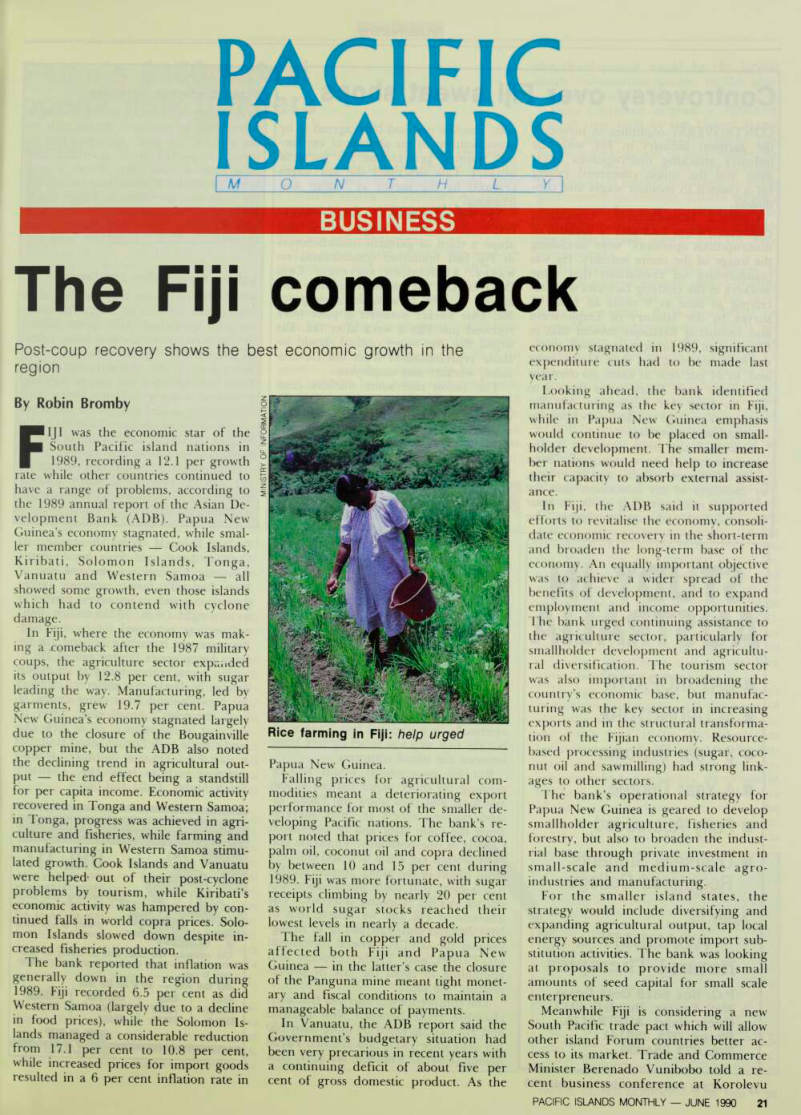
Rice farming in Fiji: help urged
that such an agreement could work along the lines of the South Pacific Re gional Trade and Economic Co operation Agreement (Sparteca) under which Forum nations have almost free access to the Australian and New Zea land markets.
“There are those in the region and in New Zealand who feel that Fiji is not committed to this region,” Vunibobo said. “Nothing could be further from the truth.”
It was Fiji’s hope that there would eventually be a regional free trade zone, but the first step was to set up free trade between the island countries.
But his government would also be pushing for other major nations to join Sparteca, and thus allow the Pacific Is land nations access to their markets along the same lines, and he nominated Canada as one possibility. Vunibobo said even though Fiji was a new and still very small player in the global apparel market it was clear that trade liberalisation was crucial to Fiji’s economic interests. “The interests of Fiji and we believe that of New Zealand and Australia lie in streng thening the GATT (General Agreement on Tariffs and Trade) process and attempting to avoid the rise of protec tionism,” he said.
The conference was also told that mer chandise trade between New Zealand and Fiji has increased by more than 200 per cent since 1987, and reached Fs23B million (U 55157.9 million) last year. New
Zealand External Affairs Ministry official Graham Ansell said from his country’s viewpoint Fiji had now become one of New Zealand’s fastest growing export destinations and an important market in its own right. Of the F|23B million, FsB7 million was accounted for by merchan dise exported from New Zealand, the ba lance being goods flowing out of Fiji.
“Fiji as an economy and as an export market is clearly in a different category for New Zealand from other Pacific Is land countries,” Ansell said. “Over 50 per cent of the value of all of New Zea land’s trade with Forum island countries is with Fiji.” Fiji now outranked trading partners such as Indonesia, Thailand, Saudi Arabia, India and Spain. □