Where pigs can swim
p. 19 · Read in the full issue
Tokelau
By Irene Nisbet
PIGS can’t fly but on Tokelau, they swim. On Fakaofo, the first of the three atolls which make up the group, space is at such a pre mium that there’s just no-where else to keep the pigs except on the reef adjoin
ing the main village.
Overcrowding, a thorny problem for the islanders, has been partially solved by re-settling some of the community on the nearby island of Fenua Fala, a few minutes across the reef by boat. The school and the hospital are now at Fenua Fala, and with lots of space available, it seems surprising that more people don’t make the move.
Heavily dependent on New Zealand aid, and on remittances from Toke lauans living overseas, and having vir tually no natural resources of their own, the Tokelauan’s views and expectations from life are altering drastically. The cash economy has wrought a very visible desire for concrete housing and western consumer goods. Gone are the days of the dugout canoe. Aluminium motor boats proliferate now, and very few households do not have a fridge, video or cassette player.
In the wake of Cyclone Ofa last Febru ary, the islanders are still making run ning repairs. From the second floor win dow of the administration building, one sees stumps of several breadfruit trees which were cut to prevent them falling on the office building. In fact, there were many mature trees which had to be felled for safety’s sake, resulting in a loss which will take years to replace.
Nukunonu, the central island of the group, is also the largest in land area and lagoon size. It’s not overcrowded.
The island is dominated by the vast bulk of the whitewashed Catholic church, a couple of miles out to sea. Nukunonu has fewer trees compared to the other atolls, partly because of Cyclone Ofa, and partly because trees were cut to clear space for new buildings. There is hardly any natural shade left. The heat comes down from the sky, shimmers up from the coral and comes in from all sides of the concrete housing. As in Fakaofo, concrete housing is the norm.
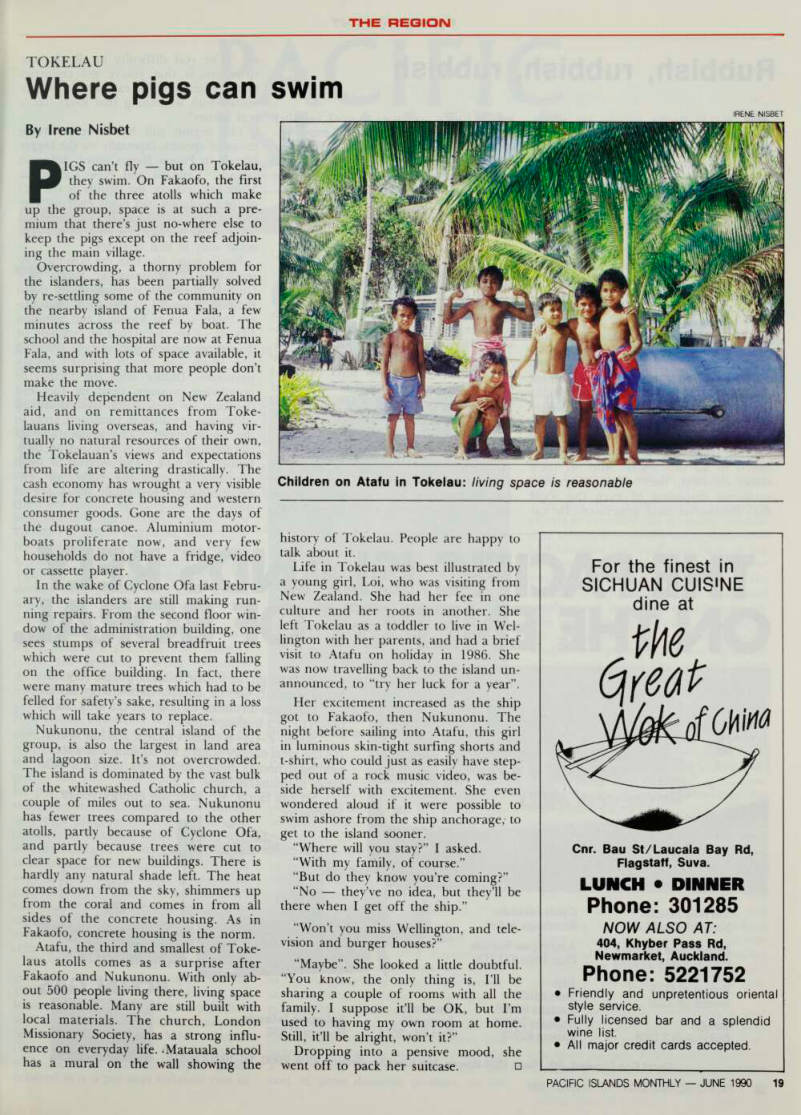
Atafu, the third and smallest of Toke laus atolls comes as a surprise after Fakaofo and Nukunonu. With only ab out 500 people living there, living space is reasonable. Many are still built with local materials. The church, London Missionary Society, has a strong influ ence on everyday life. <Matauala school has a mural on the wall showing the
history of Tokelau. People are happy to talk about it.
Life in Tokelau was best illustrated by a young girl, Loi, who was visiting from New Zealand. She had her fee in one culture and her roots in another. She left Tokelau as a toddler to live in Wel lington with her parents, and had a brief visit to Atafu on holiday in 1986. She was now travelling back to the island un announced, to “try her luck for a year”.
Her excitement increased as the ship got to Fakaofo, then Nukunonu. The night before sailing into Atafu, this girl in luminous skin-tight surfing shorts and t-shirt, who could just as easily have step ped out of a rock music video, was be side herself with excitement. She even wondered aloud if it were possible to swim ashore from the ship anchorage, to get to the island sooner.
“Where will you stay?” I asked.
“With my family, of course.”
“But do they know you’re coming?”
“No they’ve no idea, but they’ll be there when I get off the ship.”
“Won’t you miss Wellington, and tele vision and burger houses?”
“Maybe”. She looked a little doubtful.
“You know, the only thing is, I’ll be sharing a couple of rooms with all the family. I suppose it’ll be OK, but I’m used to having my own room at home.
Still, it’ll be alright, won’t it?”
Dropping into a pensive mood, she went off to pack her suitcase. □
Irene Nisbet
Children on Atafu in Tokelau: living space is reasonable