deepens
pp. 17-18 · Read in the full issue
Bougainville
The crisis deepens
By Frank Senge
THE Bougainville crisis came to a head in May. As Waigani, the hub of Papua New Guinea Govern ment, in Port Moresby, tried to govern its North Solomons province, the oppor tunity for any form of peace negotiation slipped further and further away.
At time of writing, there was no reli able source of information from Bougainville except those that the Bougainville Republican Army (BRA) re leased. There was a total communication black-out, the result of a Government economic blockade of the island. The Bougainville Republican Army had de clared the island independent but de spite appeals to foreign Governments within and outside the region, there had been no public recognition of it. Mean while, the sanctions were digging in deep. Fuel supplies were short. Kerosene had run out and other basic necessities were running out, as shipping dwindled.
One group, the Nissan islanders, pledged to break away from Bougainville.
Now, the PNG Defence Force under a call-out order is amassing troops on Nis san for what its command claims is a “reconciliation, reconstruction, and re habilitation” exercise and disclaim any plans to retake Bougainville militarily.
The island and its mentor were slipping wider and wider apart. It seemed, in March and April that finally peace and some form of compromise was around the corner when the Government and the Bougainville Republican Army agreed to negotiate. Although, each side maintained that secession was non negotiable for opposite reasons, there was a lot of hope at what Melanesian
consensus could bring through negotia
tion. Then, something very petty such as the location for the negotiation wedged itself in between the two and failed to come unstuck.
The BRA maintained that all negotia tions would be conducted at the Pangu na mine, the Government opted for more neutral ground. Eventually, both the Solomon Islands and Vanuatu offered their capitals as venues. BRA would not budge and the Government steadfastly refused the BRA’s choice for “security reasons”. In the meantime nor mal activity on Bougainville began to
close down or withdraw. Bank closed down, then the post office. Basic necessities fell short as shipping into the area dwindled. On May 2, Papua New Guinea Cabinet issued an order to all mariners operating in and around Bougainville island that an exclusive 50-mile zone was in force around the province. All unauthorised vessels operating within the exelusive zone would be fired upon without warning.
The exclusion included airspace of up to 20,000 feet. One week later, on May 9 the Government announced selective sanctions against Bougainville island.
Only those ships bearing very bare
essentials mainly to the hospital on the island were to pass through. On May 17, the Bougainville Republican Army re plied by declaring Papua New Guinea’s North Solomons Province a republic, Rebel chief Francis Ona was appointed President of the new republic. The more popular and public figure of Sam Kauona was appointed Defence Minister in a new cabinet. Bougainville was re tained as the name North Solomons Pre mier, Joseph Kabui and his agriculture minister, Michael Laimo were given senior ministries in the new republic. It
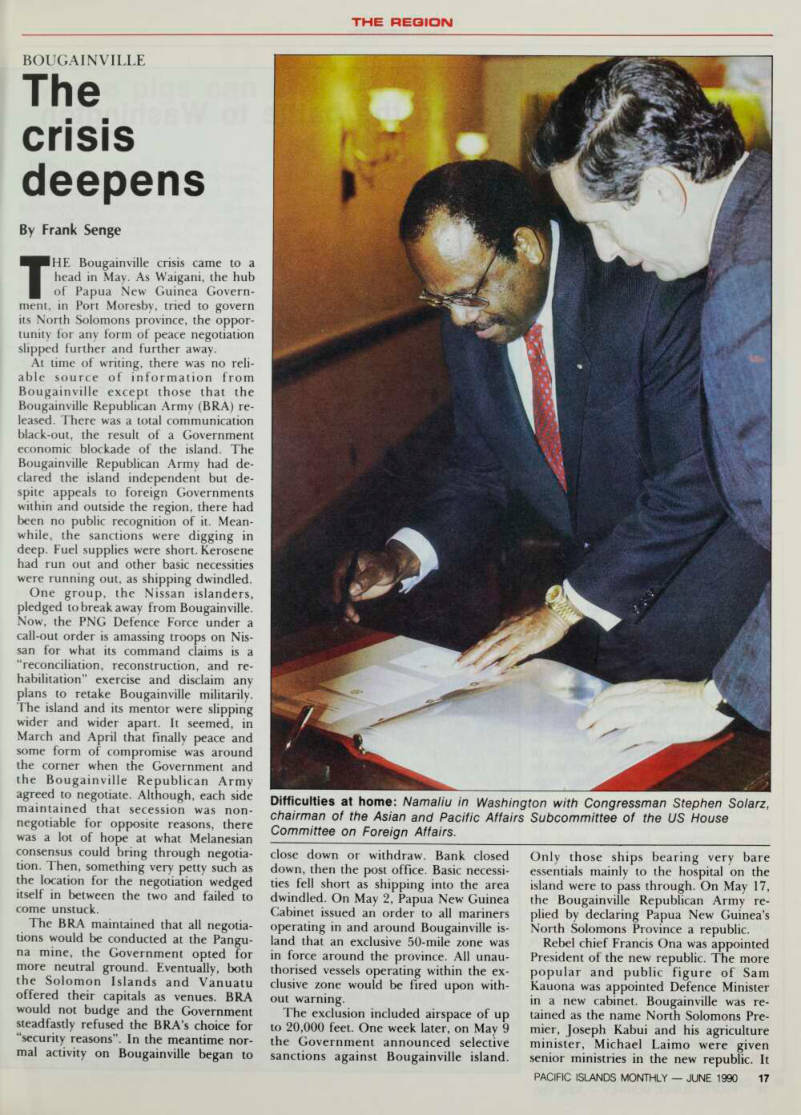
Difficulties at home: Namaliu in Washington with Congressman Stephen Solarz, chairman of the Asian and Pacific Affairs Subcommittee of the US House Committee on Foreign Affairs.
finally confirmed allegations that Kabui had been an active collaborator of the BRA throughout the uprising. On July 2, 1989, Papua New Guinean riot squad policemen attacked Kabui and Laimo.
Kabui was beaten with rifle butts and had his car tyres and wind screens shot out. Laimo is blind in one eye as a result of that assault. The incident looked like a payback for the wounding of six policemen by militants that weekend.
The security force command expressed concern and promised an investigation.
The beating started a nationwide and international outcry against the security forces. The forces kept quiet and it is not certain if the promised investigation got off the ground at all.
PNG intelligence officers intercepted
several letters written by the Bougainville Republican Army and countersigned by Premier Kabui requesting foreign Gov ernments to recognise Bougainville as an
independent state.
Kabui was also party to efforts by the BRA to print passports in Singapore.
However, no nation has openly recog nised the declaration by the BRA. Both Solomon Islands and Vanuatu, members of the Melanesian Spearhead Group, have told Papua New Guinea that they would not support any push to fragment Melanesian solidarity. Solomon Islands has agreed to monitor its borders and to seal it off to traditional border crossers until the Boungainville crisis is resolved.
Can it be resolved?
Waigani has adopted a wait and see attitude, hoping that the blocade will cause internal dissent and that dissent will eventually sort things out on the is land of Bougainville. The PNG Defence Force in mid-May recommended in a secret brief that the island ought to be retaken in a military invasion. The brief stated that any such move should be aimed at capturing or killing Kauona who is seen as the strongest supporter of secession. The report was leaked to the BRA which circulated it to media orga nisations.
Defence Force Minister, Benias Sabumei, was furious and ordered an in ternal investigation but again ruled out any military invasion of the island. Yet military invasion is the next likely alternative if the blockade does not suc ceed. There is a fear that the blockade may have the opposite effect to its ori ginal intention and that those people who may have wanted to remain with PNG may eventually join the BRA.
The biggest question is how an inde pendent Bougainville will fare? Will Au stralia and Papua New Guinea support its rebuilding process? Will the Solomon Islands and Vanuatu accept it into their fold? Will another multi-national be will ing to take on Boungainville Copper? □