A woman’s champion
pp. 56-57 · Read in the full issue
Pacific People
Naama Latasi: politician, community worker
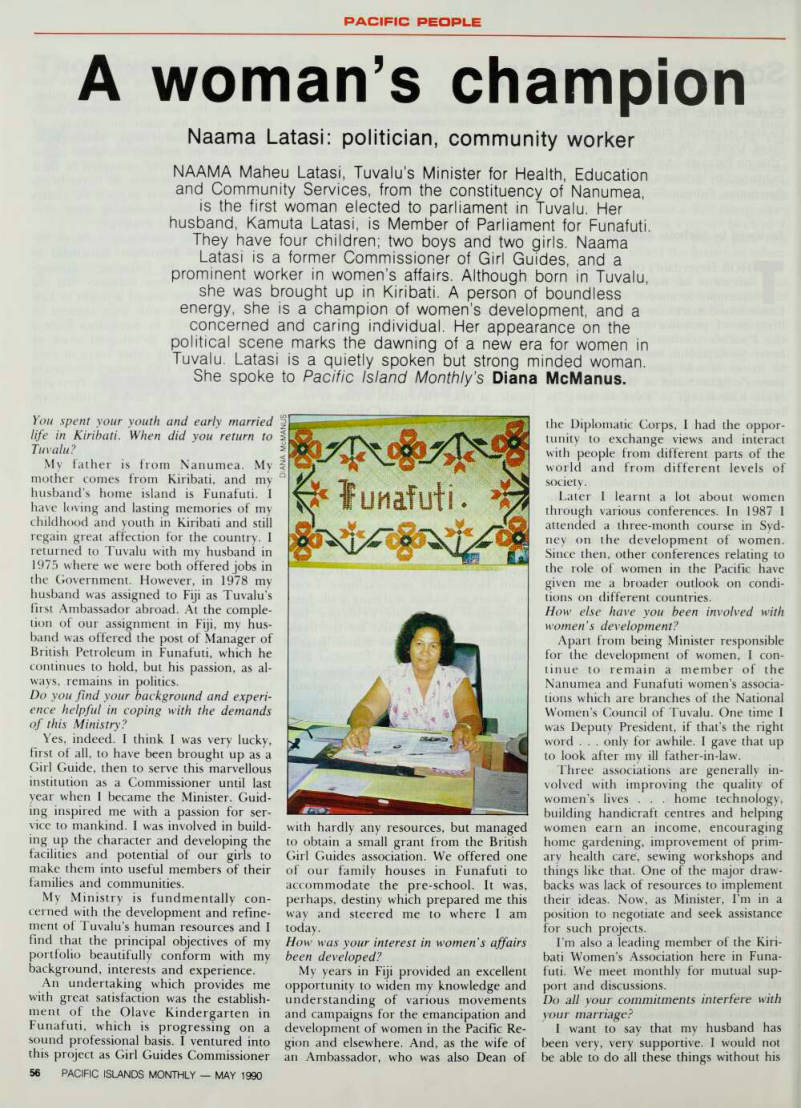
NAAMA Maheu Latasi, Tuvalu's Minister for Health, Education and Community Services, from the constituency of Nanumea, is the first woman elected to parliament in Tuvalu. Her husband, Kamuta Latasi, is Member of Parliament for Funafuti, They have four children; two boys and two girls. Naama Latasi is a former Commissioner of Girl Guides, and a prominent worker in women’s affairs. Although born in Tuvalu, she was brought up in Kiribati. A person of boundless energy, she is a champion of women's development, and a concerned and caring individual. Her appearance on the political scene marks the dawning of a new era for women in Tuvalu. Latasi is a quietly spoken but strong minded woman.
She spoke to Pacific Island Monthly's Diana McManus.
You spent your youth and early married life in Kiribati. When did you return to Tuvalu?
My father is from Nanumea. My mother comes from Kiribati, and my husband’s home island is Funafuti. I have loving and lasting memories of my childhood and youth in Kiribati and still regain great affection for the country. I returned to Tuvalu with my husband in 1975 where we were both offered jobs in the Government. However, in 1978 my husband was assigned to Fiji as Tuvalu’s first Ambassador abroad. At the comple tion of our assignment in Fiji, my hus band was offered the post of Manager of British Petroleum in Funafuti, which he continues to hold, but his passion, as al ways, remains in politics.
Do you find your background and experi ence helpful in coping with the demands of this Ministry?
Yes, indeed. I think I was very lucky, first of all, to have been brought up as a Girl Guide, then to serve this marvellous institution as a Commissioner until last year when I became the Minister. Guid ing inspired me with a passion for ser vice to mankind. I was involved in build ing up the character and developing the facilities and potential of our girls to make them into useful members of their families and communities.
My Ministry is fundmentally con cerned with the development and refine ment of Tuvalu’s human resources and I find that the principal objectives of my portfolio beautifully conform with my background, interests and experience.
An undertaking which provides me with great satisfaction was the establish ment of the Olave Kindergarten in Funafuti, which is progressing on a sound professional basis. I ventured into this project as Girl Guides Commissioner
with hardly any resources, but managed to obtain a small grant from the British Girl Guides association. We offered one of our family houses in Funafuti to accommodate the pre-school. It was,
perhaps, destiny which prepared me this
way and steered me to where I am
today.
How was your interest in women’s affairs been developed?
My years in Fiji provided an excellent opportunity to widen my knowledge and understanding of various movements and campaigns for the emancipation and development of women in the Pacific Re gion and elsewhere. And, as the wife of an Ambassador, who was also Dean of
the Diplomatic Corps, I had the oppor tunity to exchange views and interact with people from different parts of the world and from different levels of society.
Later I learnt a lot about women through various conferences. In 1987 I attended a three-month course in Syd ney on the development of women.
Since then, other conferences relating to the role of women in the Pacific have given me a broader outlook on condi tions on different countries.
How else have you been involved with women’s development?
Apart from being Minister responsible for the development of women, I con tinue to remain a member of the Nanumea and Funafuti women’s associa tions which are branches of the National Women’s Council of Tuvalu. One time I was Deputy President, if that’s the right word . . . only for awhile. I gave that up to look after my ill father-in-law.
Three associations are generally in volved with improving the quality of women’s lives . . . home technology, building handicraft centres and helping women earn an income, encouraging home gardening, improvement of prim ary health care, sewing workshops and things like that. One of the major draw backs was lack of resources to implement their ideas. Now, as Minister, I’m in a position to negotiate and seek assistance for such projects.
I’m also a leading member of the Kiri bati Women’s Association here in Funa futi. We meet monthly for mutual sup port and discussions.
Do all your commitments interfere with your marriage?
I want to say that my husband has been very, very supportive. I would not be able to do all these things without his
help. He has always been an understand ing partner, encouraging me to fully contribute to whatever I considered worthwhile.
As Girl Guides Commissioner I often had to attend conferences abroad, leav ing our small children behind. Some times I was away for up to three weeks and during my absence Kamuta gladly performed all the domestic chores in cluding cooking for and feeding the chil dren. I’m fully appreciative of him.
Indeed he has set a good example for the men of Tuvalu to follow; that is, to adopt a flexibility in roles and adjust sensibly to circumstances to allow women to pursue their useful interests, and app ly their faculties fully to the welfare of their families, communities and the na tion.
Are roles changing in Tuvalu society?
Yes, they are. Much faster than any one can realise. There is an undercur rent of social changes and its ripples be come visible every now and then. We are much more exposed to outside people and cultures, and to a variety of lifestyles and ideologies of people in this region and beyond. Socially, it’s a very delicate transitional period through which Tuva lu is passing. We have to remain very firm and steadfast to keep the fabric of our society strong. We want to maintain our identity and dignity. We don’t wish to develop into a synthesised society whose texture belongs nowhere.
I am a strong woman on principles, and I like to see our women take their rightful place in this changing society, but this should take place in harmony, rather than conflict with the men-folk of our nation.
What do you regard is the woman’s role in today’s society?
I must stress that our concept of women’s development is not what it may be in some western cultures. We wish to raise the status, the contribution and participation of our women in national development within the perimeters of our culture and traditions.
The first and foremost duty of a woman is towards her family and com munity. She must apportion her time to make sure she fulfils her role as a wife and mother honourably. She should not get involved in so many activities that she neglects her own children and mem bers of the family. It’s important for women to be aware of their right to equal opportunity with men to express their opinion, and to participate in deci sion making and decision execution.
Women must respond sensibly to the changing economic scene of the country and acquire the skills to enable them to pursue income earning activities.
All this, of course, can only be made possible if men too understand, adapt and change as required. Above all, men
or women, we must remain strongly attached to our cultural values and prac tises, and never be led off the track by the thinking, values and practices of peo ple from overseas within whom we come into contact through travel, tourism or videos.
Do you have difficulties in your position because you are a woman?
Not really. On the contrary, I have received commendable cooperation and assistance from the male staff. I have nothing but praise for my colleagues in Cabinet. At ministerial discussions my contributions are treated with the same respect as anyone else’s. Similarly in all the committees and non-governmental organisations, I find no expression of
the slightest prejudice against my gen
der. Despite the fact that women in our society still remain a disadvantaged group, it is certainly not on account of any prejudice against them. It is much
mes and more trainers. I’d like to see a considerable increase in resources, both monetary and technical, to ensure the success of women’s welfare programme at grassroots level.
Another of my serious concerns is to heighten women’s awareness of their present condition and infuse them with dynamism to work towards their own betterment. I’m keen to see the infras tructure of the Women’s National Coun cil and all the women’s associations strengthened. They are reliable channels of communication and can play a very valuable role in mobilising women at all levels.
Why are you working so hard for women in particular?
Our nation is not endowed with many natural resources. Our greatest wealth lies in our people. One of my primary objectives is to ensure that we develop our human resources to the fullest for
more to do with adherence to traditional roles and conventions.
Is having more women on decision making bodies presents a cultural threat?
No. I don’t see any threat in it at all.
Our culture and society at present is like a cart with one full size wheel and the other a miniature. How can such a cart reach its destination? What I want to see is the miniature wheel being developed to full size as well, so that the cart of our national development can move smooth ly and fast in order to realize the goals we have set for ourselves. Women’s full participation in all our national affairs is therefore a necessity, and not a threat in any way.
What are you doing at Government level about improving the condition of women?
I am considering several structural changes in the women’s office of my Ministry, largely to facilitate greater con centration on women’s welfare program mes. We need more training program
the benefit of the nation. As such, I have to make sure that women, who are re latively left behind in this regard, receive the extra attention due in order to catch up with the menfolk; so we can strive for the good of all.
Cultural definition and change form a part of your portfolio. What are some developments in that area?
We are in the process of strengthening the development of the Tuvalu language and promoting its greater use in our education system. Our national language must be given its rightful status as the first language of education. We have schemes to provide incentives for the promotion and production of literature in the Tuvaluan language.
We are also making sure that our cul ture is emphasised throughout the education system, so that when our youth go overseas for education and training they do not lose sight of their
identity. □
Diana Mcmanus
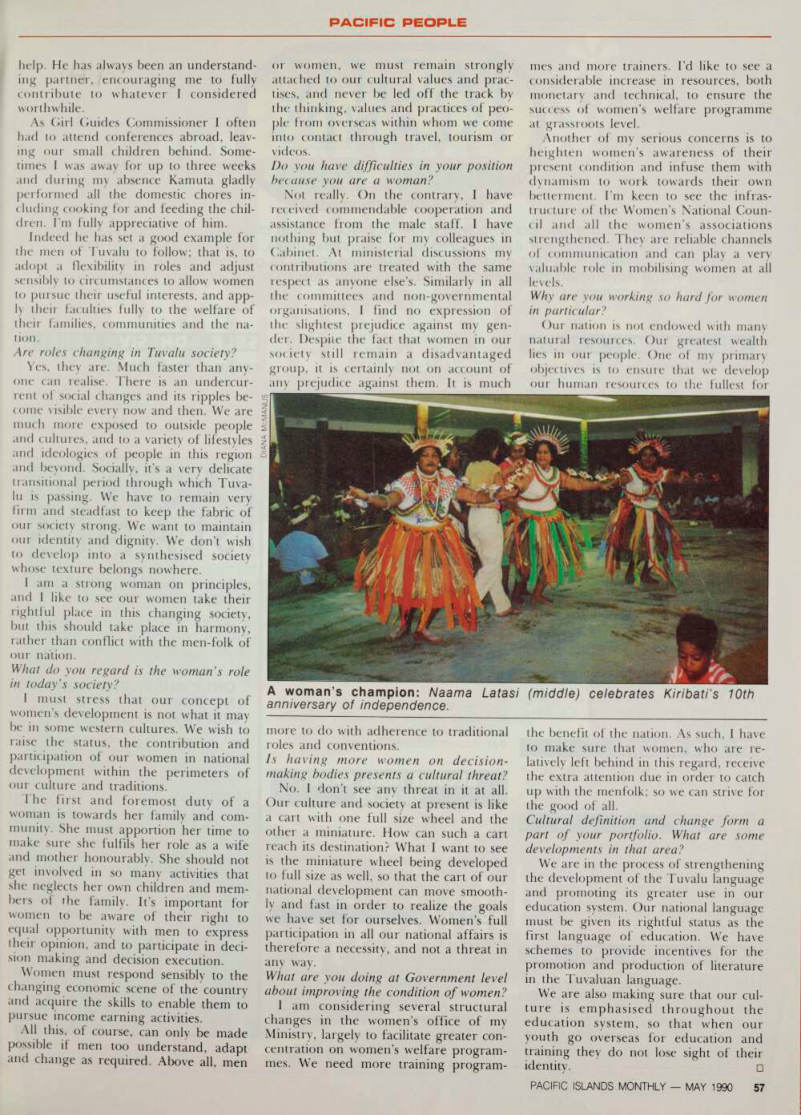
A woman’s champion: Naama Latasi (middle) celebrates Kiribati’s 10th anniversary of independence.