Inter-island shipping
pp. 49-51 · Read in the full issue
is no plain sailing
WHILE the last de cade has seen great leaps in both sea and air links be tween the island states of the Pacific and with the major neighbours on the Pacific rim, there are still enormous problems for most of the countries with internal transport. And in ternal transport, given that most of the countries con sist of a chain of islands and road development is still at an early stage, means inter-island ship ping. Low volumes over sometimes long distances pose the same problems on a more local scale as those faced by internation al transport operators in the Pacific Islands.
In recent months we have witnessed remote islanders in Tonga faced with rotting coconuts be cause there was no ship prepared to make the un economic voyage to collect the cargo; coastal shipping companies in Papua New Guinea proposing stiff rate hikes as costs skyrocket;
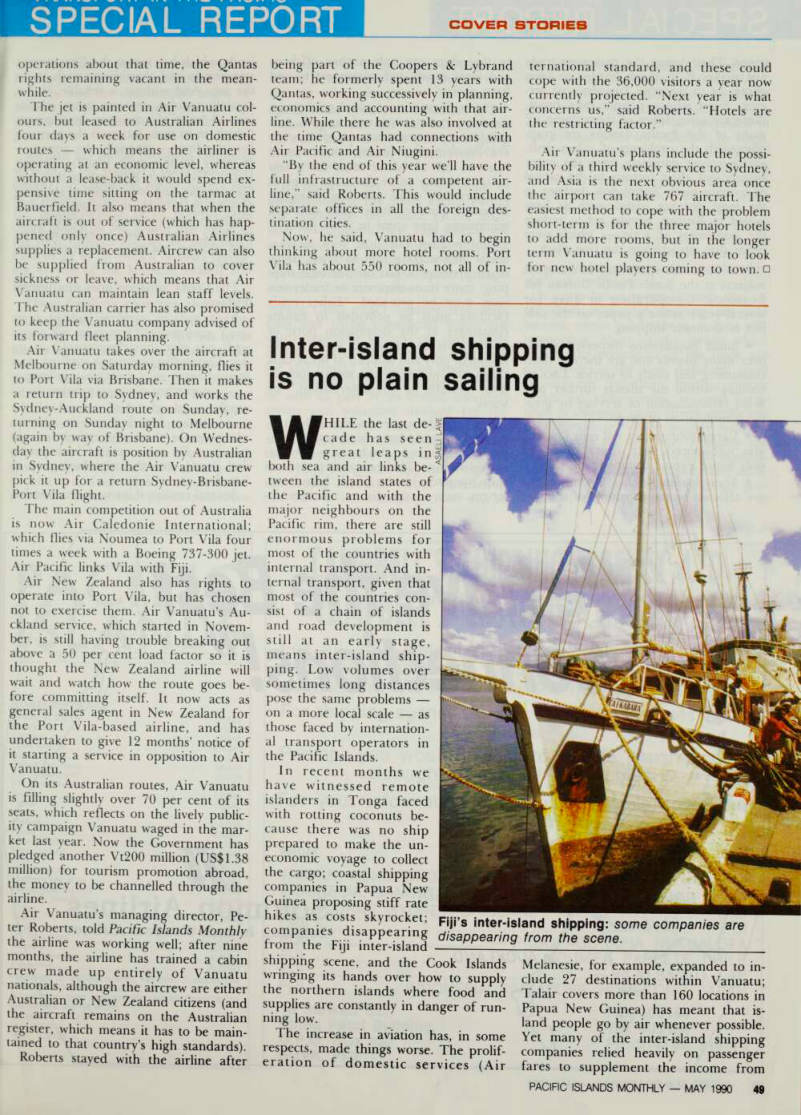
companies disappearing
from the Fiji inter-island
shipping scene, and the Cook Islands wringing its hands over how to supply the northern islands where food and supplies are constantly in danger of run ning low.
The increase in aviation has, in some respects, made things worse. The prolif eration of domestic services (Air
Melanesie, for example, expanded to in clude 27 destinations within Vanuatu; Talair covers more than 160 locations in Papua New Guinea) has meant that is land people go by air whenever possible.
Yet many of the inter-island shipping companies relied heavily on passenger fares to supplement the income from
Fiji’s inter-island shipping: some companies are disappearing from the scene.
cargo. Their losing the passenger trade just makes it so much harder to keep going, or to maintain frequency of ser vice. Even where people take boats, there are often fewer of them doing so; many of the Pacific nations are grap pling with the problems of urban drift, where young nationals from the outer islands seek their fortune in the capital or a main town. Population declines in the most distance island, such as hap pened in Kiribati, against act to reduce the economies of scale which were never that attractive in the first place.
Paul Gini, who specialised in transport subjects at the South Pacific Bureau for Economic Co-operation in Suva for several years, wrote a paper on the sub
ject of domestic shipping.
• Small populations dispersed widely
over many islands and are thereby time consuming and costly to service. Lack of roading within the islands further pre vents rationalisation of services by grea ter consolidation of cargo. • Cargo volumes are not only low, but also unbalanced, with copra often the
only major export commodity.
• Many loading and unloading points
are affected by the proximity of the reef
so that ships can only anchor offshore and ferry goods and passengers to and from shore.
The container revolution made things worse by the fact that the large ocean going ships stop at fewer ports than the old conventional vessels, which could heave-to off an island town for a few hours and take on or discharge cargo in
comparatively small quantities. Shipping
is now a game of fewer port calls and minimising time spent in those ports.
Gini pointed out that, with interna tional lines making calls to fewer ports, more pressure is put on domestic ship ping: more trans-shipment or feeder ser vices must be provided. “Either costly facilities must be provided to handle containers at the destination port, or goods must be unpacked at the trans shipment port and shipped as break-bulk cargo, this nullifying the major door-to door benefit of containerisation,” he wrote.
But and no one can blame them
privately-owned domestic shipping com
panies cannot be in the business of cross
subsidisation. The remaining private
ship operator in the Cook Islands no longer runs to the distant northern is
lands, which has meant the Government stepping in and chartering vessels to do the job. And without a reliable, if not entirely regular, services outer islands lose all hope of economic development (which, in its turn, increases the pressure for islanders especially the young to move to the main island). Tonga’s fourth Five Year Plan summed it up:
“Inadequacy and irregularity of shipping
services particularly in the outer islands results in large quantities of produce not reaching internal and external markets with growers not being adequately com pensated.”
The Cooks’ situation does sum up the problem.
The Government in Rarotonga char tered the Fiji vessel Kaunitoni. Most ves sels operating out of Rarotonga service the southern islands, where the greatest distance on a voyage is less than 300 km, compared with more than 1100 km to the northern islands. And several of the more distant islands have no airstrip, which means they rely entirely on sea transport for movement of both people and goods, with the trips lasting up to five days.
Several smaller ships were chartered to
take essential supplies to the northern islands but they had inadequate cargo capacity, and the communities began re porting they were running low on sup plies including diesel fuel for electricity generators.
Kiribati has similar problems. Shipping services to the country’s outermost com munity, on Christmas Island, do not run to a regular schedule. That is acceptable for non-perishable cargo inwards, and copra outwards, but means that much of the food supplies and all the passengers have to go by air (which involves travell ing by way of the Marshall Islands and Hawaii).
These far-flung countries also gener ate a further problem, in that the dis tances are so great (3200 km from Tara wa to Christmas Island) that the ships must be large enough to withstand heavy ocean seas, and also have crews trained
in advanced navigation techniques.
There is no simple answer. Private operators are unlikely to keep a modern fleet of ships because the money re quired for re-investment is not being generated, so they tend to stick with old er and less fuel-efficient ships. Inde pendence brought to power politicians
who answered to constituents, many of whom demand better shipping services (among other things), so that govern ments have been sensitive to these press ures. But governments tend to get land ed with the uneconomic routes, and this becomes just one more drain on already
strained budgets.
In order to try and solve some of these problems, the South Pacific Forum has established the South Pacific Mari time Development Plan. This scheme will seek answers to the islands’ shipping questions, from evolving vessels which are suited to the trade to port manage ment and infrastructure.
Paul Gini’s paper stressed that ship ping had to be considered within the entire transport framework, particularly how aircraft could be used to carry peo ple and freight in places on uneconomic sea voyages. “Domestic shipping should be seen as part of an overall transport sector and solutions devised for the problems it now faces should fully account for constraints imposed by and the effects on other parts of that sector,” he wrote. Integrated approach was all: developing container wharf facilities at one link in the transport chain will be
less efficient if the reading, storage and other requirements are not met.
Similarly, attention, too, should be paid to small-scale streamlining such as organising copra to be assembled in one central point for collection by ships.
“It is important that new vessels that might be built do not become liabilities for the future, too expensive to operate or difficult to maintain,” said Gini. While it is now a few years since this was writ ten, the situation in the Pacific is still largely the same and the points he makes remain valid, simply because so many ships used on domestic routes are old and inefficient.
It nevertheless seems unlikely that in ter-island or coastal shipping can ever become totally profitable or at least self supporting. Many of the factors which govern the economics of the trade are immutable the long distances, small
populations, problems finding return
cargos on some routes, seasonal varia tions in shipping space needs, inefficient port handlings where proper wharves and storage do not exist. Probably the best that can be hoped for is the elimina tion of the most costly aspects and mini misation of losses and the drain on gov ernment or aid funds. □