Bridging
pp. 35-37 · Read in the full issue
Special Report
Cover Stories
Bridging the islands
Towards the end of the 20th century, the Pacific Islands are carving their names in the transport industry Robin Bromby reports.
THE Pacific transport scene has not confirmed the worst fears of the pessimists, but has instead seemed to turn itself around. There are, of course, still major problems as outlined in the following reports from the par lous state of inter-island shipping, the
immense logistical problems of develop
ing countries where reading systems are such that access to the interior is severely limited, to the problems small airlines (such as Air Nauru) face trying to cut themselves a niche and profitable mar ket. In shipping, the Pacific Forum Line
continues to thrive, but constantly faces the intrusion of bigger predators on its more lucrative routes.
Transport links run by outsiders have generally been tailored to the operators’ rather than the Pacific clients’ needs.
Airline links tend to radiate out from the major metropolitan companies; services from such places as Sydney, Auckland or Honolulu to most of the Pacific island capitals are regular and frequent (although in the case of the smaller countries these often revolve around seven-day tour packages rather than con
venience for business travellers). But try and get from Apia to Honiara, Port Vila to Tonga, or Niue to anywhere, and it involves circuitous and expensive travel.
If the profit is not there, the foreign company will not be considerate of local needs such a situation led to Ansett withdrawing from Vanuatu and from the Cook Islands International Airways run from Rarotonga to Auckland, as did Air Nauru from its servicing of Niue, when there was no financial incen tive.
So as with shipping; foreign operators will home into the Sydney-Suva or Auck land-Suva route but will withdraw quick ly if the ship is not making a profit, or can make a bigger one elsewhere. These lines are keen to siphon business away from such as the Pacific Forum Line on these heavy density routes, but will happily leave Forum the milk run up to Kiribati and the Marshall Islands.
The prominence of expatriate-run op erations was an obvious hangover from colonial days, but the weakening of that hold on the transportation infrastructure of the Pacific Islands is continuing to weaken.
But whatever the national aspirations and needs of the small states of the re
gion, they face inherent problems: low
export volumes mean that containers bringing in consumer goods and food are often shipped out empty. Countries
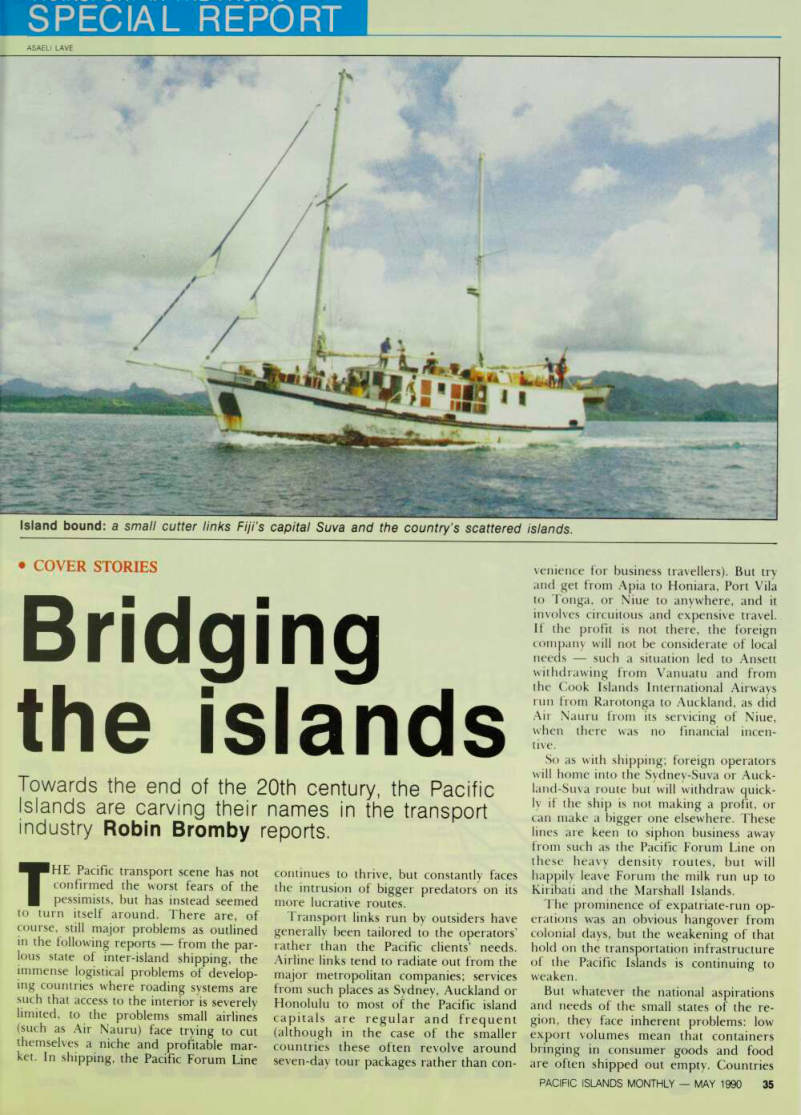
Island bound: a small cutter links Fiji’s capital Suva and the country’s scattered islands.
can get the foreign aid to lengthen run ways or buy a jet aircraft, but that means little if the hotels and other infrastruc ture is not in place to accommodate the extra number of tourists, or the frills are not there or too expensive as was the case in Vanuatu when tourists found the
country’s duty-free shopping no cheaper
than ordinary retail outlets at home.
Historically, transport links have been at their best when keeping them thus has been in the interests of the metropolitan powers or colonial companies. Burns Philp was a good example of this, although the Germans (who ruled New Guinea, Nauru, the Caroline Islands and Western Samoa until 1914) took it to the extreme, with trade being monopolised by German companies German registered ships operating in the South Pacific were second only in number to vessels sailing under British colours.
While the colonial powers gave earnest
attention to what were then
mainly shipping links
the whole purpose of col onies being to link them to the metropolitan powers internal communications were another matter.
Roads were not built un less they were essential, such as to plantations. Even now many of the states have an underdeveloped road system; recently land owners in a part of the Solomon Islands agreed to
a forestry project mainly
because it involved the Taiwanese company build ing a network of roads through their area.
The one nation that does
have a major internal transport problem is Papua New Guinea. Its forbidding ter rain has inhibited land transport. A rail way system would be prohibitively ex pensive, and even good all-weather read ing linking the country on a large scale is many years away. Fortunately for Papua New Guinea, the rich mineral and oil finds have been of a scale to justify the use of helicopters and aircraft to trans port people and equipment.
In this survey of the state of Pacific transport, many of the same old prob lems keep coming up: the lack of re sources so that ships and aircraft cannot be repaired if they break down in the island countries; wharves and airports are often inadequate and there is a con tinuing problem with air traffic control.
The bind in which micro-economies find themselves is agonisingly simple.
Economic growth depends largely on good and efficient transport links
which can be sustained only by economic growth.
The island states must, however diffi cult the task, continue working towards the development and expansion of their own transport systems. That is the only means by which they can control their communications with the outside world and their main markets. It was not possi ble to establish an aviation equivalent of the Pacific Forum Line, but the countries could go a long way toward such a con cept by pooling their rights and inter
lining.
There is a tendency in many of the islands to blame the expatriate for eco nomic problems, to resent companies which make and repatriate profits. This can take a petty form, such as problems airline operators have had renewing work permits for foreign staff members in Vanuatu and Papua New Guinea; or it can lead to foreign businessmen being forced to pull out.
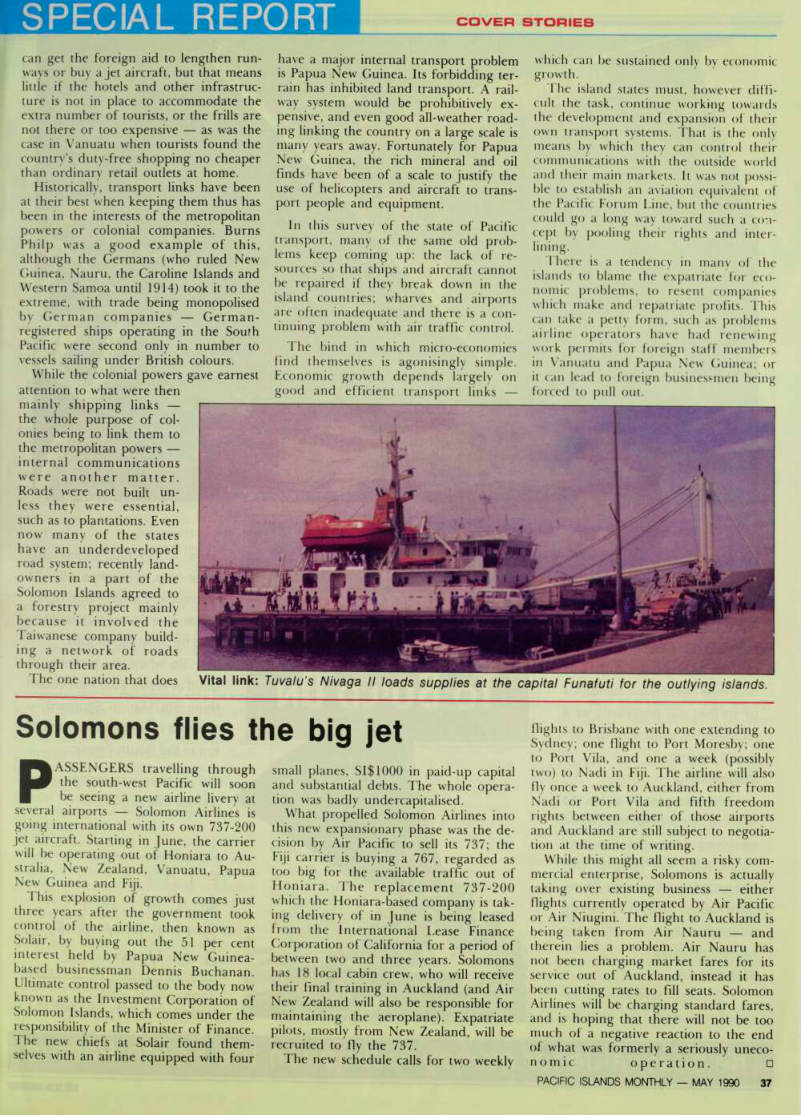
Vital link: Tuvalu’s Nivaga II loads supplies at the capital Funafuti for the outlying islands.