The return of the Giant Clam
pp. 32-34 · Read in the full issue
By David North
THE goals: To help feed burgeon
ing island populations with a
nutritious yet inexpensive protein,
while creating an export industry with virtually unlimited potential. The means: By sowing the reefs of the tropical Paci fic with seeds that produce the world’s largest, and one of its tastiest and most sought after, mollusks.
Though it sounds fanciful, an interna tionally-funded marine research team based in the Republic of Palau believes it has developed a way to achieve those goals with a clam called Tridacna derasa.
One of several species of the Giant
Clam of fishing legends and Hollywood
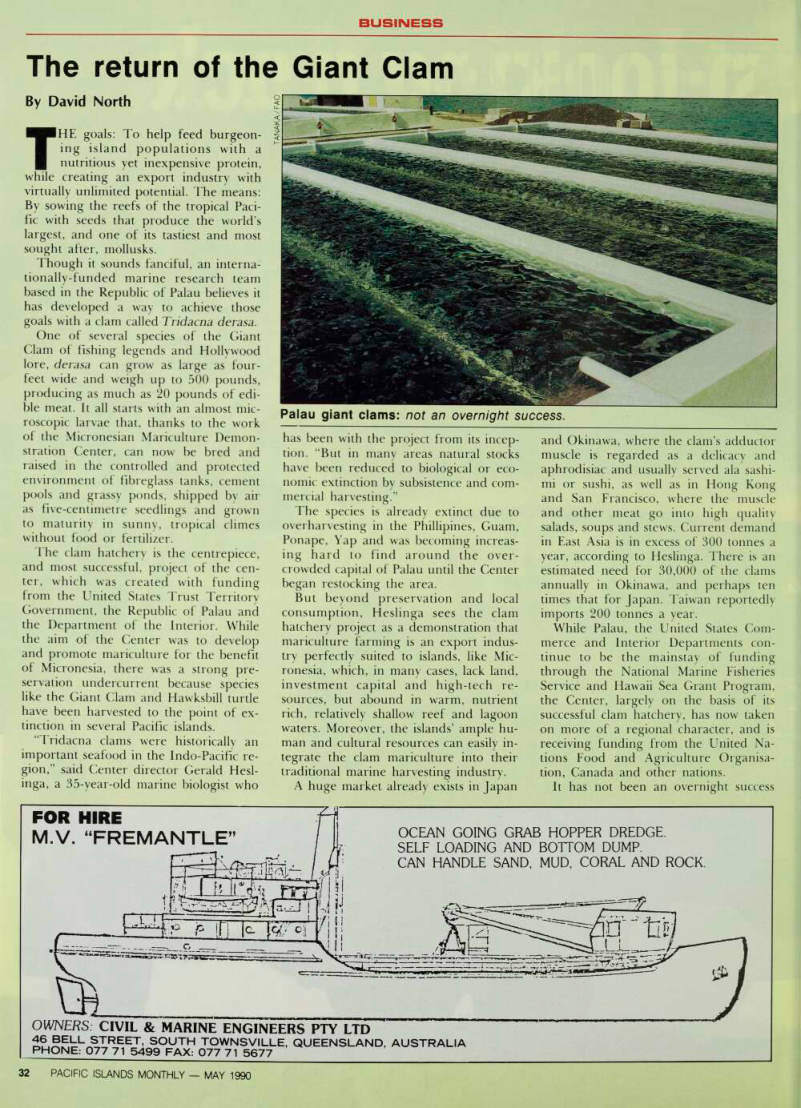
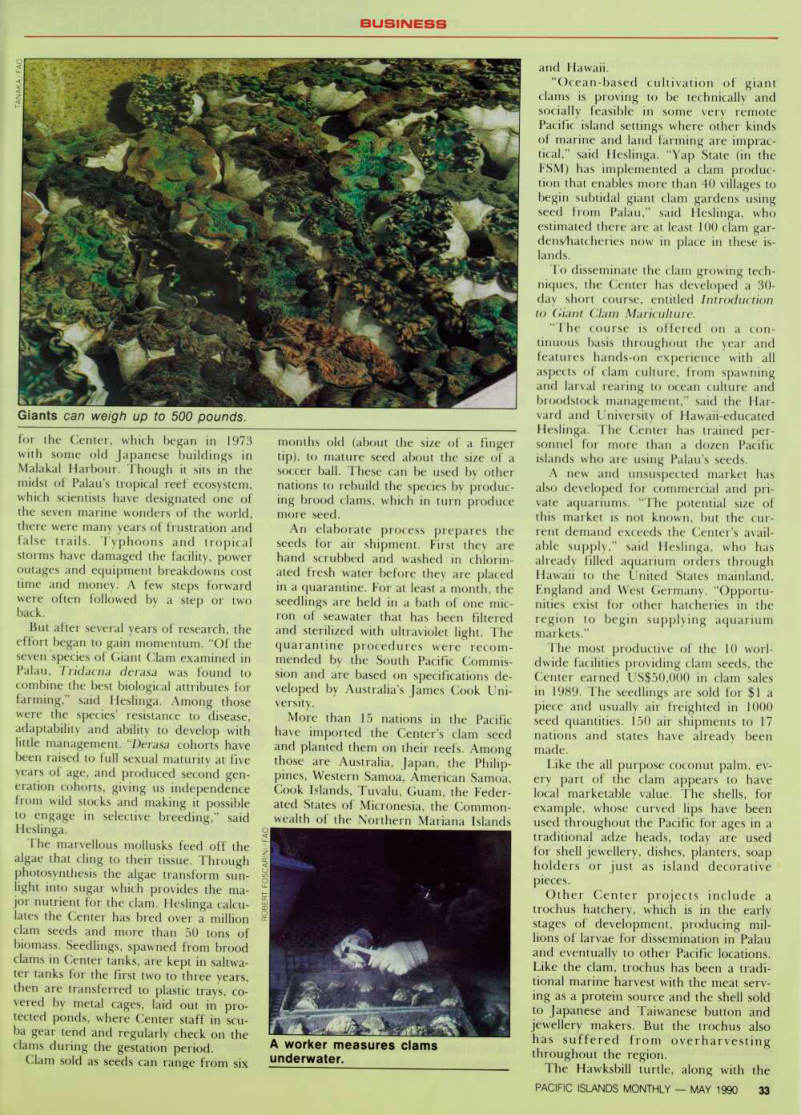
lore, derasa can grow as large as four feet wide and weigh up to 500 pounds, producing as much as 20 pounds of edi ble meat. It all starts with an almost mic roscopic larvae that, thanks to the work of the Micronesian Mariculture Demon stration Center, can now be bred and raised in the controlled and protected environment of fibreglass tanks, cement pools and grassy ponds, shipped by air as five-centimetre seedlings and grown to maturity in sunny, tropical climes without food or fertilizer.
The clam hatchery is the centrepiece, and most successful, project of the cen ter, which was created with funding from the United States Trust Territory Government, the Republic of Palau and the Department of the Interior. While the aim of the Center was to develop and promote mariculture for the benefit of Micronesia, there was a strong pre servation undercurrent because species like the Giant Clam and Hawksbill turtle have been harvested to the point of ex tinction in several Pacific islands.
“Tridacna clams were historically an important seafood in the Indo-Pacific re gion,” said Center director Gerald Hesl
inga, a 35-year-old marine biologist who
has been with the project from its incep tion. “But in many areas natural stocks have been reduced to biological or eco nomic extinction by subsistence and com
mercial harvesting.”
The species is already extinct due to overharvesting in the Phillipines, Guam, Ponape, Yap and was becoming increas ing hard to find around the over crowded capital of Palau until the Center
began restocking the area.
But beyond preservation and local consumption, Heslinga sees the clam hatchery project as a demonstration that mariculture farming is an export indus try perfectly suited to islands, like Mic ronesia, which, in many cases, lack land, investment capital and high-tech re sources, but abound in warm, nutrient rich, relatively shallow reef and lagoon waters. Moreover, the islands’ ample hu man and cultural resources can easily in tegrate the clam mariculture into their
traditional marine harvesting industry.
A huge market already exists in Japan
and Okinawa, where the clam’s adductor muscle is regarded as a delicacy and aphrodisiac and usually served ala sashi mi or sushi, as well as in Hong Kong and San Francisco, where the muscle and other meat go into high quality salads, soups and stews. Current demand in East Asia is in excess of 300 tonnes a year, according to Heslinga. There is an estimated need for 30,000 of the clams annually in Okinawa, and perhaps ten times that for Japan. Taiwan reportedly imports 200 tonnes a year.
While Palau, the United States Com merce and Interior Departments con tinue to be the mainstay of funding through the National Marine Fisheries Service and Hawaii Sea Grant Program, the Center, largely on the basis of its successful clam hatchery, has now taken on more of a regional character, and is receiving funding from the United Na tions Food and Agriculture Organisa tion, Canada and other nations.
It has not been an overnight success
Palau giant clams: not an overnight success.
for the Center, which began in 1973 with some old Japanese buildings in Malakal Harbour. Though it sits in the midst of Palau’s tropical reef ecosystem, which scientists have designated one of the seven marine wonders of the world, there were many years of frustration and false trails. Typhoons and tropical storms have damaged the facility, power outages and equipment breakdowns cost time and money. A few steps forward were often followed by a step or two back.
But after several years of research, the effort began to gain momentum. “Of the seven species of Giant Clam examined in Palau, Tridacna dcrasa was found to combine the best biological attributes for
farming,” said Heslinga. Among those
were the species’ resistance to disease,
adaptability and ability to develop with
little management. “Derasa cohorts have been raised to full sexual maturity at five years of age, and produced second gen eration cohorts, giving us independence from wild stocks and making it possible to engage in selective breeding,” said
Heslinga.
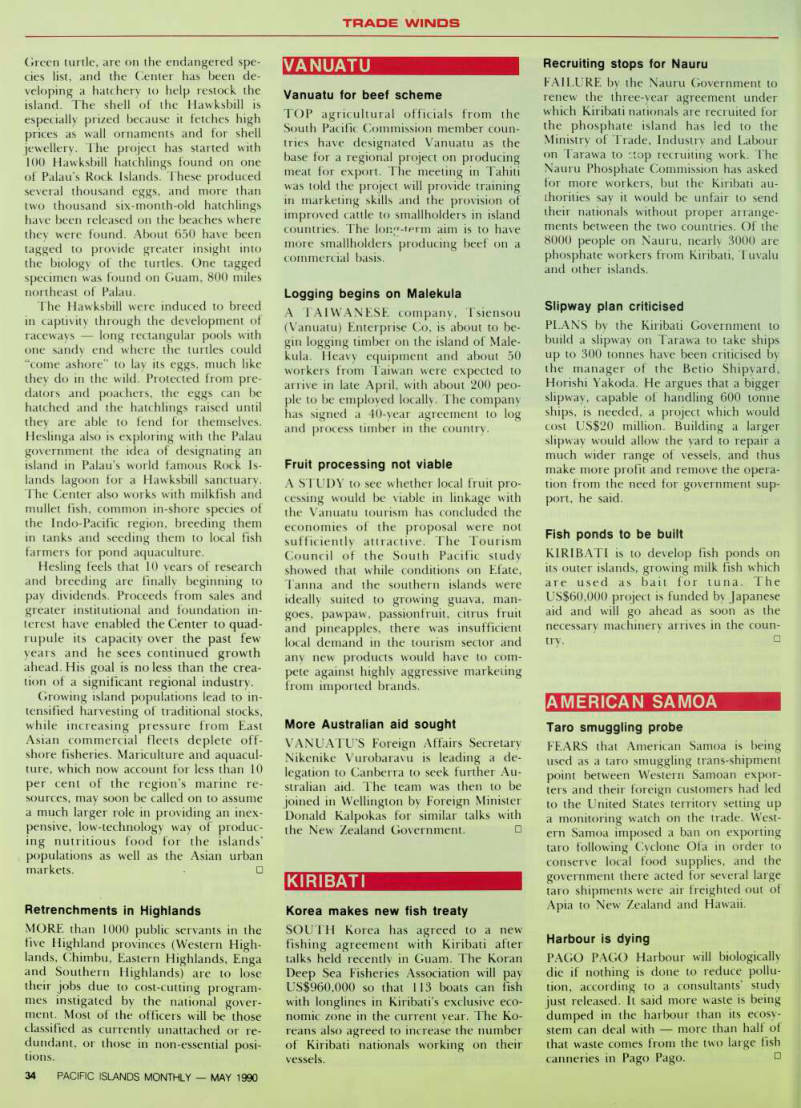
The marvellous mollusks feed off the algae that cling to their tissue. Through photosynthesis the algae transform sun light into sugar which provides the ma jor nutrient for the clam. Heslinga calcu lates the Center has bred over a million clam seeds and more than 50 tons of biomass. Seedlings, spawned from brood clams in Center tanks, are kept in saltwa ter tanks for the first two to three years, then are transferred to plastic trays, co vered by metal cages, laid out in pro tected ponds, where Center staff in scu ba gear tend and regularly check on the clams during the gestation period.
Clam sold as seeds can range from six
months old (about the size of a finger tip), to mature seed about the size of a soccer ball. These can be used by other nations to rebuild the species by produc ing brood clams, which in turn produce more seed.
An elaborate process prepares the seeds for air shipment. First they are hand scrubbed and washed in chlorin ated fresh water before they are placed in a quarantine. For at least a month, the seedlings are held in a bath of one mic ron of seawater that has been filtered and sterilized with ultraviolet light. The quarantine procedures were recom mended by the South Pacific Commis sion and are based on specifications de veloped by Australia’s James Cook Uni
versity.
More than 15 nations in the Pacific have imported the Center’s clam seed and planted them on their reefs. Among those are Australia, Japan, the Philip pines, Western Samoa, American Samoa, Cook Islands, Tuvalu, Guam, the Feder ated States of Micronesia, the Common wealth of the Northern Mariana Islands
and Hawaii.
“Ocean-based cultivation of giant clams is proving to be technically and socially feasible in some very remote Pacific island settings where other kinds of marine and land farming are imprac tical,” said Heslinga. “Yap State (in the FSM) has implemented a clam produc tion that enables more than 40 villages to
begin subtidal giant clam gardens using
seed from Palau,” said Heslinga, who estimated there are at least 100 clam gar densdiatcheries now in place in these is lands.
To disseminate the clam growing tech niques, the Center has developed a 30day short course, entitled Introduction to Giant Clam Mariculture.
“The course is offered on a con tinuous basis throughout the year and features hands-on experience with all aspects of clam culture, from spawning and larval rearing to ocean culture and broodstock management,” said the Har vard and University of Hawaii-educated Heslinga. The Center has trained per sonnel for more than a dozen Pacific islands who are using Palau’s seeds.
A new and unsuspected market has also developed for commercial and pri vate aquariums. “The potential size of this market is not known, but the cur rent demand exceeds the Center’s avail able supply,” said Heslinga, who has
already filled aquarium orders through
Hawaii to the United States mainland,
England and West Germany. “Opportu
nities exist for other hatcheries in the
region to begin supplying aquarium
markets.”
The most productive of the 10 worl dwide facilities providing clam seeds, the Center earned US$5O,OOO in clam sales in 1989. The seedlings are sold for $1 a piece and usually air freighted in 1000 seed quantities. 150 air shipments to 17 nations and states have already been made.
Like the all purpose coconut palm, ev ery part of the clam appears to have local marketable value. The shells, for example, whose curved lips have been used throughout the Pacific for ages in a traditional adze heads, today are used for shell jewellery, dishes, planters, soap holders or just as island decorative pieces.
Other Center projects include a trochus hatchery, which is in the early stages of development, producing mil lions of larvae for dissemination in Palau and eventually to other Pacific locations.
Like the clam, trochus has been a tradi tional marine harvest with the meat serv ing as a protein source and the shell sold to Japanese and Taiwanese button and jewellery makers. But the trochus also has suffered from overharvesting
throughout the region.
The Hawksbill turtle, along with the
Giants can weigh up to 500 pounds.
A worker measures clams underwater.
Green turtle, are on the endangered spe cies list, and the Center has been de veloping a hatchery to help restock the island. The shell of the Hawksbill is especially prized because it fetches high prices as wall ornaments and for shell jewellery. The project has started with 100 Hawksbill hatchlings found on one of Palau’s Rock Islands. These produced several thousand eggs, and more than two thousand six-month-old hatchlings have been released on the beaches where they were found. About 650 have been
tagged to provide greater insight into
the biology of the turtles. One tagged specimen was found on Guam, 800 miles northeast of Palau.
The Hawksbill were induced to breed
in captivity through the development of
raceways long rectangular pools with
one sandy end where the turtles could “come ashore” to lay its eggs, much like they do in the wild. Protected from pre dators and poachers, the eggs can be hatched and the hatchlings raised until they are able to fend for themselves.
Heslinga also is exploring with the Palau government the idea of designating an island in Palau’s world famous Rock Is lands lagoon for a Hawksbill sanctuary.
The Center also works with milkfish and mullet fish, common in-shore species of the Indo-Pacific region, breeding them in tanks and seeding them to local fish
farmers for pond aquaculture.
Hesling feels that 10 years of research
and breeding are finally beginning to
pay dividends. Proceeds from sales and greater institutional and foundation in terest have enabled the Center to quad ruple its capacity over the past few years and he sees continued growth ahead. His goal is no less than the crea
tion of a significant regional industry.
Growing island populations lead to in tensified harvesting of traditional stocks, while increasing pressure from East Asian commercial fleets deplete off shore fisheries. Mariculture and aquacul ture, which now account for less than 10 per cent of the region’s marine re sources, may soon be called on to assume a much larger role in providing an inex
pensive, low-technology way of produc
ing nutritious food for the islands’ populations as well as the Asian urban markets. □ Retrenchments in Highlands MORE than 1000 public servants in the five Highland provinces (Western High lands, Chimbu, Eastern Highlands, Enga and Southern Highlands) are to lose their jobs due to cost-cutting program mes instigated by the national gover ment. Most of the officers will be those classified as currently unattached or re dundant, or those in non-essential posi tions.