Tuna industry loses battle
pp. 28-29 · Read in the full issue
THE United States tuna industry, which appears so rich and strong from the islands’ point of view, has lost a major battle in the US Congress.
It may have been partially selfinflicted, and it certainly was complicated, but the result was clearly not desired by the owners of the tunaboats and of the two big tuna factories in American Samoa.
The tuna industry found itself outgunned despite an interesting set of allies: President Bush, the US State Department, some California Congressmen, American Samoa’s Democratic Congressman Eni F.H. Faleomavaega, and its legislature, the Fono. On the other side, which is winning so far, are the Governors of the four US flag jurisdictions in the Pacific (American Samoa, Guam, Hawaii and the Marianas), the big sea sports fishermen and, importantly, most of the members of the House of Representatives Merchant Marine and Fisher-
ies Committee (including Congress-
woman Pat Saiki, Republican of Hawaii).
The issue is whether the US should manage (i.e. regulate) the harvest of tuna within 200 miles of its coasts, in the Exclusive Economic Zone (EEZ). The tuna industry does not want this regulation; but a larger group pushed for it,
winning a 396-21 roll call vote on the floor of the House of Representatives, The tuna industry usually gets its own way in Washington.
When the US Department of Labors tried to extend Mainland-level minimum wages to workers in the Pago Pago tuna plants, the tuna industry defeated the Department; when the State Department negotiated the multi-year and multi million dollar treaty with the Pacific Is lands over tuna fishing rights Uncle Sam paid 80 per cent of the bill. (That treaty, incidentally, seems to be perking along happily, now about half-way through its five-year life). So why did the industry lose this battle in the Conrgess?
Part of the answer lies in the convo luted argument that the industry tried to make, and part in the complex environ ment in which the 200-mile limit issue
was fought.
The industry contends that if the US were to regulate the harvest of tuna within the 200-mile limit it would make it harder for the State Department (and the industry) to bargain with other coun tries for the US tuna fleet to fish in their waters. While the US and the Pacific is lands have worked out such a treaty, there is no such treaty in place with the nations of Central and South America,
and the Eastern Pacific is a rich hunting ground for the San Diego and Pago
Pago-based vessels.
The industry argues that the only way, effectively, to manage and conserve tuna is to do so on an international basis, and that the US ability to do this would be hurt by the US regulating within its own 200-mile zone. Regardless of its merits, this is an indirect line of reasoning and is hard for some to follow.
Further, the overseas precedents are not attractive. Japan, Korea and Taiwan do not regulate tuna within their waters to give those nations a stronger position when their ships fish in someone else’s waters; no members of Congress men tioned these precedents on the floor of the House.
Congressman Faleomavaega, in a letter to the editor of the Samoa News, linked this argument to American Samoa’s im mediate interests: “The United States is currently negotiating with Mexico for the rights to fish for tuna in the waters over which Mexico has economic control.
Additionally, Ecuador, El Salvador, Mex ico, Nicaragua, and Peru have suggested the formation of a multilateral regime to manage tuna in the waters over which those countries have economic control.
Should these negotiations result in other multilateral agreements, the catch from this region would go to the canneries in Samoa and Puerto Rico . .
The other side of the issue says that they are also for conservation, which is popular in the States, and argues that there is the position of consistency. The US already manages all other fish in its EEZ (and, at the state level, all fresh water fish). Why not, asked the suppor ters, extend the rule to tuna as well?
Further, as Congresswoman Saiki
argued, the legislation would not impair
the tuna industry’s prowess because “the U.S. has implicitly acknowledged this management right [within the EEZs] by signing the South Pacific Tuna Treaty.”
The second reason for the industry’s difficulties was the legislative environ ment. The question of controlling tuna within the American EEZ was one speci fic issue within a much broader context of the regulation and conservation of big-sea fish. These issues were forced on
Congress by the impending automatic
termination of the Magnuson Act, the omnibus legislation which currently sup ports commercial fishing in the US and regulates the harvest of most sports and commercial fish in the ocean.
Many commercial and sports fisher men want the Magnuson Act to be re enacted, to protect specific research, pro tection and subsidy programme that they are now enjoying. Further, the current version of the bill includes both a ban on the use of driftnets within the American EEZ as well as a recommendation to the
Secretary of State to push for a worl dwide ban on the “walls of death”. In short, the entire bill presented an attrac tive package for the Congress.
Such issues in the Congress are usually worked out by members of the House who have become experts in the field; in this case it was done by the members of the Fisheries and Wildlife Conservation and the Environment Subcommittee of the House Committee on Merchant Marine and Fisheries. Typically the rest of the membership of the House accepts what their colleagues have laboured over in committee, expecting that the favour will be returned when their committee’s work reaches the floor.
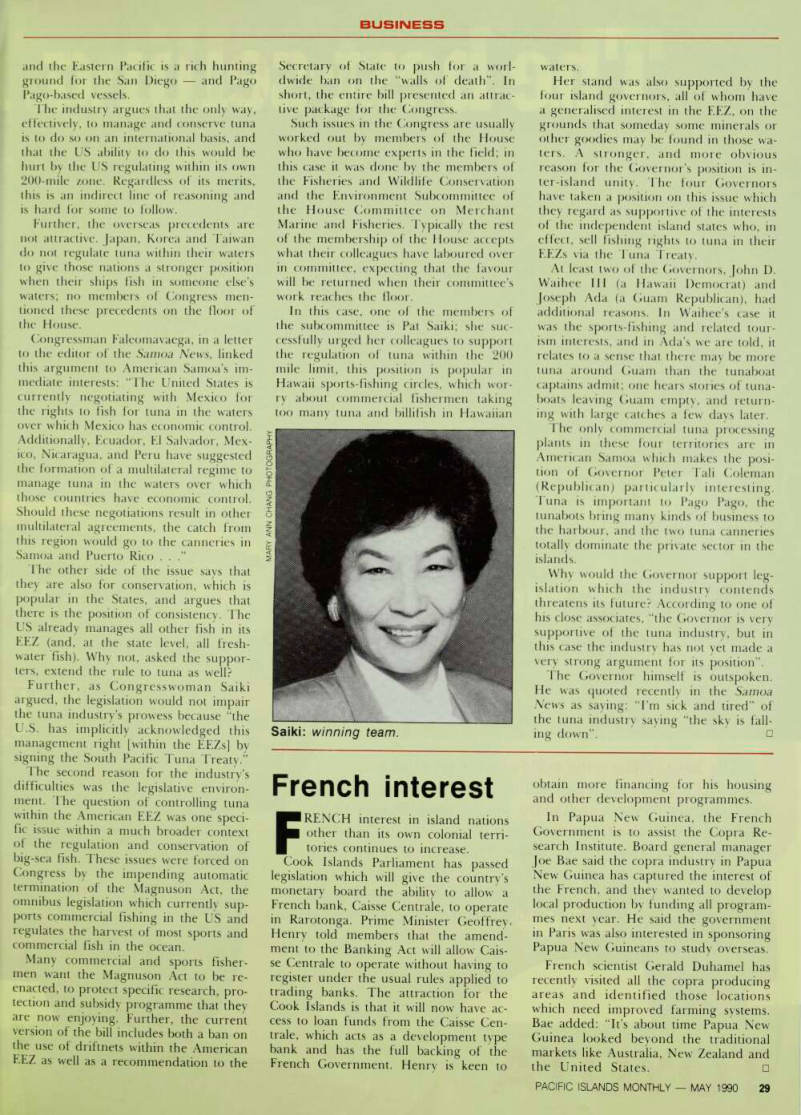
In this case, one of the members of the subcommittee is Pat Saiki; she suc
cessfully urged her colleagues to support
the regulation of tuna within the 200 mile limit, this position is popular in Hawaii sports-fishing circles, which wor ry about commercial fishermen taking 100 many tuna and billifish in Hawaiian
waters.
Her stand was also supported by the four island governors, all of whom have a generalised interest in the EEZ, on the grounds that someday some minerals or other goodies may be found in those wa ters. A stronger, and more obvious reason for the Governor’s position is in ter-island unity. The four Governors have taken a position on this issue which they regard as supportive of the interests of the independent island states who, in effect, sell fishing rights to tuna in their EEZs via the Tuna Treaty.
At least two of the Governors, John D.
Waihee 111 (a Hawaii Democrat) and Joseph Ada (a Guam Republican), had additional reasons. In Waihee’s case it was the sports-fishing and related tour ism interests, and in Ada’s we are told, it relates to a sense that there may be more tuna around Guam than the tunaboat captains admit; one hears stories of tuna boats leaving Guam empty, and return ing with large catches a few days later.
The only commercial tuna processing plants in these four territories are in American Samoa which makes the posi tion of Governor Peter Tali Coleman
(Republican) particularly interesting.
Tuna is important to Pago Pago, the lunabots bring many kinds of business to the harbour, and the two tuna canneries totally dominate the private sector in the islands.
Why would the Governor support leg islation which the industry contends threatens its future? According to one of his close associates, “the Governor is very supportive of the tuna industry, but in this case the industry has not yet made a very strong argument for its position”.
The Governor himself is outspoken.
He was quoted recently in the Samoa News as saying: “I’m sick and tired” of the tuna industry saying “the sky is fall ing down”. □
Saiki: winning team.