Buchanan accepts a truce
pp. 18-19 · Read in the full issue
By Robin Bromby
JUST at a time when the last thing it needed was another business crisis, the Papua New Guinea Govern ment was confronted by threats from the country’s most colourful expatriate en
trepreneur. Citing departmental refusal
to allow his companies to employ urgent ly needed foreign workers and what he saw as official “anti-foreigner” feelings, Dennis Buchanan closed down his daily newspaper, The Niugini News, and threatened to ground Talair, the nation’s main third-level airline.
It was not the first time Buchanan had threatened to leave the country after doing business there for 40 years, but the Government was quick to try and mend fences. They must have been aware that, although Buchanan is well known for his occasional outbursts, he had faced similar problems in Vanuatu last year; there, after being refused work permits for expatriate staff, Buchanan sold his Air Melanesie and pulled out all his investments in Vanuatu.
The end result of the Papua New Guinea imbroglio is likely to be that Talair will continue operating but that the Niugini News could remain closed the staff has been paid off and any new buyer is likely to be deterred by both the paper’s chronic financial losses and re vived ministerial talk of new Press con trols in Papua New Guinea (Communica tions Minister Brown Sinamoi having said he will introduce legislation to con trol all the media and would ban jour nalists from Parliament).
The latest row began when Buchanan
suddenly announced that he was closing both Talair and the paper, both of which are owned by his family company, over night.
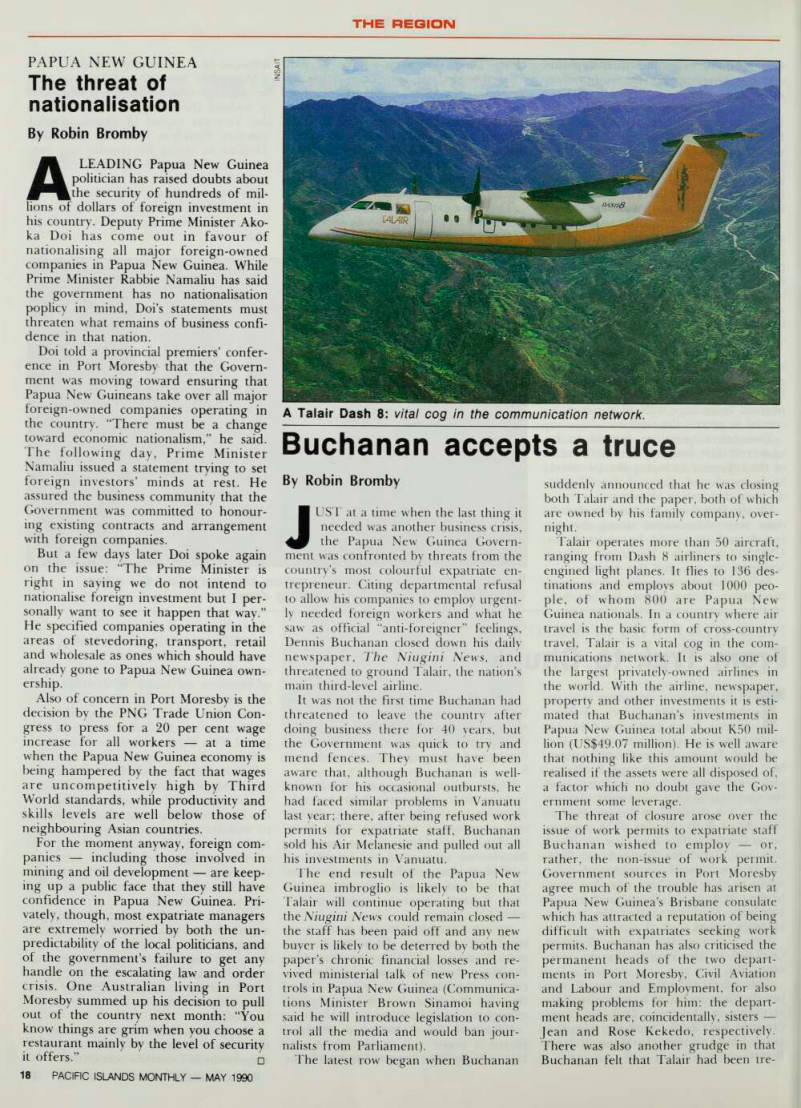
Talair operates more than 50 aircraft, ranging from Dash 8 airliners to single engined light planes. It flies to 136 des tinations and employs about 1000 peo ple, of whom 800 are Papua New Guinea nationals. In a country where air travel is the basic form of cross-country travel, Talair is a vital cog in the com munications network. It is also one of the largest privately-owned airlines in the world. With the airline, newspaper, property and other investments it is esti mated that Buchanan’s investments in Papua New Guinea total about K5O mil lion (U 5549.07 million). He is well aware that nothing like this amount would be realised if the assets were all disposed of, a factor which no doubt gave the Gov ernment some leverage.
The threat of closure arose over the issue of work permits to expatriate staff Buchanan wished to employ or, rather, the non-issue of work permit.
Government sources in Port Moresby agree much of the trouble has arisen at Papua New Guinea’s Brisbane consulate which has attracted a reputation of being difficult with expatriates seeking work permits. Buchanan has also criticised the permanent heads of the two depart ments in Port Moresby, Civil Aviation and Labour and Employment, for also
making problems for him: the depart
ment heads are, coincidentally, sisters Jean and Rose Kekedo, respectively.
There was also another grudge in that Buchanan felt that Talair had been tre
A Talair Dash 8: vital cog in the communication network.
aled unfairly in being excluded from operating charters for mining and pet
roleum companies.
Buchanan’s charge is that a streak of anti-expatriate dislike runs through the Public Service. His other complaint is that the breakdown of law and order in the country is making it extremely un pleasant for anyone trying to run a busi ness and, as if to prove his point the day after he threatened to close all his businesses the Lae office of Talair was hit by armed robbers who made off with the K5OOO (US$49O7) payroll. He also claimed that it was impossible to find foreign engineers willing to work in Papua New Guinea because most poten tial employees were worried about their personal security if they worked in the country.
Buchanan is not on his own in com plaining about either issue: the rapidly deteriorating law and order situation is a matter of intense concern to the expatri ate business community in Port Moresby.
And there would be many companies operating in Papua New Guinea which have, at one time or another, run into
problems obtaining work permits for
foreign staff members.
The particular incident which set Buchanan off this time was the problem of Talair’s chief pilot, Bryan McCook, had in obtaining a new work permit at the Papua New Guinea consulate in Bris bane. McCook has lived in Papua New Guinea since 1956 and had left the
country just before Christmas on leave.
Buchanan then went to Prime Minister Rabbie Namaliu and made it clear that he had lost his patience and made the threat of complete closure. McCook had his documentation within 18 hours.
Buchanan had also been seeking a per mit to employ an expatriate to run the English-language Niugini News, but the government apparently stuck by its belief that a local person could do that job.
Both the government and Buchanan were hit by a barrage of criticism.
The Public Employees Association (PEA) likened Buchanan to Bougainville rebel leader Francis Ona in making threats to the national government.
“We’ve had enough threats,” said PEA general secretary Jack Kutal. “No re sponsible government should accept threats by any foreigner or any agents dealing with foreign interests.” He added that any foreigner who did not want to accept the country’s laws should pack up and leave. The Opposition lashed the government for seeming to give into Buchanan’s demands, with MP Albert Kipalan saying the government should freeze all of Buchanan’s assets, and this was followed by threats from the Tax Office to investigate Talair’s financial affairs.
Meanwhile, Civil Aviation Minister Bernard Vogae revealed that he had in dicated to Buchanan that the business man should leave the country if he felt strongly aggrieved, but he denied there
was any anti-foreigner feeling in his de partment.
Then the government struck back by seeking a court order to restrain Bucha nan from closing the airline on the ground that would cause undue incon venience to the travelling public. An order to seek continuation of the A iugini News was received too late the staff had already been paid off.
It later emerged that Buchanan had gone so far as to inform the Internation al Air Transport Association that Talair would merge with his Queensland opera tion, Flight West, and much of the air line’s fleet was assembled at Port Mores by’s Jackson Airport. The airline’s offices turned customers away when people tried to book on Talair flights. But the airline did eventually operate limited ser vices while the battle of wills continued.
Further court action was instituted by the Government to prevent Buchanan from liquidating his assets until customs and taxation clearances had been obtained this was aimed mainly at forestalling Buchanan from living his aircraft to Australia.
As Press time approached for Pacific Islands Monthly . a temporary agreement between the two parlies had been reached under which Talair resumed all its services, with Buchanan undertaking to operate the airline for six months while the Government considered his de mands. On its part, the Namaliu admi nistration discontinued its action before the National Court.