Christian Durocher
p. 18 · Read in the full issue
Standing up to a nuclear power
By Al Prince (Editor, Tahiti Sun Press)
MONDAY March 5 was a tradi tional day of celebrations and marches in scattered parts of French Polynesia. For thousands of peo ple there were church services in Protes tant parishes throughout Polynesia to celebrate the arrival of the first Christian missionaries 193 years ago. But for a smaller crowd, March 5 was also the day to protest the French nuclear testing programme in French Polynesia.
Unlike in previous years, last month’s protest programme was the longest, from March 5-13, organised as part of an international campaign against nuc lear testing anywhere. Although unre lated to the celebration of the arrival of missionaries, the anti-nuclear protest was still church-inspired. The impetus for this annual event was a 1978 meeting in Micronesia organised by the Pacific Con ference of Churches. A resolution of
that meeting urged regular anti-nuclear
protests throughout the region.
In French Polynesia, that early effort has been organised by Oscar Temaru, the Mayor of the commune of Faaa and the leader of the Polynesian Liberation Front, a political party pushing for the independence of French Polynesia from France. But this year’s protest was also aimed against French Polynesia’s integra tion into the European Economic Com munity at the end of 1992 when the European Community’s 12 members are scheduled to drop barriers and allow the free movement between countries of goods, money and people.
Europe 1993 is a subject that has un ited just about all of French Polynesia’s politicians regardless of political lean ings. The politicians are worried that the removal of the European barriers will result in French Polynesia being flooded
by Europeans seeking work, an opening
up businesses in competition with the locals.
French Polynesia’s Territorial President, Alexandre Leontieff, has however made some assurances, saying the territory will be involved in talks regarding
the European single market.
Last month’s anti-nuclear protest took two forms. First a small group of women staged a demonstration in front of the Territorial Assembly building in downtown Papeete where the 41-member legislative body meets. The Polynesian Liberation Front held a similar demonstration on the Leeward islands of Huahine and Tahaa.
The other part of the demonstration on Tahiti was more traditional. It consisted of separate groups of marchers setting out in opposite directions for a protest march around half the island of Tahiti. The marchers met for a rally at Faaa. This was planned to coincide with
a worldwide youth demonstration against nuclear testing. Three members of Temaru’s Polynesian Liberation Front (known in French Polynesia as Tavini Huiraatira) Party went to Paris to attend a demonstration there.
France’s Pacific nuclear testing prog ramme began with atmospheric explo sions over Mururoa in French Polynesia in 1966. Regional and international pressure forced them in 1975 to do tests underground. Since then France has done 119 tests up to the end of last year.
There were 114 tests at Mururoa and five at Fangataufa.
French Prime Minister announced last August that his country will reduce, be ginning this year, from eight to six the number of tests in French Polynesia.
This was still not welcomed with New Zealand Prime Minister Geoffrey Palmer saying: “Six tests are as an unaccaptable as eight in the region. □
Christian Durocher
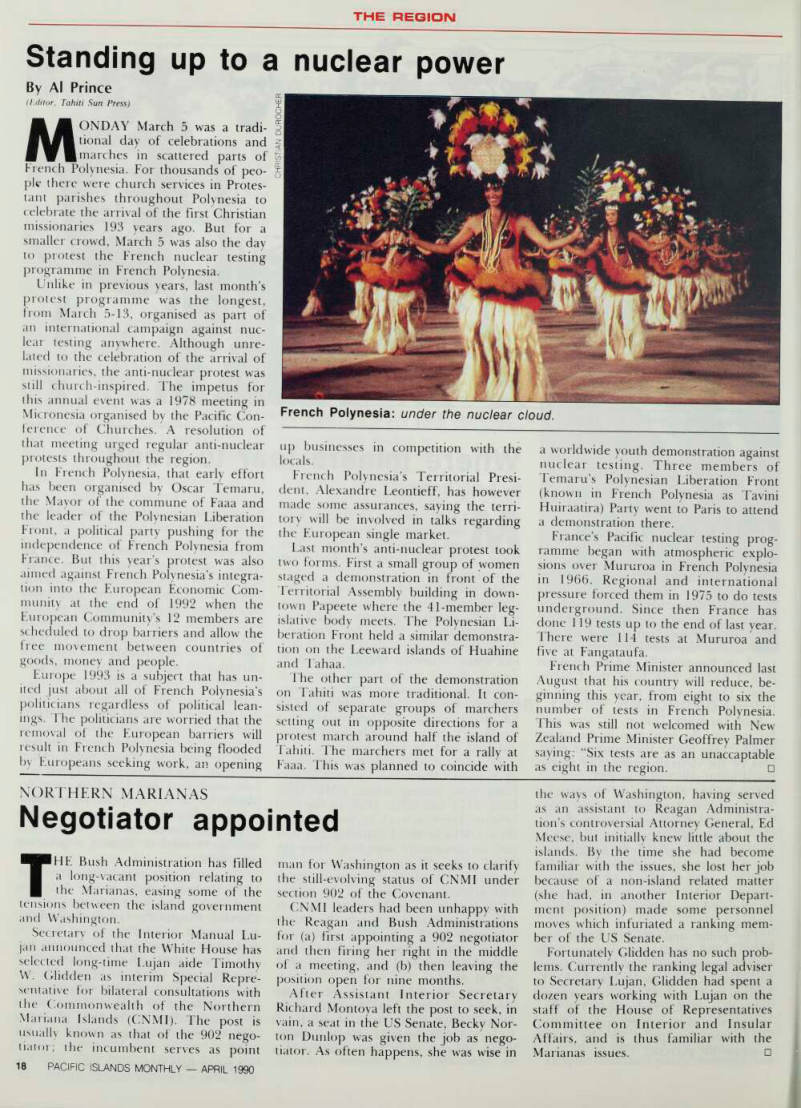
French Polynesia: under the nuclear cloud.