Campus
pp. 12-15 · Read in the full issue
Cover Stories
Education
Crisis on Campus
University of the South Pacific faces new problems in 1990 s
By Jope Balawanilotu
WHEN the University of the South Pacific turned 21 last year there were no candles, no parties, no celebrations. Yet it rightly de served a major bash, in typical island fashion. The university was freely touted as the Pacific’s most successful example of regional co-operation. Just two years earlier, it had survived its biggest test a genuine but little-known threat of com
plete closure during and immediately af ter Fiji’s coups in May and September 1987. The resumption of lectures after an enforced early mid-year break that year marked the USP’s coming of age.
But emergence into adolescence has brought its own turbulence. The uni versity faces the 1990 s in the grip of a crisis of identity and finance. Educa tionally, the USP’s 11 member nations must decide whether to prune the in stitution’s role back to its charter origins of providing a “pure” university educa
tion, or whether to continue with the present mishmash of post-secondary, technical and university teaching. Philo sophically, the USP has to decide whether it’s an international institution which just happens to be in the Pacific or whether to consciously assert, in staf fing and course content, its regional
identity.
Culturally, the university is struggling
to reconcile traditional Pacific respect for lines of authority and the need to en courage young, challenging intellects.
But it’s money which poses the most immediate threat to the USP’s growth.
Vice chancellor Geoffrey Caston is this month asking the USP grants committee to sanction a 50 per cent hike in the operating budget for the next triennium.
Funding from the USP’s member nations peaked in 1983 when Caston took over to find the budget overspent by half a million dollars. Since then the annual budget has remained the same in real terms, and Caston says seven years on, he’s got no additional staff but half as many students again.
The regional governments’ current annual contribution of F 513.4 million won’t, Caston says, pay for much-needed new dining facilities, more lab equip ment, more library books and salaries which will attract, and keep, adequately qualified staff. The requested hike would boost the annual budget to just over Fs23 million. But Caston points out this will merely return funding to its 1984 level.
The university cannot afford its pre
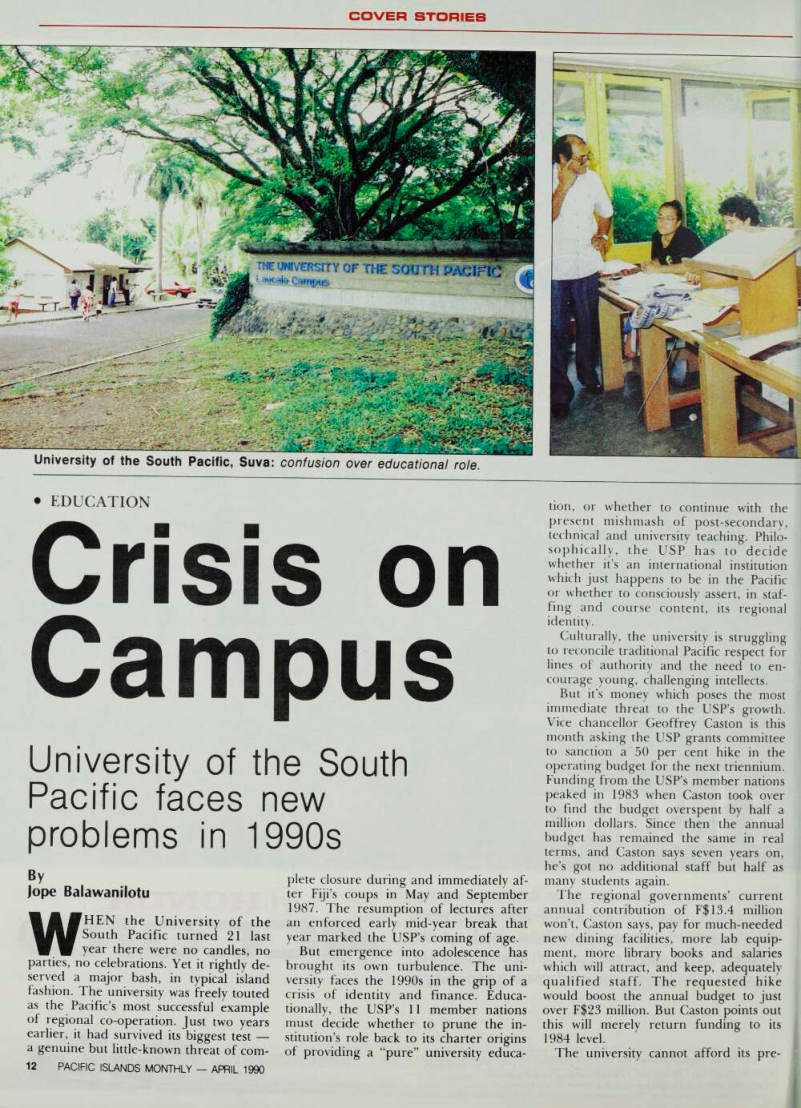
University of the South Pacific, Suva: confusion over educational role.
sent student numbers and Gaston warns that if the budget doesn’t go up, student rolls will have to be cut. He wants a change in the method of handling fees: 90 per cent of students are government sponsored and pay no fees while the fees from the remaining private students go back to their home governments, mainly Fiji.
Gaston says this inflexibility prevents the USP from becoming more self
financing, as required by its Council.
“We have to impose quotas on the num ber of students sponsored by govern ments,” he says. “We also have to reduce the number of extension students throughout the region, which has been
going up and up.”
But the Vice-Chancellor appreciates the Council’s 11 member nations will find it hard to put more money into the USP, with their economies not growing, with the exception of Fiji.
These domestic financial constraints will undoubtedly set the parameters for debate at the May Council meeting when members grapple with the USP’s future
identity.
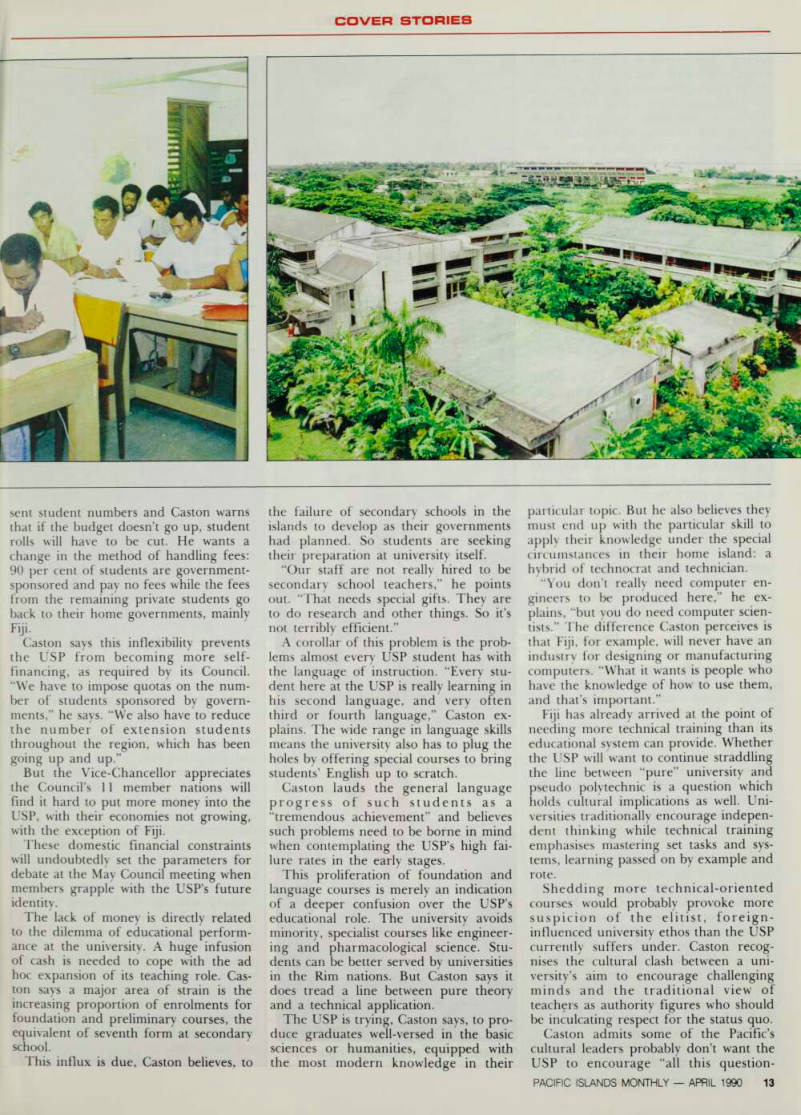
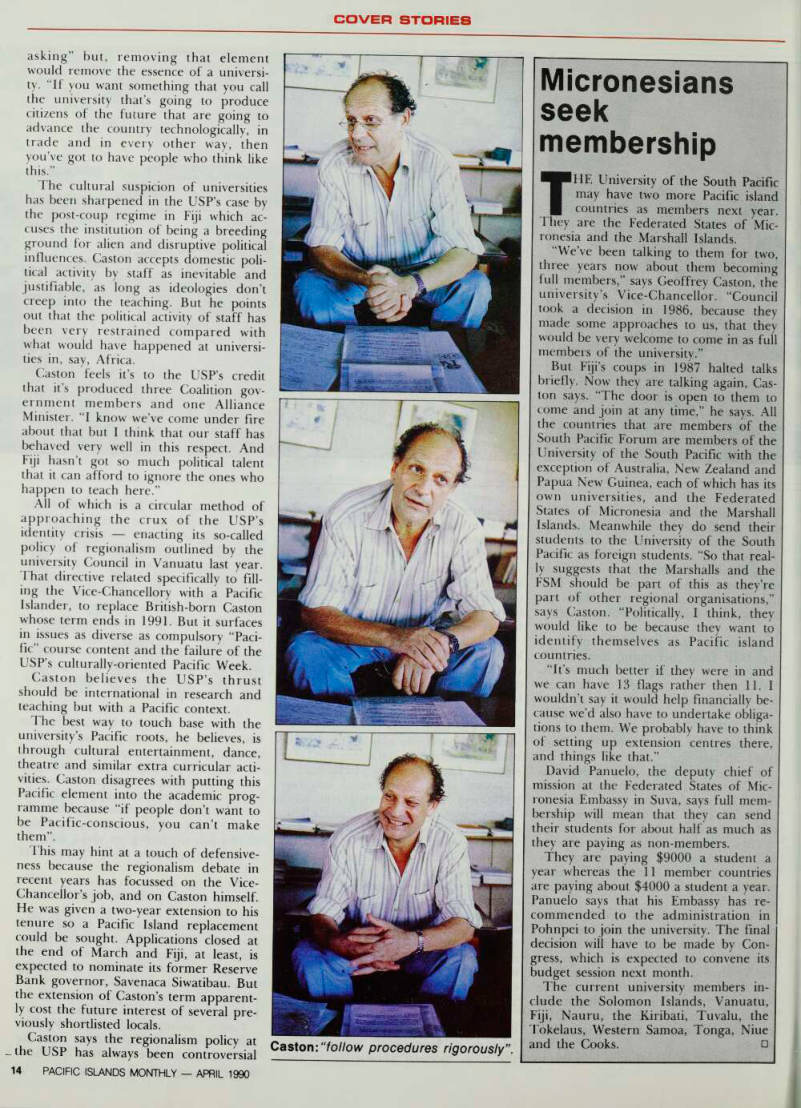
The lack of money is directly related to the dilemma of educational perform ance at the university. A huge infusion of cash is needed to cope with the ad hoc expansion of its teaching role. Gas ton says a major area of strain is the increasing proportion of enrolments for foundation and preliminary courses, the equivalent of seventh form at secondary school.
This influx is due, Gaston believes, to
the failure of secondary schools in the islands to develop as their governments had planned. So students are seeking their preparation at university itself.
“Our staff are not really hired to be secondary school teachers,” he points out. “That needs special gifts. They are to do research and other things. So it’s not terribly efficient.”
A corollar of this problem is the problems almost every USP student has with the language of instruction. “Every student here at the USP is really learning in his second language, and very often third or fourth language,” Gaston explains. The wide range in language skills means the university also has to plug the holes by offering special courses to bring students’ English up to scratch.
Gaston lauds the general language progress of such students as a “tremendous achievement” and believes such problems need to be borne in mind when contemplating the USP’s high failure rates in the early stages.
This proliferation of foundation and language courses is merely an indication of a deeper confusion over the USP’s educational role. The university avoids
minority, specialist courses like engineer-
ing and pharmacological science. Students can be better served by universities in the Rim nations. But Gaston says it does tread a line between pure theory and a technical application.
The USP is trying, Gaston says, to produce graduates well-versed in the basic sciences or humanities, equipped with the most modern knowledge in their
particular topic. But he also believes they must end up with the particular skill to apply their knowledge under the special circumstances in their home island: a hybrid of technocrat and technician.
“You don’t really need computer en gineers to be produced here,” he ex plains, “but you do need computer scien tists.” The difference Gaston perceives is that Fiji, for example, will never have an industry for designing or manufacturing computers. “What it wants is people who have the knowledge of how to use them, and that’s important.”
Fiji has already arrived at the point of needing more technical training than its educational system can provide. Whether the USP will want to continue straddling the line between “pure” university and
pseudo polytechnic is a question which
holds cultural implications as well. Uni
versities traditionally encourage indepen
dent thinking while technical training emphasises mastering set tasks and sys tems, learning passed on by example and rote.
Shedding more technical-oriented courses would probably provoke more suspicion of the elitist, foreign influenced university ethos than the USP currently suffers under. Gaston recog nises the cultural clash between a uni versity’s aim to encourage challenging minds and the traditional view of teachers as authority figures who should be inculcating respect for the status quo.
Gaston admits some of the Pacific’s cultural leaders probably don’t want the USP to encourage “all this question
asking” but, removing that element would remove the essence of a universi ty. “If you want something that you call the university that’s going to produce citizens of the future that are going to advance the country technologically, in trade and in every other way, then you’ve got to have people who think like this.”
The cultural suspicion of universities has been sharpened in the USP’s case by the post-coup regime in Fiji which ac cuses the institution of being a breeding ground for alien and disruptive political influences. Gaston accepts domestic poli tical activity by staff as inevitable and
justifiable, as long as ideologies don’t
creep into the teaching. But he points out that the political activity of staff has been very restrained compared with what would have happened at universi ties in, say, Africa.
Gaston feels it’s to the USP’s credit that it’s produced three Coalition gov ernment members and one Alliance Minister. “I know we’ve come under fire about that but I think that our staff has behaved very well in this respect. And Fiji hasn’t got so much political talent that it can afford to ignore the ones who happen to teach here.”
All of which is a circular method of approaching the crux of the USP’s identity crisis enacting its so-called policy of regionalism outlined by the university Council in Vanuatu last year.
That directive related specifically to fill ing the Vice-Chancellory with a Pacific Islander, to replace British-born Gaston whose term ends in 1991. But it surfaces in issues as diverse as compulsory “Paci fic” course content and the failure of the USP’s culturally-oriented Pacific Week.
Gaston believes the USP’s thrust should be international in research and teaching but with a Pacific context.
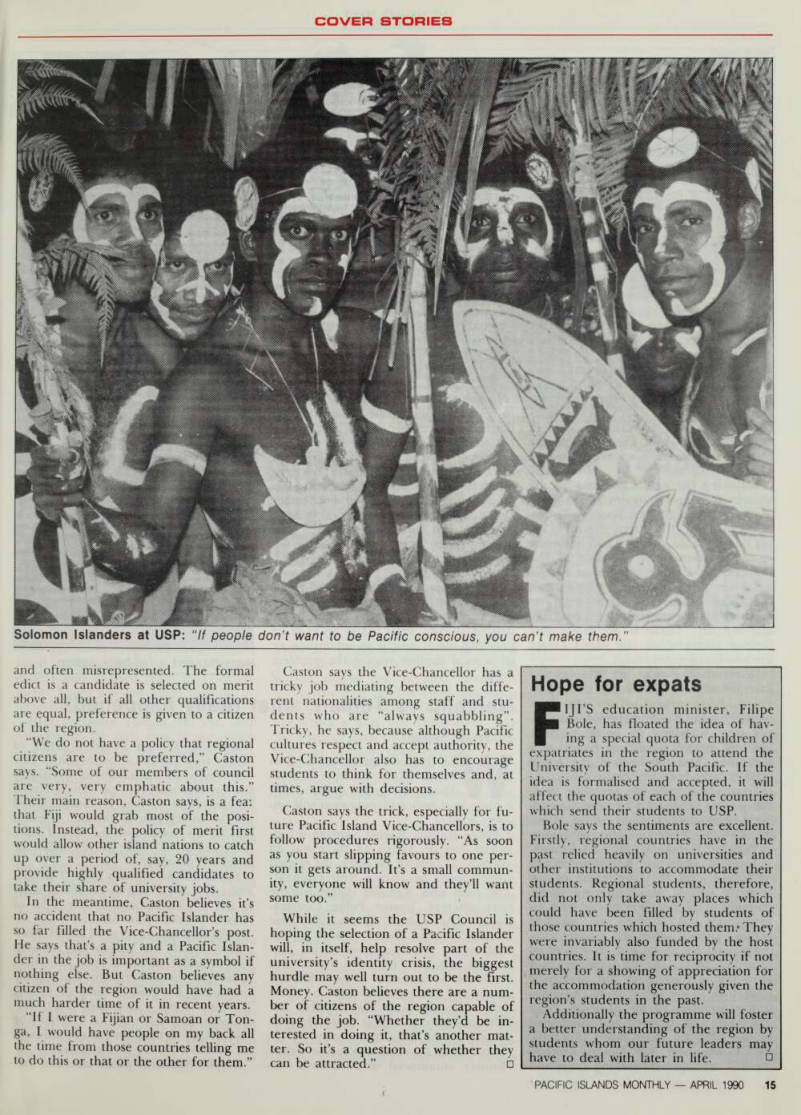
The best way to touch base with the university’s Pacific roots, he believes, is through cultural entertainment, dance, theatre and similar extra curricular acti vities. Gaston disagrees with putting this Pacific element into the academic prog ramme because “if people don’t want to be Pacific-conscious, you can’t make them”.
This may hint at a touch of defensive ness because the regionalism debate in recent years has focussed on the Vice- Chancellor’s job, and on Gaston himself.
He was given a two-year extension to his tenure so a Pacific Island replacement could be sought. Applications closed at the end of March and Fiji, at least, is expected to nominate its former Reserve Bank governor, Savenaca Siwatibau. But the extension of Gaston’s term apparent ly cost the future interest of several pre viously shortlisted locals.
Gaston says the regionalism policy at the USP has always been controversial
Caston -.“follow procedures rigorously”.
and often misrepresented. The formal edict is a candidate is selected on merit above all, but if all other qualifications are equal, preference is given to a citizen of the region.
“We do not have a policy that regional citizens are to be preferred,” Gaston says. “Some of our members of council are very, very emphatic about this.”
Their main reason, Gaston says, is a fea: that Fiji would grab most of the positions. Instead, the policy of merit first would allow other island nations to catch up over a period of, say, 20 years and provide highly qualified candidates to take their share of university jobs.
In the meantime, Caston believes it’s no accident that no Pacific Islander has so far filled the Vice-Chancellor’s post, He says that’s a pity and a Pacific Islander in the job is important as a symbol if nothing else. But Caston believes any citizen of the region would have had a much harder time of it in recent years.
If I were a Fijian or Samoan or Tonga, I would have people on my back all the time from those countries telling me to do this or that or the other for them.”
Caston says the Vice-Chancellor has a tricky job mediating between the diffe rent nationalities among staff and stu dents who are “always squabbling”.
Tricky, he says, because although Pacific cultures respect and accept authority, the Vice-Chancellor also has to encourage students to think for themselves and, at times, argue with decisions.
Caston says the trick, especially for fu ture Pacific Island Vice-Chancellors, is to follow procedures rigorously. “As soon as you start slipping favours to one per son it gets around. It’s a small commun ity, everyone will know and they’ll want some too.”
While it seems the USP Council is hoping the selection of a Pacific Islander will, in itself, help resolve part of the
university’s identity crisis, the biggest
hurdle may well turn out to be the first.
Money. Caston believes there are a num ber of citizens of the region capable of doing the job. “Whether they’d be in terested in doing it, that’s another mat ter. So it’s a question of whether they can be attracted.” □
Solomon Islanders at USP: “If people don’t want to be Pacific conscious, you can’t make them.”