The waterfalls of Papua New Guinea
Stamp Box
FOR hundreds of years after New Guinea became known to them, Europeans left it alone. The huge island had no obvious riches and it had more mountains, swamps and jungle for its size than anywhere else in the world.
The advance guards of Western ‘civilisa tion’ were missionaries and traders, many of whom paid with their lives for their adventurousness.
By 1900 the Dutch had the western half of the island and the Germans and Australians the eastern part. After the First World War the Australians were mandated the east by the League of Na tions with a sacred trust to spread Euro pean civilisation.
The exact nature of the interior was unknown to such an extent that even as late as 1930 it was thought to be largely uninhabited. As far back as 1876 a French sailor called Tregance had pub lished a totally fraudulent account of a journey whereby he had encountered a powerful people called the ‘Orangwoks’ given to gold mining and horse riding.
The reality was very different however .
It was apparent from both north and south coasts that there was a huge mountain range running along the is land and it was assumed that it was ‘solid’. In fact there were two mountain ranges separated by a huge sparsely populated plateau which is in turn in
terspersed by deep river valleys.
Expeditions in the early 30s estab lished the existence of a huge population hidden in the highlands, away from the sultry mosquito-ridden coast. A stone
age people, separated into thousands of tiny enclaves with their own languages, came face to face with the all-powerful Westerners. Warriors confident at fight ing with spear and arrows were shocked beyond belief when they came to face to face with rifles. Many such tribes had had no idea that there were any other people in the world except themselves.
From the mountains, many rivers de scend to the coast. Fast flowing streams interspersed with waterfalls and rapids have grown to enormous shallow slug gish giants by the time they reach the coastal regions. There are five thousand
or so miles of coastline much of it lined with mangroves. Ship’s launches cannot usually penetrate more than a hundred miles upstream.
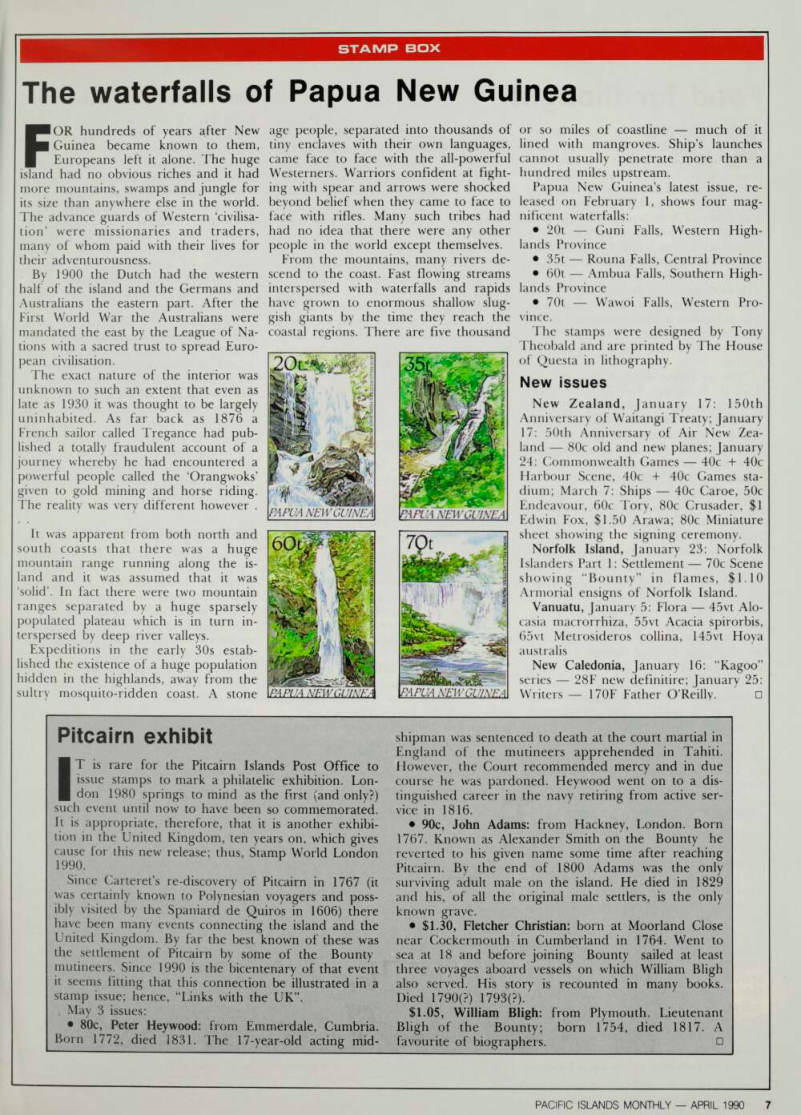
Papua New Guinea’s latest issue, re leased on February 1, shows four mag nificent waterfalls: • 20t Guni Falls, Western High lands Province • 35t Rouna Falls, Central Province • 60t Ambua Falls, Southern High lands Province • 70t Wawoi Falls, Western Pro vince.
The stamps were designed by Tony Theobald and are printed by The House of Questa in lithography.
New issues New Zealand, January 17: 150th Anniversary of Waitangi Treaty; January 17: 50th Anniversary of Air New Zea land —80 c and new planes; January 24: Commonwealth Games —40 c 40c Harbour Scene, 40c -I- 40c Games sta dium; March 7: Ships —40 c 50c Endeavour, 60c Tory, 80c Crusader, $1 Edwin Fox, $1.50 Arawa; 80c Miniature sheet showing the signing ceremony.
Norfolk Island, January 23: Norfolk Islanders Part 1; Settlement —70 c showing “Bounty” in flames, $l.lO Armorial ensigns of Norfolk Island.
Vanuatu, January 5: Flora 45vt Alo casia macrorrhiza, 55vt Acacia spirorbis, 65vt Metrosideros collina, 145vt Hoya australis New Caledonia, January 16: “Kagoo” series —28 F definitire; January 25: Writers —170 F O’Reilly. □