Pacific People
pp. 51-53 · Read in the full issue
Living in America
Lelei Lelaulu is the first Polynesian to work for the United Nations as an international civil servant. He was born at Apia, in 1944, and after primary school, went to New Zealand to further his education. Lelei edited the Auckland University newspaper, beginning a multifaceted media career that has taken this native son around much of the world. After stints at Radio New Zealand and Television New Zealand, Lelei travelled to Asia, Europe, the Middle East, and Africa as a foreign correspondent. Journalism led the South Seas islander to Manhattan in New York and eventually to the United Nations. As an international civil servant, Lelei does not work for the Samoan UN mission or for any other member state, but rather as a UN employee owing his allegiance to the Secretary General and Secretariat (the UN international civil service) of the world body. After years in New York, Lelei somehow manages to maintain his Samoan-ness and Aloha Spirit amidst the hustle bustle of big city life, which he views with a detached, ironic wit. He brings a peculiarly Pacific sensibility to the UN and provides a behind-the-scenes insider look at global diplomacy. Lelaulu spoke to Pacific Islands Monthly's Ed Rampell.
What’s your work at the United Nations ?
I started at a radio programme called UN Calling Asia. . . trying to focus more attention on the Pacific, rather than just Asia. From there, I worked for U.N. radio and TV in the news section. [ln 1988] I was promoted to this job, editor in-chief of the UN newspaper, called UN Secretariat News, and I’m also chief of
the housing and staff activities unit here in the UN . . . The UN Secretariat News is for the worldwide staff of the UN, about 55,000 employees, covering topical issues of interest to UN staffers, from the political through life style.
How do you see the phrase “Pacific Rim”? 1 find the term Pacific Rim rather dis
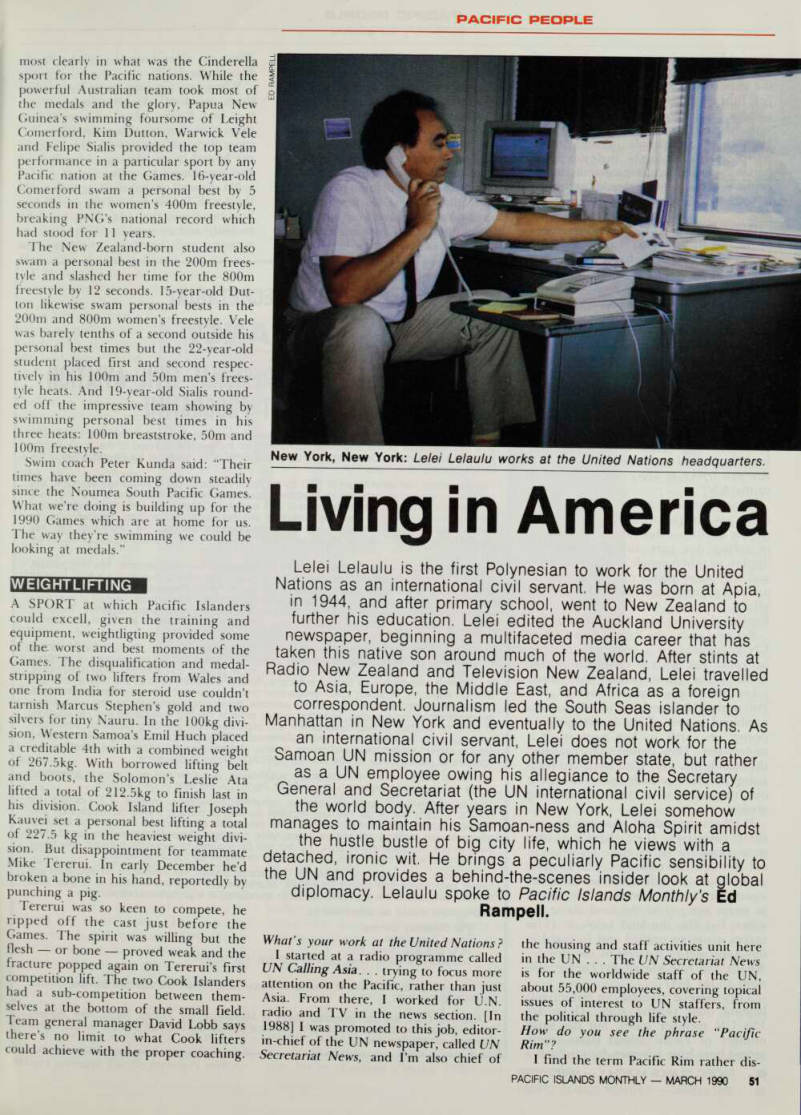
New York, New York: Lelei Lelaulu works at the United Nations headquarters.
Ed Rampell
tasteful because it conjures up images of a bowl, in the same sense that the Rim is the important part, and we in the Pacific get flushed after everyone is finished with us. So, I have tremendous problems with that, and I wanted to point out that.
Hey! there are people in the Pacific,
people with strongly independent,
nationalistic and to a large extent, demo cratic systems, which should either be left alone or developed along lines they’d like.
I’ve tried to push for better awareness of the fact that Oceania is an area, which albeit very small has a lot to teach the world in terms of getting on with their neighbours and dealing with their own communities, making sure they’re in harmony with the environment and those around them. We in the Pacific do have a tremendous amount to offer the rest of the world. And as we all know, it’s not the size of the country that gives the advice, it’s the quality of the advice.
What we have done in the Pacific over the centuries is something that the rest of the world can well learn from. It’s one of the driving forces behind my work here at the UN and elsewhere.
Are you trying to bring the Pacific Way to the UN?
As an alternative to the way things are done, we can point out the Pacific Way can be useful this idea of consensus, of taking due care and affording the dignity to other people’s points of view, and why those points of view are there, are very important in international affairs.
Explain the term “aquatic continent”?
Renagi Lohia, the Papua New Guinea UN ambassador, is a proponent of what he calls “the aquatic continent of the Pacific”. For years, people have made jokes about the Pacific, saying . . .
Polynesia, Melanesia, and Micronesia combined is one of the largest political power on earth but most of it is underwater. They should stop regarding the islands this way. With advanced tech nology, it’s now possible for us to look at our resources in a three dimensional sense.
If others can restrict what can fly over their countries, then there’s a very strong case for us to make on who can sail through our countries. The Oceanic area should consider themselves as an aquatic or Oceania continent. Think of it in terms not just of the land above the water, but also the land below it. (This makes us) more unified and focussed in our approach to the rest of the world.
What’s the role played by Pacific mis sions to the UN?
They have a tremendous value, way beyond their relative sizes. There are 159 UN member states, but the small number of Pacific Island states repre sented here have a tremendous influence
beyond their size on the issues discussed by the UN because most Pacific peoples are highly literate and well in tune with the necessity to find out what bothers the person down stream. I’m very, very proud of the people that the Pacific sends to New York on the diplomatic level. For example, the top man on the Law of the Sea is a Fijian. Fiji has a strong mission here, Samoa has probably one of the hardest working missions.
They make a tremendous impact be cause of their good common sense, the
Pacific Way and approach.
What are other examples of the Pacific Way at the UN?
When you get into committees, when there are deadlocks between blocs you find Pacific Island counsel is very important for breaking deadlocks be cause they can speak to all sides. They’re not bound by an ideological brush.
Are they bound by voting blocs?
No. Except on positions agreed on by the South Pacific Forum, they’re all free to vote anyway they like. They have this
mobility and acceptability by parties not
agreeing and this ability to traverse the
political lines is very important for the business of international diplomacy.
Are there other Pacific UN international civil servants?
Yes, I believe there’s another Samoan working for UNDP in Africa. The Fi jians play a very important part in the UN. A Fijian is the centre director of the UN office at New Delhi. Another Fijian worked as UNICEF information officer and is currently working on anti apartheid affairs. Other Pacific Islanders are sprinkled throughout the system.
How often do you get back to Samoa?
I try to go home at least once a year.
It’s very important to stay in touch with the islands. There’s always the problem
when you’re working internationally to lose touch with the peo ple and your blood and your bones. It’s very important to feel the sand be tween your toes, get a new perspective on
things.
How could Oceania take greater advan tage of the UN?
I’ve always said the Pacific Islands are the most over colonised and most ignored part of the planet. We’ve all been divided by any number of colonisers and now we all have
different ideological
stripes. I think we should take advan tage of this, we should try and get as
many political entities out of the South Pacific as possible.
If every island entity became indepen dent, we’d have about 29 votes, which would give us a very powerful voting voice in the international community.
The UN is 159 nations, the Organization for African Unity is 50 countries. If you extract the Islamic countries from that, it goes down considerably. If you’re talking about a bloc, the potential voting power of the Pacific Islands community is enor mous.
In the General Assembly, the vote of Niue or the Cooks would be equal to that of the United States. This is some thing we should look at. After all, we were divided by the colonisers into mic ro-states all over the place, so why not use this colonial disadvantage to our
advantage?
The Pacific bloc’s biggest victory at the UN was the successful reinscription of New Caledonia on the list of non-self governing territories. Did any of the big powers pressure Pacific members with re
prisal threats regarding aid, etc?
The diplomatic offensive undertaken by a major power regarding the reins cription issue was amazing. It was one of the most forceful diplomatic offensives that’s been seen in the UN for a long time. Lots of countries a long way from the Pacific understood this pressure to mean that if they didn’t vote in favour of
France, they’d suffer financially.
Observers considered the French offensive as one of their most powerful and forceful in many years in the UN system. The fact Pacific Island states were able to make their case clearly known and accepted by the majority is a
major diplomatic victory. It shows exact-
ly what Pacific states can do if they’re unified and determined to get the fairest settlement of any dispute.
Tell us about the closest thing to an Oceanic thinktank, the Pacific Islands Association.
My colleague, Cook Islander Pamela Ingram Pryor, and I decided to set up the Pacific Islands Association ourselves because we really couldn’t rely on others to take to heart the interests of the Paci fic. We started off with a number of seminars and symposiums.
The whole idea was to get together the policymakers from the metropolitan states with their Pacific counterparts to ensure problems would not come up due to lack of communications. We’ve co vered everything from the Law of the Sea through strategies, through fisheries, the role of women, trade and develop ment, and we look forward to doing more of them. Prominent participants include Hawaii’s Congressman Dan Aka ka, Mufi Hanneman, and Greg Knud sen. We’re planning a major 1990 s con
ference at Paris to discuss France’s role in the Pacific.
You once wrote a wry PIM piece on com ing of age in Manhattan from a Samoan perspective, spoofing Margaret Mead.
As a Samoan, we’re always asked about Mead, to which I reply: “She’s my mother.” Then Derek Freeman came
along . . .
And he’s your father. [Laughs] No. He started dumping on Mead. First, we had one character telling us we Samoans are very happy-go-lucky people whose only functions in life seem to be jumping up and down, laughing,
singing, and making love endlessly, as
the gentle Pacific breezes lap over our
brown feet. Very
good, because
whenever we went to cocktail parties, there were always co-eds
willing to indulge in
immediate field re search, which was fine with me and a good way to get to know these particular natives.
Then suddenly,
Derek Freeman com es along and tells ev erybody we’re a pack of suicidal depressed, murderous and vio lent rapists just like New Yorkers. So I advised anyone looking to make their name in anthropolo gy, that I live at an island driven apart by tribal tensions and where sexual
neuroses are rife ... and that island is called Manhattan.
I just wanted to point out the ridicu lousness of other people from distant lands discussing us. This young, recently separated woman from Philadelphia going over with a lot of emotional, poli tical and other baggage and unloading it on us and tarring us with her particular difficulties. It’s always a problem for us in the Pacific and I think eventually we’ll all get up and say it.
What do you think of your new island home?
It’s always interesting. New York is much like any island, with lots of little villages, except all the villages are jam med up together. It is rather similar to the Pacific. There’s a thousand indepen dent communities with their own colour, depth, and vibrations. The small Pacific Island community here stays In close contact.
Do you miss Samoa?
I miss it all the time, I’ll return to live
someday. □
Ed Rampell
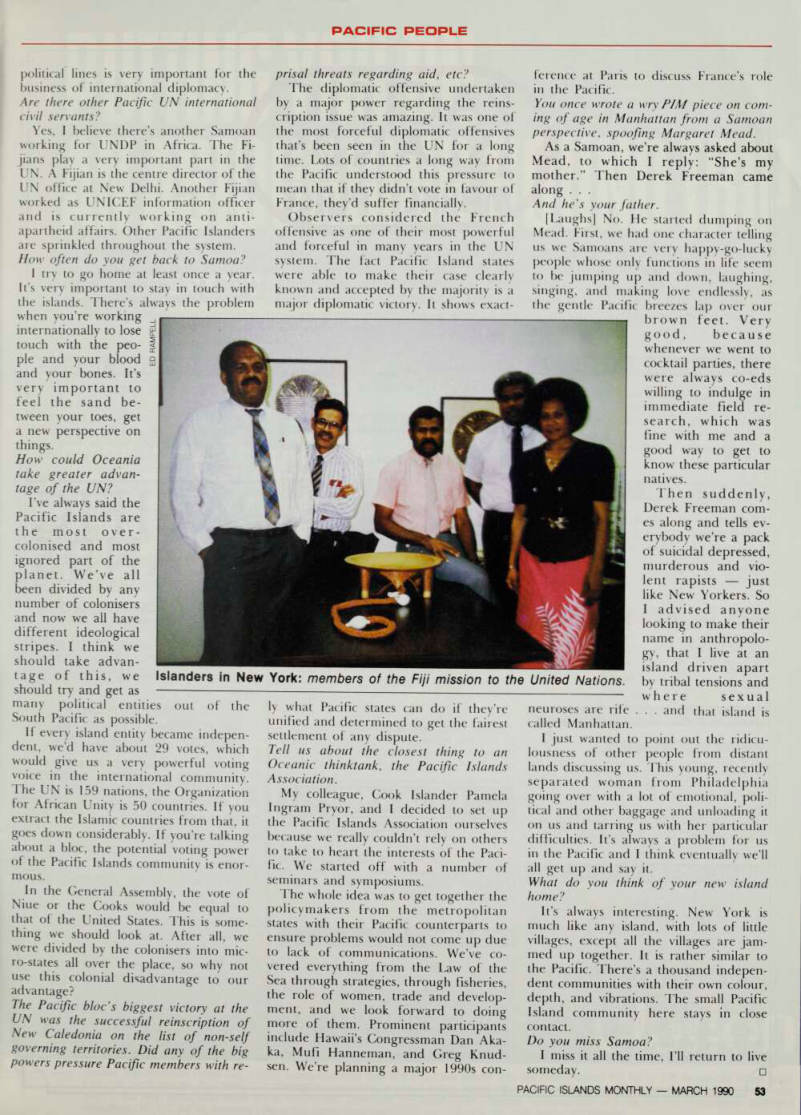
Islanders in New York: members of the Fiji mission to the United Nations.