The search for glory and those who found it
pp. 48-51 · Read in the full issue
By Karen Mangnall
WHILE the spectators and cameras focussed on the medal
winning giants Australia
(162), England (129) and Canada (112) the seven Pacific nations taking part were scoring their own victories. They had their brief moments in the limelight with six medals: Nauru a gold and two silvers, Papua New Guinea a gold, West ern Samoa two bronzes. But there were other quieter successes and, of course, sorrows.
Iathletics
Cook Islands ERIN Tierney, the only female track athlete competing for a Pacific nation, just missed personal best times in the 100 m and 200 m. But the 19-year-old Auckland-based student enjoyed a splen did rear view in each of her heats of the great Jamaican sprinter Merlene Ottey on her way to two gold medals. The Cooks national 100 m record fell to 20year-old Waikato University student Mark Sherwin in his heat. Sprinter Alan Rua, aged 16, showed such tremendous
improvement he’s likely to go to the Junior World Games in Europe in Au gust.
Papua New Guinea A KNEE injury kept Immano Launa from a personal best score in the women’s heptathlon and she finished 11th in the women’s javelin final. John Hou, Emmanle Mack, Takale Tuna and Ezekiel Wartovo finished 7th in the fin als of the men’s 4xloom relay. Hou, Wartovo and Tuna all made it to the second round in each sprint distance.
Hou and Wartovo also ran personal
bests in the 100 m. Said coach Samu Sasama: “Only one qualified for the second round in the the Brisbane Games. We’re improving. Maybe next time we’ll get into the semis.” Aaron Dupnai, a 21-year-old student from Kiunga, was cheered home by the Mt Smart crowd to a personal best in the 10,000 m despite being lapped by all but two runners.
Tonga PEAUOPE Suli, a 26-year-old farmer from Vaini, reached the second round in the 100 m and 200 m. Siulolovao Ikavuka finished 10th in the women’s discus fin al. 22-year-old policeman Homelo Vi left the field in tears after fouling all three long jumps on the first day of the
decathlon. Team general manager Lisi ate Akolo: “He lost about 700 points and was very, very depressed. But at the end it turned out he was quite popular be cause of his miss and people were sym pathetic. His mood reversed and he was enjoying it, especially on the second
day.”
Vanuatu ANCEL Nalau and Firiam Baptiste we ren’t embarrassed at all by finishing a distant last in their 400 m heats. Nalau, who trailed in 30m behind the rest, says he was glad to compete. “I do not feel upset. I feel good just for competing with the champions, to get more experi ence.” Baptiste was so determined to compete he ran despite the after-effects
of a fever contracted two days earlier.
“When I got to the last corner I felt so tired, I could not give that push any more. My tummy was too weak.” He finished last by 100 metres.
Badminton
WESTERN Samoa’s singles champion
Faafetai Ah Kuoi and national number three Kapeneta Lausului came, saw and
were comprehensively conquered. Each
picked up a couple of points in their straight-sets losses to their respective Hong Kong opponents, but went down 0-15 0-15 in their doubles against a Northern Ireland pairing. Badminton is barely two years old in Samoa, and this first international outing saw both com
petitors obviously self-conscious. Said
team manager Akeripa To’alepaiali’i;
“They learnt more during the period be fore the tournament by practising with the other teams. That was the main pur pose: to train, make contacts and get to know who’s in the badminton world.”
Samoa is lobbying for badminton at the South Pacific Games in PNG.
Bowls
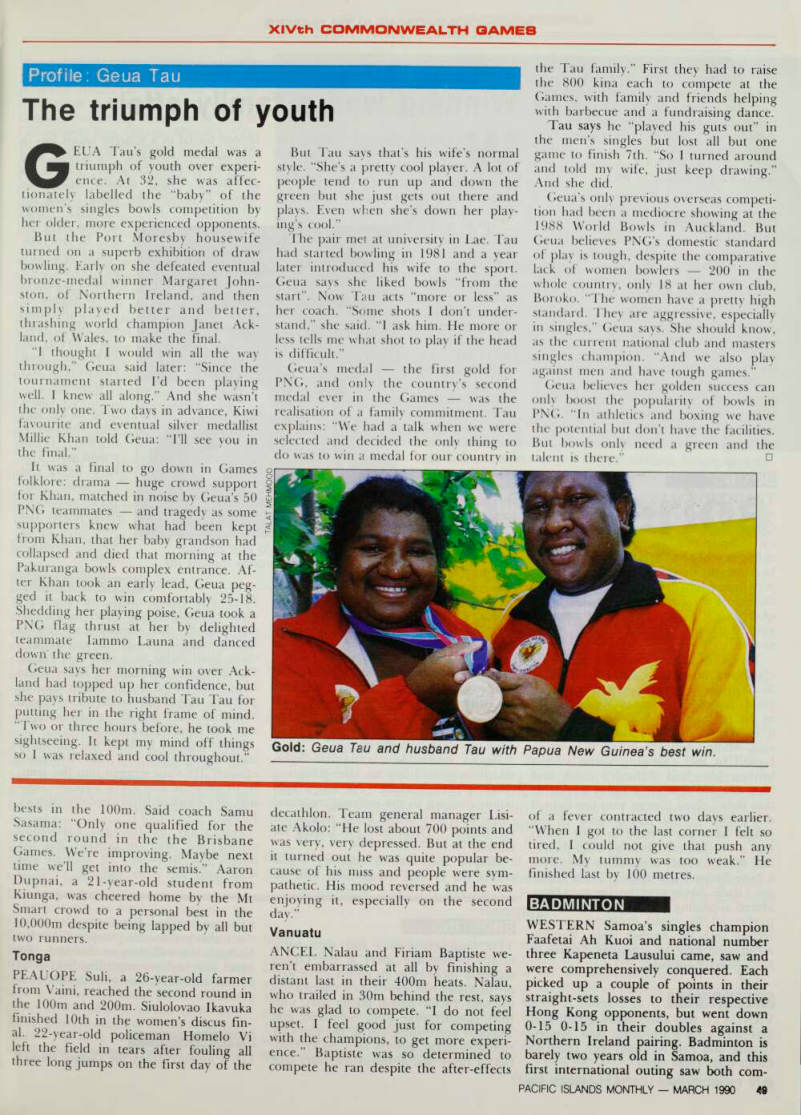
BOWLS drew the greatest Pacific Island participation, with 42 competitors from Papua New Guinea, the Cooks and West ern Samoa. PNG turned in the best re sults: Geua Tau’s gold medal in the women’s singles and the men’s fours’ narrow miss for the bronze medal play off. Generally, the Pacific women played more consistently than the men.
Women’s bowls also threw up one of the great Games characters, Samoan singles player Vaiee Siaosi. Cooks Deputy Prime Minister Inatio Akaruru illustrated how sports is a great leveller: he and his pairs partner lost every match.
Boxing
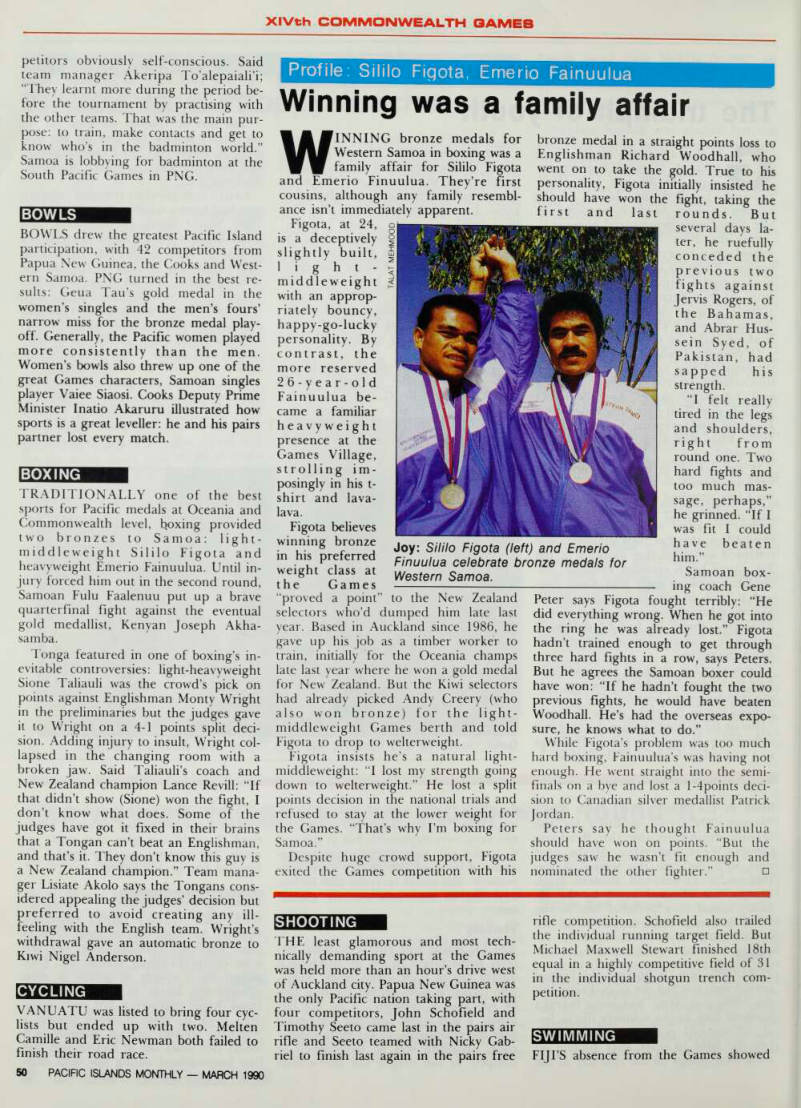
TRADITIONALLY one of the best sports for Pacific medals at Oceania and
Commonwealth level, boxing provided
two bronzes to Samoa: light
middleweight Sililo Figota and
heavyweight Emerio Fainuulua. Until in jury forced him out in the second round, Samoan Fulu Faalenuu put up a brave quarterfinal fight against the eventual gold medallist, Kenyan Joseph Akha samba.
Tonga featured in one of boxing’s in evitable controversies: light-heavyweight Sione Taliauli was the crowd’s pick on
points against Englishman Monty Wright
in the preliminaries but the judges gave it to Wright on a 4-1 points split deci sion. Adding injury to insult, Wright col lapsed in the changing room with a broken jaw. Said Taliauli’s coach and New Zealand champion Lance Revill: “If that didn’t show (Sione) won the fight, I don’t know what does. Some of the judges have got it fixed in their brains that a Tongan can’t beat an Englishman, and that’s it. They don’t know this guy is a New Zealand champion.” Team mana ger Lisiate Akolo says the Tongans cons idered appealing the judges’ decision but preferred to avoid creating any ill
feeling with the English team. Wright’s
withdrawal gave an automatic bronze to Kiwi Nigel Anderson.
(Cycling
VANUATU was listed to bring four cyc lists but ended up with two. Melten Camille and Eric Newman both failed to finish their road race.
Ishooting
THE least glamorous and most tech nically demanding sport at the Games was held more than an hour’s drive west of Auckland city. Papua New Guinea was the only Pacific nation taking part, with four competitors, John Schofield and Timothy Seeto came last in the pairs air rifle and Seeto teamed with Nicky Gab riel to finish last again in the pairs free
rifle competition. Schofield also trailed the individual running target field. But Michael Maxwell Stewart finished 18th equal in a highly competitive field of 31 in the individual shotgun trench com petition.
Swimming
FIJI’S absence from the Games showed
most clearly in what was the Cinderella sport for the Pacific nations. While the powerful Australian team took most of the medals and the glory, Papua New Guinea’s swimming foursome of height Comerford, Kim Dutton, Warwick Vele and Felipe Sialis provided the top team performance in a particular sport by any Pacific nation at the Games. 16-year-old Comerford swam a personal best by 5 seconds in the women’s 400 m freestyle, breaking PNG’s national record which had stood for 11 years.
The New Zealand-born student also swam a personal best in the 200 m frees tyle and slashed her time for the 800 m freestyle by 12 seconds. 15-year-old Dut ton likewise swam personal bests in the 200 m and 800 m women’s freestyle. Vele was barely tenths of a second outside his personal best times but the 22-year-old student placed first and second respec tively in his 100 m and 50m men’s frees tyle heats. And 19-year-old Sialis round ed off the impressive team showing by swimming personal best times in his three heats: 100 m breaststroke, 50m and
100 m freestyle.
Swim coach Peter Kunda said: “Their times have been coming down steadily since the Noumea South Pacific Games.
What we’re doing is building up for the 1990 Games which are at home for us.
The way they’re swimming we could be looking at medals.”
Iweightlifting
A SPORT at which Pacific Islanders could excell, given the training and
equipment, weightligting provided some
of the. worst and best moments of the Games. The disqualification and medal stripping of two lifters from Wales and one from India for steroid use couldn’t tarnish Marcus Stephen’s gold and two silvers for tiny Nauru. In the 100 kg divi sion, Western Samoa’s Emil Huch placed a creditable 4th with a combined weight of 267.5 kg. With borrowed lifting belt and boots, the Solomon’s Leslie Ata lifted a total of 212.5 kg to finish last in his division. Cook Island lifter Joseph Kauvei set a personal best lifting a total of 227.5 kg in the heaviest weight divi sion. But disappointment for teammate Mike Tererui. In early December he’d broken a bone in his hand, reportedly by
punching a pig.
Tererui was so keen to compete, he ripped off the cast just before the Games. The spirit was willing but the flesh or bone proved weak and the fracture popped again on Tererui’s first competition lift. The two Cook Islanders had a sub-competition between them selves at the bottom of the small field.
Team general manager David Lobb says there’s no limit to what Cook lifters could achieve with the proper coaching.