Money talks
pp. 44-47 · Read in the full issue
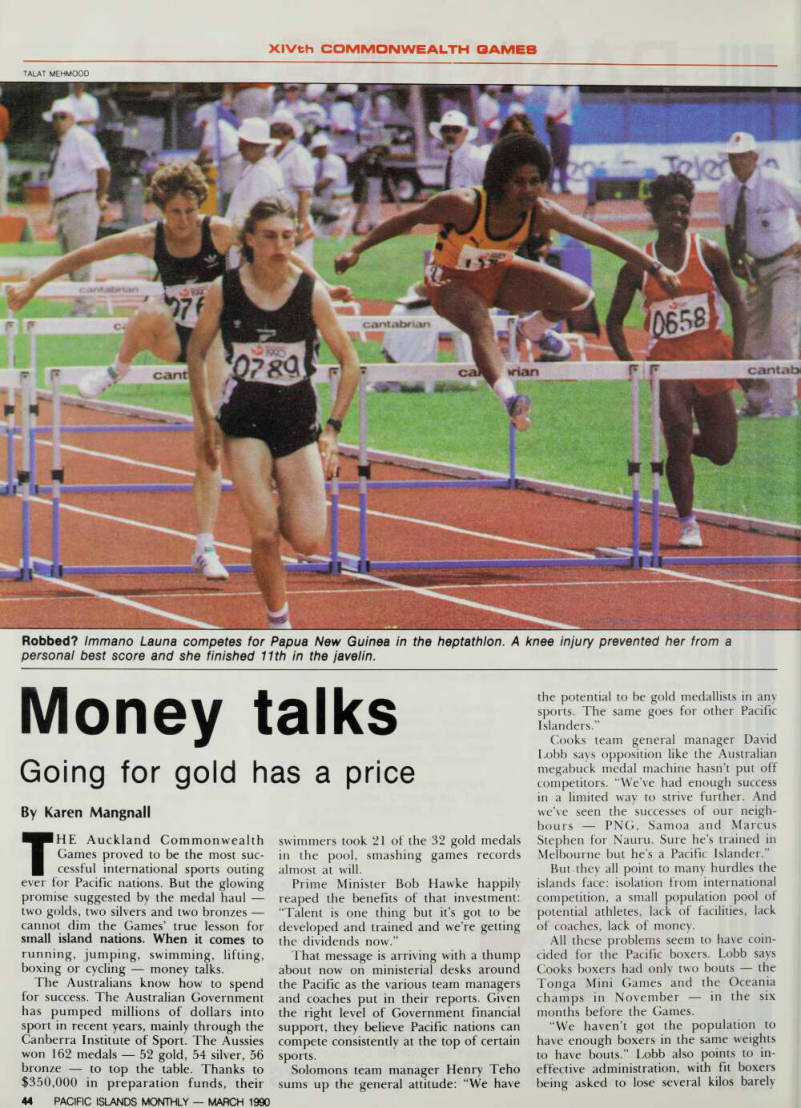
Going for gold has a price
By Karen Mangnall
THE Auckland Commonwealth Games proved to be the most suc cessful international sports outing ever for Pacific nations. But the glowing promise suggested by the medal haul two golds, two silvers and two bronzes cannot dim the Games’ true lesson for small island nations. When it comes to
running, jumping, swimming, lifting,
boxing or cycling money talks.
The Australians know how to spend for success. The Australian Government has pumped millions of dollars into sport in recent years, mainly through the Canberra Institute of Sport. The Aussies won 162 medals 52 gold, 54 silver, 56 bronze to top the table. Thanks to $350,000 in preparation funds, their
swimmers took 21 of the 32 gold medals in the pool, smashing games records almost at will.
Prime Minister Bob Hawke happily reaped the benefits of that investment: “Talent is one thing but it’s got to be developed and trained and we’re getting the dividends now.”
That message is arriving with a thump about now on ministerial desks around the Pacific as the various team managers and coaches put in their reports. Given the right level of Government financial support, they believe Pacific nations can compete consistently at the top of certain sports.
Solomons team manager Henry Teho sums up the general attitude: “We have
the potential to be gold medallists in any sports. The same goes for other Pacific Islanders.”
Cooks team general manager David Lobb says opposition like the Australian megabuck medal machine hasn’t put off competitors. “We’ve had enough success in a limited way to strive further. And we’ve seen the successes of our neigh bours PNG, Samoa and Marcus Stephen for Nauru. Sure he’s trained in Melbourne but he’s a Pacific Islander.”
But they all point to many hurdles the islands face: isolation from international competition, a small population pool of potential athletes, lack of facilities, lack of coaches, lack of money.
All these problems seem to have coin cided for the Pacific boxers. Lobb says Cooks boxers had only two bouts the Tonga Mini Games and the Oceania champs in November in the six months before the Games.
“We haven’t got the population to have enough boxers in the same weights to have bouts.” Lobb also points to in effective administration, with fit boxers being asked to lose several kilos barely
weeks before the Games started just so they could fight at the weight selectors chose.
Samoan boxing coach Gene Peters wants to see inter-island competitions to provide boxers with more regular bouts.
“The boys feel there’s no point in train ing,” Peter explains. “That’s why boxers exposed to the Commonwealth Games give it up because they think they’re too good for the other boys back home.”
Tongan team general manager Lisiate Akolo says this traps Pacific boxing into a standard below the rest of the Com monwealth. “Some of the African boxers have been fighting for many years and remained amateurs. The tendency in the Pacific is to fight at the Games and then go professional. So there’s a new cycle every Games with young boxers who lack experience.”
Peters, Teho and Akolo all say their Governments must fund basic training facilities. Samoan boxers couldn’t fight before the games because they lacked a hall. Teho says the Solomons’ boxers must practice punches on flourbags.
“The style is there but nothing for build
ing up stamina and fitness or to resist
strong punches.”
Akolo says the facilities provided by the Tonga Mini Games will help but are restricted to only five sporting codes. “A lot of other facilities are required for weightlifting, for example, which would give us a better chance of a medal than running on to the track.”
Coaches and administrators are unanimously agreed that while facilities are desperately needed, they’re useless without proper coaching. David Lobb says no Cook Island field competitors were taken to the Games precisely because they lacked proper coaching.
Samoan team general manager Charles Slavern believes the islands suffer because they get virtually no outside assistance for sport, unlike the talented African nations, and rely on mainly untrained volunteers to run the codes. Like Slavern, Solomons’ team coach Francis Mahlon is convinced athletic standards won’t improve until the administrators and coaches are properly trained and in constant contact overseas to keep their countries up to date with the latest train-
ing methods.
“The Solomons needs to be serious not only with funds but also its overall plan.
Even officials need exposure and should be attached to the better organised sports bodies overseas to see how' it’s done,” Mahlon insists, The cry for facilities, coaching and competition is reinforced by the reasons why most of the Pacific’s medals were won. Marcus Stephen, who won a gold and two silvers for Nauru, received all his weightlifting training at one of the best clubs in Australia. Similarly, Silolo Figota was undoubtedly helped to his bronze medal by the Westside Club’s coaching at Auckland’s City Gym, and regular bouts in New r Zealand, Those teams which performed above expectations the Cooks sprinters and Papua New Guinea’s track and swim teams all benefitted from sponsorship and deliberate overseas exposure, David Lobb is sure Erin Tierney and Mark Sherwin owe their improved per formances to a year’s coaching in New Zealand. While 16-year-old Ala Rua adv anced noticeably in the pre-Games meets
Talat Mehmood
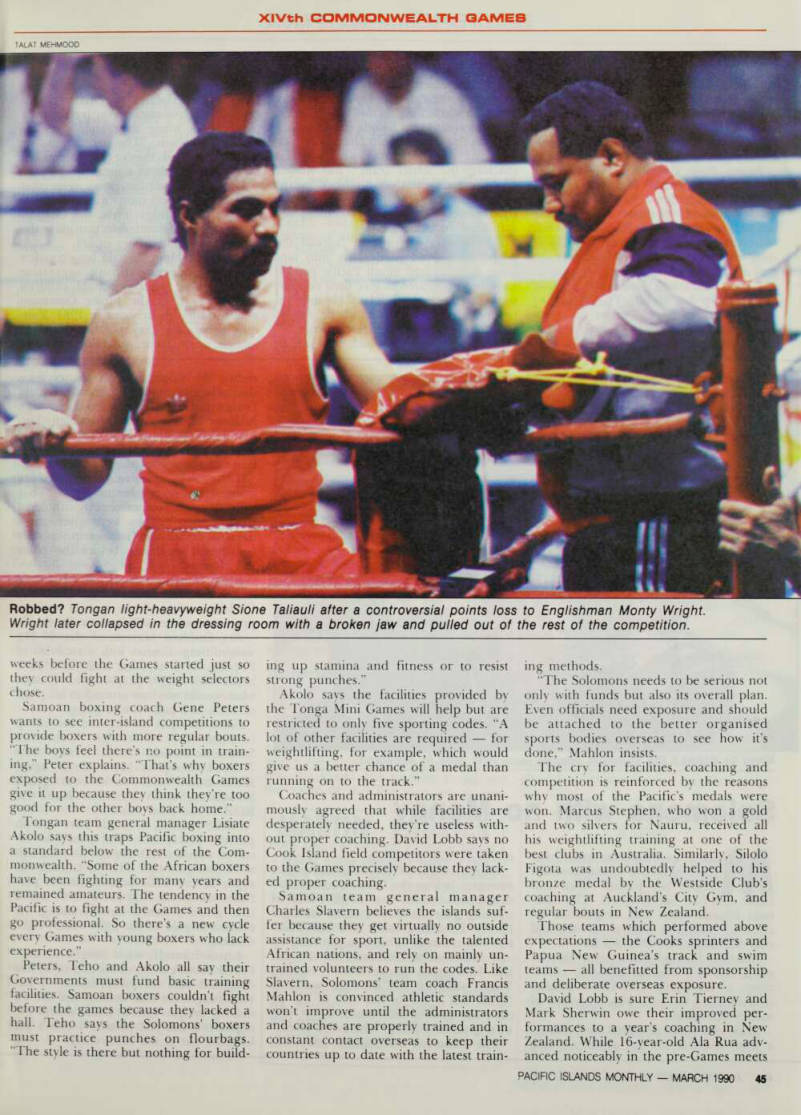
Robbed? Tongan light-heavyweight Sione Taliauli after a controversial points loss to Englishman Monty Wright.
Wright later collapsed in the dressing room with a broken jaw and pulled out of the rest of the competition.
and went home with a specially designed
training programme from Tierney’s
coach. Lobb also credits the 400 m grass track gained from the 1985 Rarotonga Mini Games for a new band of teenage track enthusiasts who’ve got their targets set on top honours at the 1993 South Pacific Games.
Papua New Guinea seems to have been most fortunate with sponsorship.
Athletics coach Samu Sasama says Col gate Palmolive sponsors a nationwide schools development programme, with twice-yearly camps for about 160 bud ding athletes each time. Sasama says the nation’s elite track and field competitors are now benefitting from two years of sponsorship by Mobil. The funds of 10,000 kina each year mean the team can be taken overseas mainly to Au stralia, Singapore and Malaysia for
regular international competition.
PNG’s swim coach Peter Kunda praises the commitment of his swim union which sent the swimmers to Brisbane for a month’s coaching before the Games.
The union also sent Kunda to a coaching clinic as the former swim champion “just got out of the water and started coaching the senior team”. But Kunda says the heavy toll on his work means he’s on the verge of quitting as national coach unless he’s offered something like
a fulltime coaching job.
Slavern says it’s time to “spread the gospel of sport”, particularly into out lying areas. “Until South Pacific nations have been educated to give their support to their own people it’ll be some time yet before standards rise so we’ll be able to compete evenly with other countries.”
Whereas countries which are serious
about their sport pick out talented youngsters at 10 years or younger and nurse them into competition, Slavern fears Pacific Island parents are still swayed by economics. “You try telling a parent back home their child’s got ta lent,” he explains. “The parent will say: ‘Okay, it’s good they’ve got talent but that won’t buy them a meal!”
Most of the administrators agree that while school-based sports development is okay at the primary levels, the Govern ments aren’t committed to providing the same opportunities later in life.
Francis Mahlon: “We do have a policy but the Government isn’t aggressive enough. Our primary school children did very well at the Junior Common wealth Games in Brisbane in 1984. Run ning in bare feet they took the most gold medals apart from Australia and New
Zealand. But when they return there’s no continuing training programme. And already there’s a big break between
primary and secondary school.”
Henry Teho says it’s a perfect argu ment for State-subsidised public gymna siums to pick up that slack when stu dents “come out in the world after school”. Teho believes seven days of training for a Solomon Islander left to his own devices is only about two days training for a Kiwi in a gym. “So to equal that, a Solomon Islander has to work six times harder to catch up.”
Akolo believes Tonga has to broaden its pool of potential athletes beyond the present limits of inter-collegiate competi tions. “There are potential athletes in the villages. In weightlifting for instance. I’m sure there are people in Tonga’s villages who can lift because they’re working physically all their lives.”
Akolo summarises what the other coaches and managers feel is now re quired of their respective Governments.
“This will mean more facilities outside the capital. The Government will have to employ more staff and administrators to make sure these programmes outlast in
dividuals coming and going.”
The most frequent suggestion as to how Pacific Governments can fund such expansions involve aid. Akolo believes bi lateral aid would be the easiest and least costly way of funding Australian or New Zealand coaches to the islands. Like other coaches, he also suggests aid be used to provide sporting scholarships overseas.
Most agree Pacific Governments have been slow to realise the marketing be nefits for trade and tourism to be reaped
from having their athletes gaining high
er profiles overseas. Kiwi Sports Minister Peter Tapsell recognised the limitations the huge expense of hosting a Common wealth Games about NZ$l5O million in Auckland places on small member nations. But the Commonwealth Sports Minister’s suggestion that financial assist ance from the more affluent nations and more spectacular” sports to gain spon sorship via television coverage would help poorer nations host the Games, shows how much is to be gained econo mically from big sports events.
For its investment, New Zealand ex pects to reap about NZ$33O million in return. Each participating country can expect some flow-own merely by virtue of having its competitors on the televi sion screens of an estimated one billion viewers. Deloitte Haskins and Sell esti mated New Zealand would have had to pay about $490 million to buy the equivalent amount of television exposure overseas. Medal-winning nations got a good slice of this lucrative advertising time.
Teho, who works for the Solomons’
tourism ministry, believes there’s a good case for Governments using some de velopment aid for sports, particularliy as a complement to extensive advertising for overseas tourists, “If people see our athletes overseas they want to know where our country is,” he explains. Lobb says the Cooks has recently recognised the value of this link between tourism
promotion and its other big-name sports stars netballs Margaret Matenga and the Iro brothers in rugby league.
But it was three-time medal winner Marcus Stephen who summed up the value of sports success at his post competition press conference! “Yes, it’s good for my country. It’s put Nauru on the map.” □