The end of a journey
pp. 20-21 · Read in the full issue
Cook Islands
By Angela McCarthy
“Aue e Rarotonga”
“Au te Cook Islands”
PA Tepaeru Ariki Lady Davis,
President of the House of Ariki (chiefs), died calling to the island and people she had represented for 45 years.
In the Cook Islands, flags flew at half mast as two days of mourning ending in a state funeral, followed the return of her body after her death in New Zea land. She returned from New Zealand accompanied by her husband Sir Tom Davis family, friends and repre sentatives of Arikinui Te Atairangi Kaahu (New Zealand Maori Queen).
The Cook Island ceremonies began at the airport on February 8 at 4.10 am where traditional and government lead ers as well as family received the body with a prayer service. The funeral party then accompanied Pa Ariki on her last traditional journey home, stopping at her tribal maraes and churches as well as her offices and her foster mother’s home. Crowds, including extended fami
ly members, gathered at each stopping
place to farewell her in prayer and pro vide refreshments for the funeral party.
After six hours of ceremony the coffin was finally carried to her home where her husband Sir Tom Davis and mem bers of her family welcomed her into the house and held a family service. The body lay in state the rest of the after noon. That evening representatives from around the island gathered at the house for an apare an evening of religious song intended to comfort the family and
signal her spirit’s ascent to the heavens.
The next morning, after a private ser vice at the house, a convoy of over a hundred vehicles escorted the body to the Bahai Centre where the Bahai com munity held a service in her honour. Pa Tepaeru Ariki had been a Bahai for 20 years. She was a founding member of the Cook Island Spiritual Assembly and one of the early translators of Bahai readings into Maori. Although a Bahai she was buried in Ariki fashion a sign of her importance as a symbol of tradi tion.
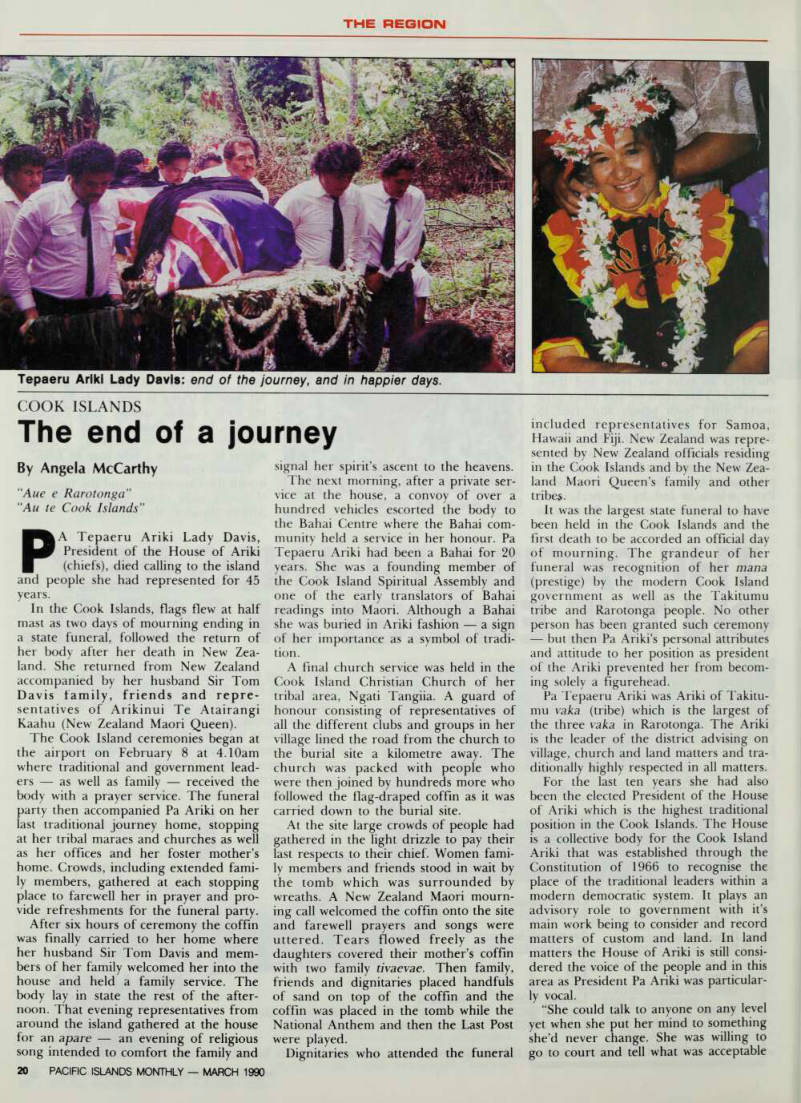
A final church service was held in the Cook Island Christian Church of her tribal area, Ngati Tangiia. A guard of honour consisting of representatives of all the different clubs and groups in her village lined the road from the church to the burial site a kilometre away. The church was packed with people who were then joined by hundreds more who followed the flag-draped coffin as it was carried down to the burial site.
At the site large crowds of people had gathered in the light drizzle to pay their last respects to their chief. Women fami ly members and friends stood in wait by the tomb which was surrounded by wreaths, A New Zealand Maori mourn ing call welcomed the coffin onto the site and farewell prayers and songs were uttered. Tears flowed freely as the daughters covered their mother’s coffin with two family tivaevae. Then family, friends and dignitaries placed handfuls of sand on top of the coffin and the coffin was placed in the tomb while the National Anthem and then the Last Post
were played.
Dignitaries who attended the funeral
included representatives for Samoa, Hawaii and Fiji. New Zealand was repre sented by New Zealand officials residing in the Cook Islands and by the New Zea land Maori Queen’s family and other tribes.
It was the largest state funeral to have been held in the Cook Islands and the first death to be accorded an official day of mourning. The grandeur of her funeral was recognition of her mana (prestige) by the modern Cook Island government as well as the Takitumu tribe and Rarotonga people. No other person has been granted such ceremony but then Pa Ariki’s personal attributes and attitude to her position as president of the Ariki prevented her from becom
ing solely a figurehead.
Pa Tepaeru Ariki was Ariki of Takitu mu vaka (tribe) which is the largest of the three vaka in Rarotonga. The Ariki is the leader of the district advising on village, church and land matters and tra ditionally highly respected in all matters.
For the last ten years she had also been the elected President of the House of Ariki which is the highest traditional position in the Cook Islands. The House is a collective body for the Cook Island Ariki that was established through the Constitution of 1966 to recognise the place of the traditional leaders within a modern democratic system. It plays an advisory role to government with it’s main work being to consider and record matters of custom and land. In land matters the House of Ariki is still consi dered the voice of the people and in this area as President Pa Ariki was particular ly vocal.
“She could talk to anyone on any level yet when she put her mind to something she’d never change. She was willing to go to court and tell what was acceptable
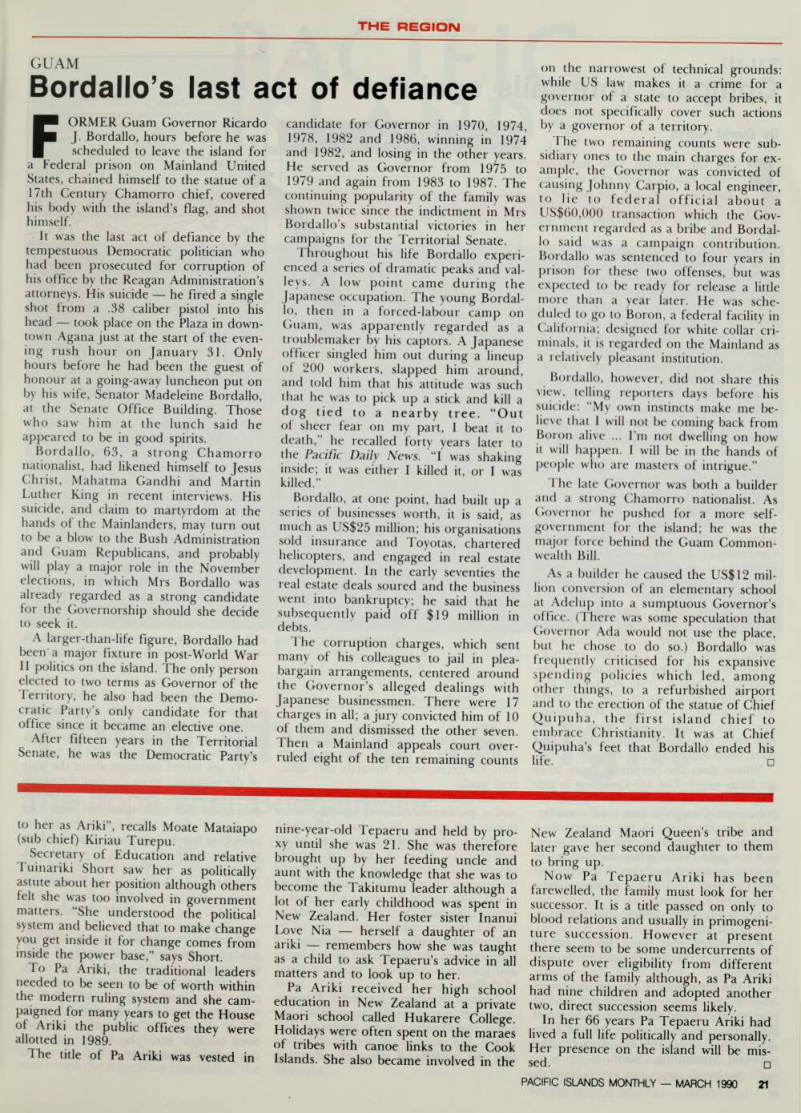
Tepaeru Ariki Lady Davis: end of the journey, and in happier days.
to her as Ariki”, recalls Moate Mataiapo (sub chief) Kiriau Turepu.
Secretary of Education and relative Tuinariki Short saw her as politically astute about her position although others felt she was too involved in government matters. “She understood the political system and believed that to make change you get inside it for change comes from inside the power base,” says Short.
To Pa Ariki, the traditional leaders needed to be seen to be of worth within the modern ruling system and she cam paigned for many years to get the House of Ariki the public offices they were allotted in 1989.
The title of Pa Ariki was vested in
nine-year-old Tepaeru and held by pro
xy until she was 21. She was therefore brought up by her feeding uncle and aunt with the knowledge that she was to become the Takitumu leader although a lot of her early childhood was spent in New Zealand. Her foster sister Inanui Love Nia herself a daughter of an ariki remembers how she was taught as a child to ask Tepaeru’s advice in all matters and to look up to her.
Pa Ariki received her high school education in New Zealand at a private Maori school called Hukarere College.
Holidays were often spent on the maraes of tribes with canoe links to the Cook Islands. She also became involved in the
New Zealand Maori Queen’s tribe and later gave her second daughter to them to bring up.
Now Pa Tepaeru Ariki has been farewelled, the family must look for her successor ‘ Bisa ** P a **ed on only to blood relations and usually in primogeni ture succession. However at present there seem to be some undercurrents of dispute over eligibility from different a ™s of the family although, as Pa Ariki had nine children and ado P te d another two direct succession seems likelv had lived a full life politically and personally.
Her presence on the island will be mis sed. □