Matangi Tonga
p. 16 · Read in the full issue
The Region
Tonga
Victory for the People
By Pesi Fonua
TONGAN general elections are
usually low-key affairs because
they do not result in a new gov ernment, a new Prime Minister or a new Cabinet. But last month it was different.
It was the most vigorously contested general election in the history of the is land kingdom; 55 candidates contested nine seats for the common people, and 23 nobles contested nine of the 33 seats allocated for nobles of the realm.
The Tongan Legislative Assembly con sists of 30 members, nine noble repre
sentatives, nine people representatives
representing and 12 Cabinet ministers
who are appointed by the King,
Taufa’ahau Tupou IV.
Despite the minority representation of
the majority of the population in Parlia ment, the commoners, the February 15 election witnessed a new political aware ness, with people in the towns and vil lages spending a good part of their time
‘talking politics’ and openly expressing
their wishes for more participation in the decision-making process. As the election day drew nearer the contest became more intense. The battle for the nine seats was no longer just a desire by indi vidual candidates to secure a seat in the House, but it was confrontation of ideals between groups of like-minded candi dates who drew the kingdom closer to
party politics.
The two major groupings were those who claimed that there is an unfair dis tribution of national wealth and that government is not accountable to any body. Their message was that if elected they would pressure government to be
more thrifty in their spendings and to become accountable to the Legislative
Assembly.
The second major groupings fought
for economic development, and sought to improve living standards and create
employment opportunities; government
inefficiency was second place. The elec tion campaign attracted a new style of political harassment where opponents tried to scandalise the other and words like communism were used to win votes.
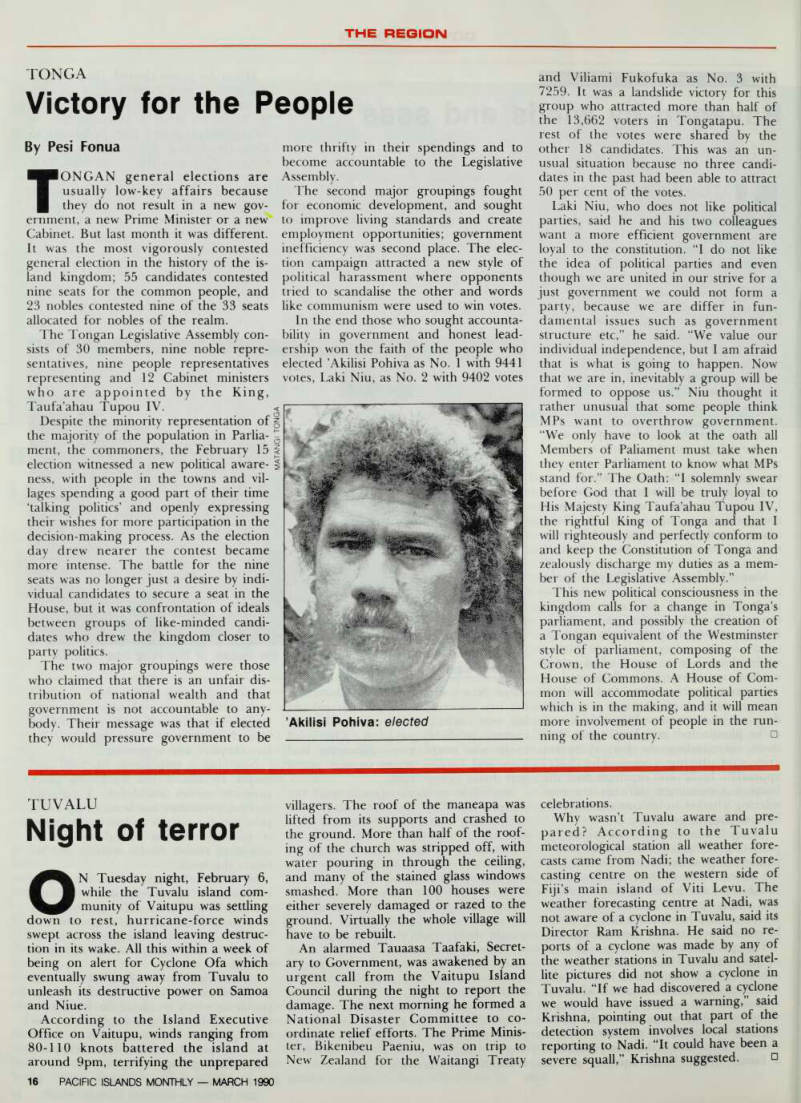
In the end those who sought accounta bility in government and honest lead ership won the faith of the people who elected ’Akilisi Pohiva as No. 1 with 9441 votes, Laki Niu, as No. 2 with 9402 votes
and Viliami Fukofuka as No. 3 with 7259. It was a landslide victory for this group who attracted more than half of the 13,662 voters in Tongatapu. The rest of the votes were shared by the other 18 candidates. This was an un usual situation because no three candi dates in the past had been able to attract 50 per cent of the votes, Laki Niu, who does not like political parties, said he and his two colleagues want a more efficient government are loyal to the constitution. “I do not like the idea of political parties and even though we are united in our strive for a just government we could not form a party, because we are differ in fun damental issues such as government structure etc,” he said. “We value our individual independence, but I am afraid that is what is going to happen. Now that we are in, inevitably a group will be formed to oppose us,” Niu thought it rather unusual that some people think MPs want to overthrow government.
“We only have to look at the oath all Members of Paliament must take when they enter Parliament to know what MPs stand for.” The Oath: “I solemnly swear before God that I will be truly loyal to
His Majesty King Taufa’ahau Tupou IV,
the rightful King of Tonga and that I will righteously and perfectly conform to and keep the Constitution of Tonga and zealously discharge my duties as a mem ber of the Legislative Assembly.”
This new political consciousness in the kingdom calls for a change in Tonga’s parliament, and possibly the creation of a Tongan equivalent of the Westminster
style of parliament, composing of the
Crown, the House of Lords and the House of Commons. A House of Com mon will accommodate political parties which is in the making, and it will mean more involvement of people in the run ning of the country. □
Matangi Tonga
’Akilisi Pohiva: elected