Two of
pp. 50-51 · Read in the full issue
Pacific People
a kind
What makes a perfect combination? In Port Vila, two artists of totally different backgrounds are showing how.
By Norman and Ngaire Douglas
NE would be hard to put to V W think of a less likely union of artistic talents than those of a Franco-Russian and a Wallis Islander, but the Michoutouchkine Pilioko Found ation is just that, and one more example of the extraordinary cultural melange that is Port Vila, Vanuatu. Nicolai Michoutouchkine and Aloi Pilioko met in Noumea, another of the Pacific’s melting pots, in the late 19505. It took little time for them to realise that they had more in common than the ability to paint; they wanted to create original works which would reflect the vitality and flam boyance of the South Seas.
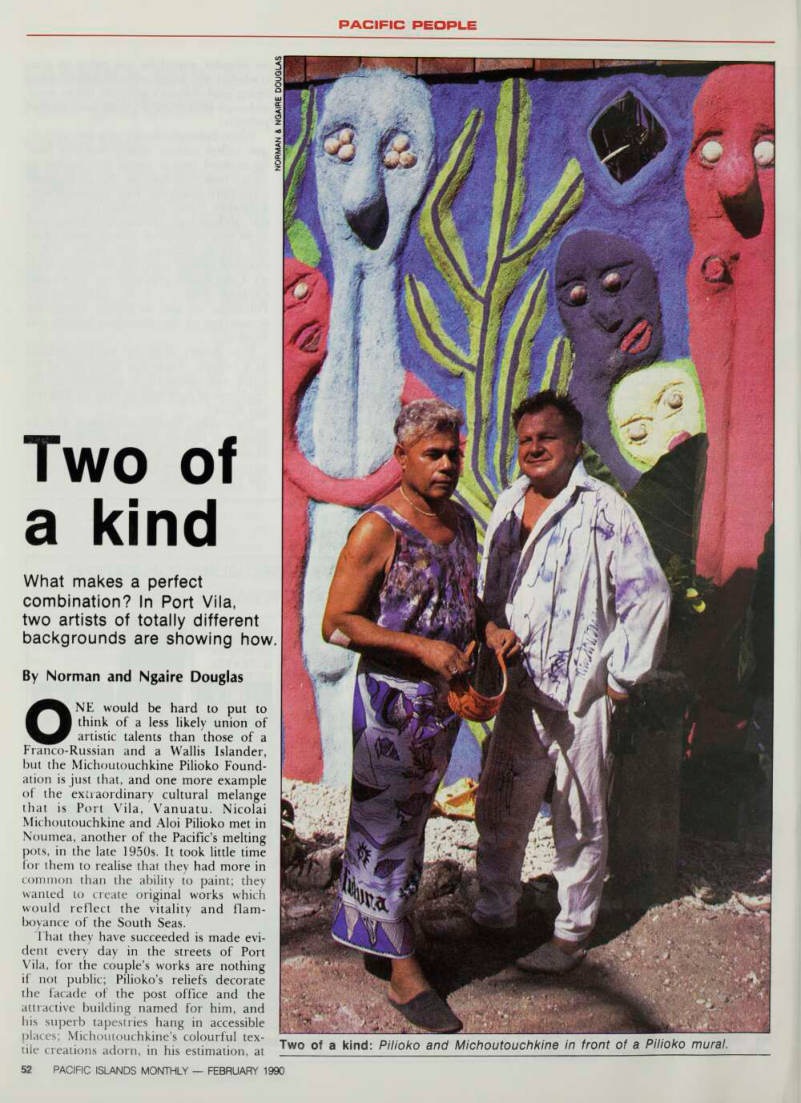
That they have succeeded is made evi dent every day in the streets of Port Vila, for the couple’s works are nothing if not public; Pilioko’s reliefs decorate the facade of the post office and the attractive building named for him, and
his superb tapestries hang in accessible
places; Michoutouchkine’s colourful tex tile creations adorn, in his estimation, at
Norman & Ngaire Douglas
Two of a kind: Pilioko and Michoutouchkine in front of a Pilioko mural.
least 75,000 bodies — mobile artworks which give a new dimension to fashion design. One cardin blouse looks much like another, but there are no two Michoutouchkine shirts exactly alike.
“When you have finished wearing it,” he says, “frame it and hang it on the wall!”
Each garment has his distinctive signa ture incorporated into the design; a sure sign of authenticity among a barrage of copy artists. He does not mind that peo ple now imitate his style on clothing; he claims to be pleased to have inspired so many artists who might otherwise have given up when their more static works did not sell.
The artists’ showcase is not simply at street level. Several hundred metres from Le Lagon Pacific Resort, along the Pango road at Ensaar, is the home, gal lery, museum, total concept inhabited by the talented pair. This is an arrangement unique in the South Seas, where ele ments of the natural and man-made have been skilfully combined not only to display the products of the couple’s artis tic abilities, but also to illustrate some thing of the philosophy behind their work.
The seeming casualness of the arrangement conceals a great deal of creative skill. They contrive to place arti facts in the position and surroundings which they had when part of traditional Pacific life. A piece which decorated the top of a house will be hung up near the roof; cooking pots will be collected around other food utensils. “It is impor tant to give the viewer the correct aspect and two free objects from the constraints of the usual museum showcases” they say. A recent addition to the collection is a piece of eighteenth century woven armour from Kiribati.
The Foundation supports and encour ages the work of young Pacific artists
through annual workshops, co-sponsored
by the University of the South Pacific. In 1989, in a move towards decentralisa tion, the first workshop was held away from Ensaar, in Tonga. Michoutouch kine and Pilioko agree that while this has some problems, it will give many more artists the chance to participate.
A major achievement of the Founda tion has been the gathering together of over 700 carvings and artifacts from across the Pacific to form an exhibition which is travelling the world. After many years and millions of viewers in Europe and Russia it will be displayed in Osaka, Japan, this year.
“We have been like pilgrims since 1959,” explains Michoutouchkine, “travelling the world to promote South Pacific art. Many people are now realis ing that the tremendous artistic level achieved by Pacific people at ground level has been inspirational to many famous artists. The first European sailors took things back to show the world. We emphasise the contributions of women because they have generally been forgotten in analysis of the male dominated societies. They preserve the customs while the men talk!”
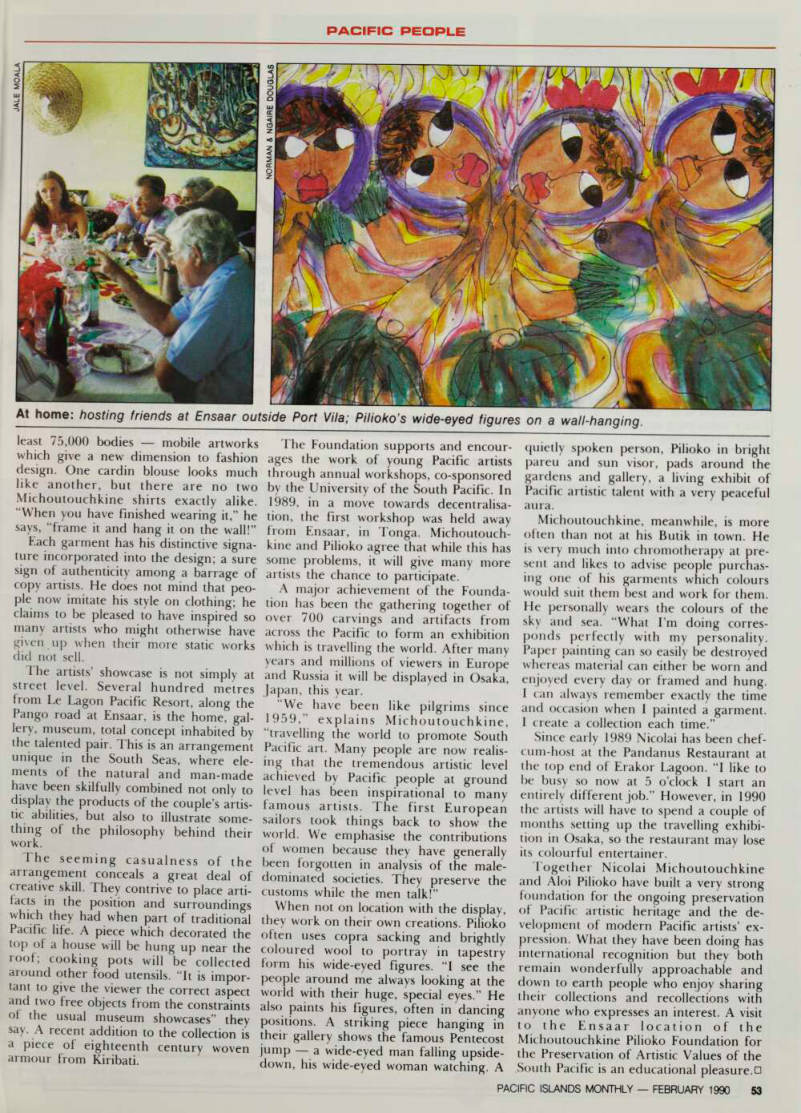
When not on location with the display, they work on their own creations. Pilioko often uses copra sacking and brightly coloured wool to portray in tapestry form his wide-eyed figures. “I see the people around me always looking at the world with their huge, special eyes.” He also paints his figures, often in dancing
positions. A striking piece hanging in
their gallery shows the famous Pentecost jump — a wide-eyed man falling upside down, his wide-eyed woman watching. A
quietly spoken person, Piiioko in bright pareu and sun visor, pads around the gardens and gallery, a living exhibit of Pacific artistic talent with a very peaceful aura.
Michoutouchkine, meanwhile, is more often than not at his Butik in town. He is very much into chromotherapy at pre sent and likes to advise people purchas ing one of his garments which colours would suit them best and work for them.
He personally wears the colours of the sky and sea. “What I’m doing corres ponds perfectly with my personality.
Paper painting can so easily be destroyed whereas material can either be worn and enjoyed every day or framed and hung.
I can always remember exactly the time and occasion when I painted a garment.
I create a collection each time.”
Since early 1989 Nicolai has been chef cum-host at the Pandanus Restaurant at the top end of Erakor Lagoon. “I like to be busy so now at 5 o’clock 1 start an entirely different job.” However, in 1990 the artists will have to spend a couple of months setting up the travelling exhibi tion in Osaka, so the restaurant may lose its colourful entertainer.
Together Nicolai Michoutouchkine and Aloi Piiioko have built a very strong foundation for the ongoing preservation of Pacific artistic heritage and the de velopment of modern Pacific artists’ ex pression. What they have been doing has international recognition but they both
remain wonderfully approachable and
down to earth people who enjoy sharing their collections and recollections with anyone who expresses an interest. A visit to the Ensaar location of the Michoutouchkine Piiioko Foundation for the Preservation of Artistic Values of the South Pacific is an educational pleasure.□
Jale Moala
Norman & Nqaire Douglas
At home: hosting friends at Ensaar outside Port Vila; Pilioko’s wide-eyed figures on a wall-hanging.