Banking in
pp. 33-36 · Read in the full issue



Special Report
Banking in the Pacific Things are looking good
By Robin Bromby
THINGS are looking up in Pacific banking. The Fiji economy is on the rebound. Vanuatu has put its political problems behind it and tourism is growing again, the Cooks are thriving as an offshore banking centre, while the ANZ Banking Group has started to ex pand into the rural areas of the Solomon Islands and found it to be a profitable move.
The only dull spot is Papua New Guinea: the economy until quite recent ly, was moving along quite well. But now the Bougainville mess has depressed business confidence and the banks are subject to new central bank controls on credit.
The region still faces the underlying
problem of it being an uphill task to build a banking and finance sector in countries with tiny population numbers and one which is often subsistence based. Without a growing indigenous capital market based on an expanding savings base, banking and finance institutions are limited in their ability to lift the level of activity. Papua New Guinea had just begun last year to attract Asian, particularly Malaysian involvement in capital formation it will be some time before we will see whether it will survive the present nervousness in that country.
When most loans are small, perhaps around the Aslooo level, it is hard for a bank to wring much profit out of local
banking activities, with administration of such a loans costing nearly as much as if the figure had been 10 or 20 times lar ger. The last year has seen banks even in the much bigger markets of Australia and New Zealand seek to recoup more of their costs; last month, new charges were levied on small business accounts by most banks. In the larger countries, too, the institutions handle many major corporations which helps to balance out the tens of thousands of smaller deposi tors and borrowers, In his recent book , Economic Develop ment in Seven Pacific Island Countries, Christopher Browne said this limited scope of monetary policy due to popula tion size, with its attendant restrictions
Suva’s financial centre: domestic spending is climbing.
on lending to the public and private sec tors, had led most commercial banks to invest abroad. This is particularly ob vious when bank reports from micro states such as Kiribati and Tuvalu are examined. In the 1988 annual report from the Bank of Kiribati (the latest available) the balance sheet showed it had A|24.3 million invested overseas out of total asset base of A 532.13 million.
The National Bank of Tuvalu had A 56.18 million of its $9.06 million total assets on term deposit in overseas banks.
Browne writes that authorities have printed money sparingly, and that li quidity growth has been closely related to balance of payments developments.
Banking in the South Pacific is domin ated by Australian banks. There are some local institutions, and others with partial foreign ownership, but the three major Australian commercial banks have entrenched their positions in recent years. Westpac, especially, has a foot in all but the smallest territories and has most recently announced it would ac quire 50 branches now operated by the Banque Indosuez in New Caledonia and
French Polynesia (and obtain a banking licence in France). The ANZ is also well established in the region, in domestic and offshore operations, and has recent ly expanded into the Cook Islands and has opened two rural offices in the Solo mons, National Australia Bank controls Bank of South Pacific in Papua New Guinea.
The New Zealanders, by contrast, have proved unadventurous in the region, and the horrendous losses recently occurred by the Bank of New Zealand will almost certainly keep that institution preoccupied in tidying up its existing op erations rather than trying to take on the Australians in the region.
This link with foreign banks has had its benefits and drawbacks.
On the plus side, the financial sound ness of the banks has been assured and even taken for granted, which has meant the small Pacific countries have not had to develop sophisticated control systems.
It has also meant the control of these banks by largely expatriate management staff has provided a very efficient ser vice, while local institutions have some
times had trouble attracting people who can make assured judgements, particu larly in loan matters the savings and loan associations in Papua New Guinea is an obvious case which springs to mind.
On the negative side, the foreign banks have been probably too reluctant to make the level of domestic lending that might otherwise be justified. This has been left to smaller institutions, such as the locally-owned National Bank of Fiji or the Vanuatu Co-operative Savings Bank. The use of expatriate officers and the adoption of the Australian (or New Zealand) banking culture has resulted in the development of a banking system which owes little to the indigenous cul ture. The Papua New Guinea Banking Corporation, for example, has needed time to develop a national image and shake off its former connection with the Commonwealth Bank of Australia (although there are still a considerable number of expatriate Australians on the staff).
Christopher Brown found that the principal private sector credit operations of the commercial banks has consisted of
short-term business financing, especially
of foreign trade, longer-term loans for the purchase of capital equipment and other investment goods in agriculture, tourism and industry have been made.
But borrowers had usually been able to obtain cheaper loans from the develop ment-type banks.
Development banks have been estab lished throughout the Pacific island re gion to help find cheaper sources of fi nance for industrial and agricultural in vestment. These were set up with gov ernment funds, but subsequently much of the loan finance has been channeled through the development banks from in ternational aid agencies, including the World Bank and the Asian Development Bank.
The two major players in the region, Westpac and ANZ found 1989 was generally good year to be operating in the Pacific islands.
Westpac operates a separate subsidiary in Papua New Guinea, while the other islands work as a division of the parent company it has branches in Niue, Cook Islands, Fiji, Solomon Islands, Vanuatu and shares in banks operating in Western Samoa, Tonga, Tuvalu and Kiribati. The acquisition of the Banque Indosuez operation in the French Pacific territories is a major step forward for the company in the region.
Business has picked up considerably in Fiji after a period after the military coups when commercial confidence was low. At one stage the Reserve Bank of Fiji had to mop up the excess liquidity in the system with its holdings reaching up to FsBo million that figure is down near Fs2o million now. Westpac reports a dramatic increase in credit expansion within the last six months, especially in the tourist industry as several major hotel projects come on the drawing board; also, many resort owners are pre pared to start spending again so that banks are being increasingly asked to fi
nance renovations and extensions.
Fiji retailing is bouncing back, too, with domestic spending climbing con siderably. Westpac reports the one sector which is still sluggish is building con struction.
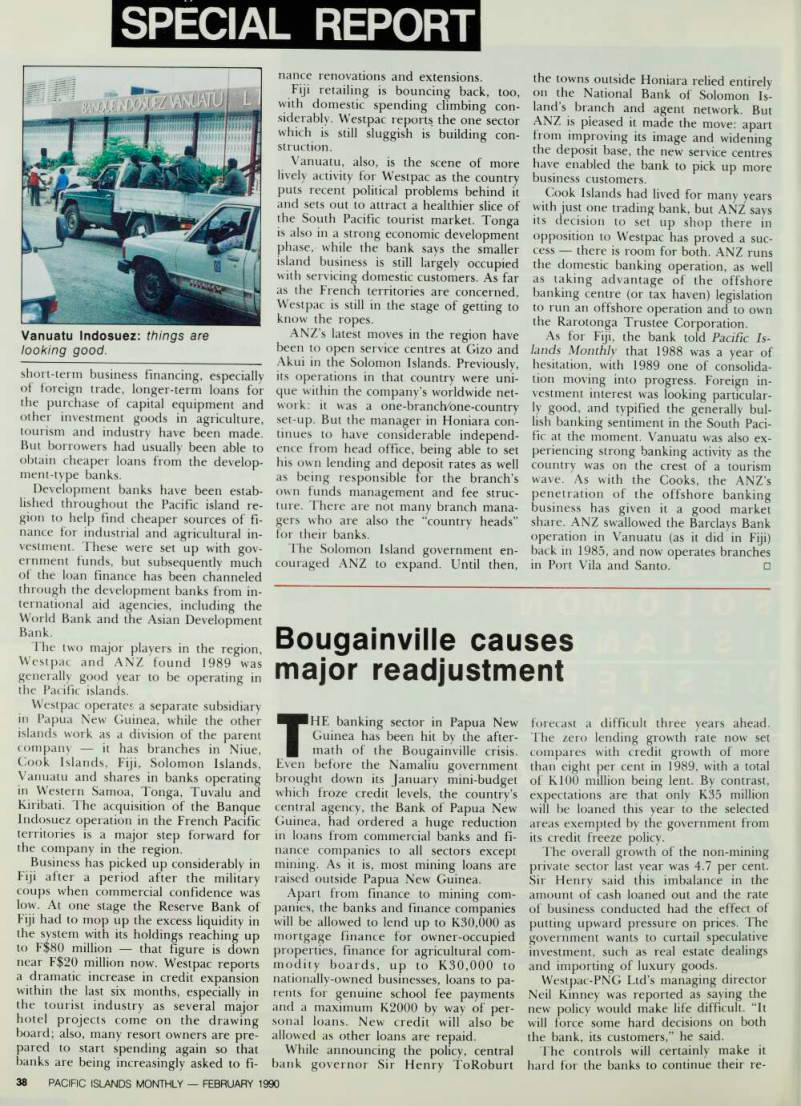
Vanuatu, also, is the scene of more lively activity for Westpac as the country puts recent political problems behind it and sets out to attract a healthier slice of the South Pacific tourist market. Tonga is also in a strong economic development phase, while the bank says the smaller island business is still largely occupied with servicing domestic customers. As far as the French territories are concerned, Westpac is still in the stage of getting to know the ropes.
ANZ’s latest moves in the region have been to open service centres at Gizo and Akui in the Solomon Islands. Previously, its operations in that country were uni que within the company’s worldwide net work: it was a one-branclvbne-country set-up. But the manager in Honiara con tinues to have considerable independ ence from head office, being able to set his own lending and deposit rates as well as being responsible for the branch’s own funds management and fee struc ture. There are not many branch mana gers who are also the “country heads” for their banks.
The Solomon Island government en couraged ANZ to expand. Until then,
the towns outside Honiara relied entirely on the National Bank of Solomon Is land’s branch and agent network. But ANZ is pleased it made the move: apart
from improving its image and widening
the deposit base, the new service centres have enabled the bank to pick up more business customers, Cook Islands had lived for many years with just one trading bank, but ANZ says its decision to set up shop there in opposition to Westpac has proved a suc cess there is room for both. ANZ runs the domestic banking operation, as well as taking advantage of the offshore banking centre (or tax haven) legislation to run an offshore operation and to own
the Rarotonga Trustee Corporation.
As for Fiji, the bank told Pacific Is lands Monthly that 1988 was a year of hesitation, with 1989 one of consolida tion moving into progress. Foreign in vestment interest was looking particular ly good, and typified the generally bul lish banking sentiment in the South Paci fic at the moment. Vanuatu was also ex
periencing strong banking activity as the
country was on the crest of a tourism wave. As with the Cooks, the ANZ’s penetration of the offshore banking business has given it a good market share. ANZ swallowed the Barclays Bank operation in Vanuatu (as it did in Fiji) back in 1985, and now operates branches in Port Vila and Santo. □
Vanuatu Indosuez: things are looking good.