Impasse on new status
pp. 20-21 · Read in the full issue
Guam
By David North
NE of the first Pacific islands to B Sbe colonised, Guam, has watch ed patiently as most of its
neighbour states gained independence.
But the 212-square mile island, a strategic United States military outpost since World War 11, remains among the last in the region to shed its colonial status.
That was the gist of the emotional, and occasionally bitter, message Guam leaders presented to a US Congressional committee in Hawaii December 11-12 in hearings on a bill calling for a new poli tical association between the island and the United States.
More than 50 Guam leaders testified at the two-day session, as about 300 Guamanians filled the Hawaii State Capi tol Building Auditorium in downtown Honolulu. Four members of the House Interior Subcommittee on Insular and International Affairs were joined by In terior Committee Chairman Morris K.
Udall on the first day. Though suffering from Parkinson’s disease, he made a brief appearance and offered words of encouragement. Hawaii Representatives Dan Akaka (Democrat and Pat Saiki (Re publican), though not members of the subcommittee, also joined the panel.
The hearings brought US and Guam
leaders
together for
the first public discussion of the territory’s
proposal, de
veloped be
tween 1983 and 1988 by successive local commissions, for a status that combines elements of free association with continued
U.S. citizenship
for Guama nians.
Guam Gov
ernor Joseph
Ada told the Committee the island remains a virtual col ony, its people held in “serf dom” by the United States for the past 91 years, and that
they have never had the right to selfdetermination. “By any definition of the word Guam is a colony. But it must be a colony no longer,” Ada said.
Noting that US President Bush “has called for self-determination and selfgovernment for the people of Eastern Europe,” Ada asked: “How about selfgovernment for Guam, for the people in
America’s own backyard?”
He recounted Guam’s colonisation and abuses by Spain, which began in 1668, and seizure by the United States during the Spanish-American War of 1898. “At that moment in history ... a great injus tice was perpetrated upon our people,”
Ada said. “Guam should have been set free ... or incorporated into the United States, with the people of Guam being made full citizens . .
Referring to a Bush Administration report which raised several Constitution al problems about sections of the bill, Ada said these federal concerns “seem to
be policy objections masquerading as
constitutional issues. Other than the im pact the changes will make on the do mains of federal bureaucracies and their exercise of authority over Guam, we can not see what the fuss is about.” “We would like to stay associated with Amer ica. But we don’t want to stay a colony,” said Ada, who received a standing ova tion from the audience following his one-hour statement.
US Department of Interior Assistant Secretary Stella Guerra, representing the Bush Administration, said the Executive Branch supports the general concept of Commonwealth and increased self government for Guam under its own constitution. But she emphasised the Administration cannot endorse other provisions of the bill as drafted because
of Constitutional, legal, and policy prob
lems.
She cited, for example, a provision giving Guam veto power over all
federal laws
and regula
tions passed af ter enactment of Common wealth status.
Pointing out that no federal statute or rule
would apply
unless specifi
cally consented
to be Guam, she said this could lead to
“legislative and
regulatory
chaos” for federal agen cies who have a myriad of programme re
sponsibilities in
the island.
In what is shaping up to be an especial ly controversial issue, Guerra
said restricting
the right of
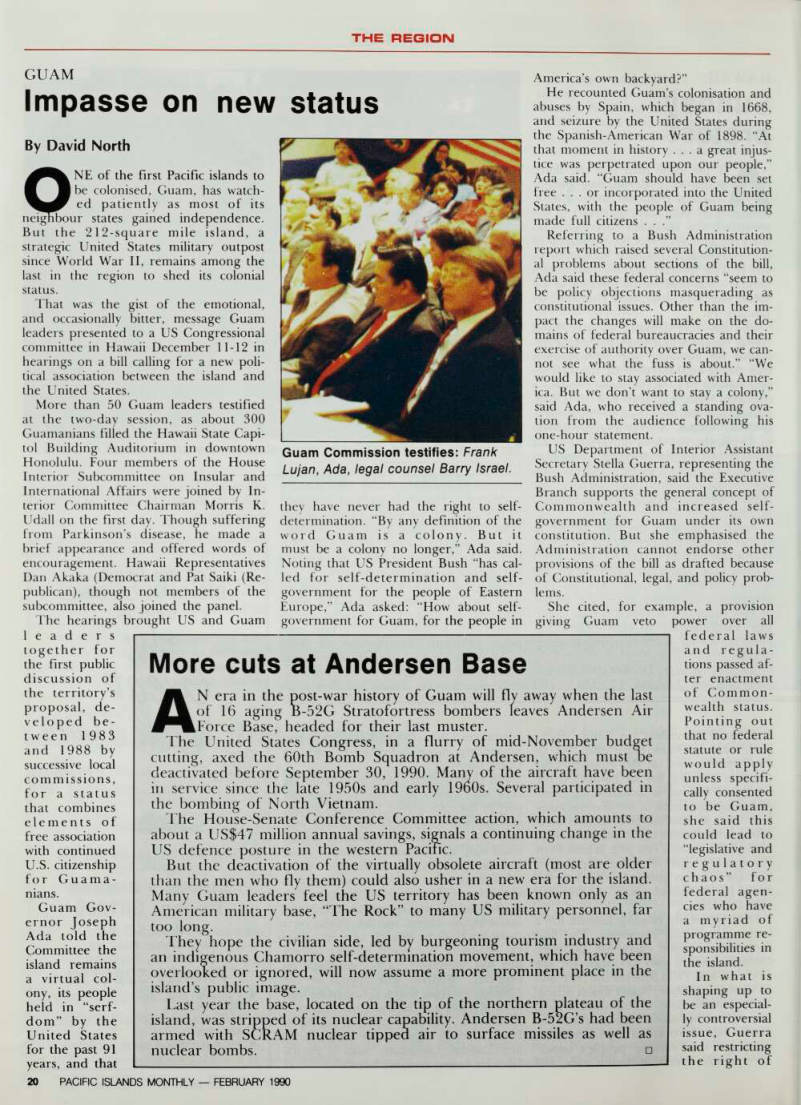
Guam Commission testifies: Frank Lujan, Ada, legal counsel Barry Israel.
of self-determination to only the indige nous inhabitants of Guam could violate fundamental US Constitutional protec
tions against limiting voting along ethnic
or racial lines.
The bill calls for the US Congress to recognise “the exclusive right to self determination of the indigenous Cha morros”, defined as those living on Guam in 1950 and their descendants.
Guam leaders testified that the island’s indigenous people have never had a chance to freely choose what political sta tus and national affiliation they desire.
Guerra said that limiting the right of self-determination (which presumably would take some form of vote in the future) to one group based solely on ethnic or racial criterion would violate Constitutional guarantees of due process and equal protection, which apply to all US citizens of Guam.
A Federal Interagency report that de veloped the Bush Administration’s posi tion expressed sympathy for the dilem ma of Chamorros, who find themselves a minority in their own island. Of the is land’s 138,000 residents, about 45 per cent are Chamorros, 25 percent Filipino- Americans, 20 percent statesiders and 10 percent Micronesians and Asians.
This demographic phenomenon is a
major concern of many Chamorro lead ers, who retain control of the local gov ernment because their extended family systems and close knit communities pro duce exceptionally high Chamorro voter turnouts. But the business community is dominated by US statesiders and Japanese tourism and real estate com panies, and the retail sector by South Koreans and Taiwanese.
Ada said the Congress, because of its constitutional authority to decide the political status of the territory, has the power to allow a one-time Chamorro only act of self-determination.
Guerra said other federal concerns in clude the bill’s provisions to give Guam
authority to negotiate foreign agree
ments and air rights, control over im
migration, special trade advantages,
annual payments for US base facilities, and granting a Guam-controlled commis sion the power to dispose of federally held lands and property, including ac cess and easements to military bases.
Subcommittee Chairman Ron de Lugo (Democrat-Virgin Islands) reiterated the position Congressional leaders have taken on the Guam-drafted bill: that there are major concerns with provisions that must be resolved through negotia tions and compromise with Guam
leaders.
De Lugo pressed Ada, who is Commis sion Chairman, on whether the Commis sion had the power to negotiate and sup port necessary changes in the measure?
The Governor maintained the Commis sion had no authority to negotiate changes and whatever amendments Con gress makes in the bill would have to be approved by Guam voters.
Acknowledging that the voters of Guam would have the ultimate say on whatever revised bill Congress passes, de Lugo told Ada, “that road map you have described to us is a design for disaster, a design for failure.”
“We have reached a point where there is political support for Commonwealth,” de Lugo said, referring to 160 House and Senate members who have co sponsored the measure on the condition that problems in the bill can be worked out.
“Congress is not going to be a political sucker,” de Lugo said. “Congress is not going to set itself up by making changes without the approval of Guam leaders.”
Commission Vice-Chairman Frank Santos wavered at one point, agreeing to introduce legislation to give the Commis sion power to negotiate, but later backed away from that position, saying the Com mission will not negotiate. □