Calling the islands:
p. 18 · Read in the full issue
New Zealand
Calling the islands: Radio NZ on the air
HORTWAVE radio listeners throughout the Pacific now have alternative to the übiquitous Radio Australia for their regional and international news from Wellington, Radio New Zealand is on air with a powerful new transmitter designed to give a good signal through the Pacific.
But not only the old, low-powered trans mitters been put on the scrapheap; the shortwave service will no longer broad cast just relays from the home service stations, it will instead originate its own programmes.
Pacific languages will be widely used, although the transmissions will be main stream English, Radio New Zealand In ternational manager lan Johnstone told Pacific Islands Monthly all on-air staff will be bi-lingual. So, in a programme about Tongans in New Zealand (for ex ample), the announcer will speak mostly in English but weave in occasional sent ences and phrases in the Tongan lan guage.
Transmissions from the new 100 kilo watt transmitter were due to start in late January in time for the Commonwealth Games being held in Auckland. This will
be followed by special programming
around Waitangi Day on February 6.
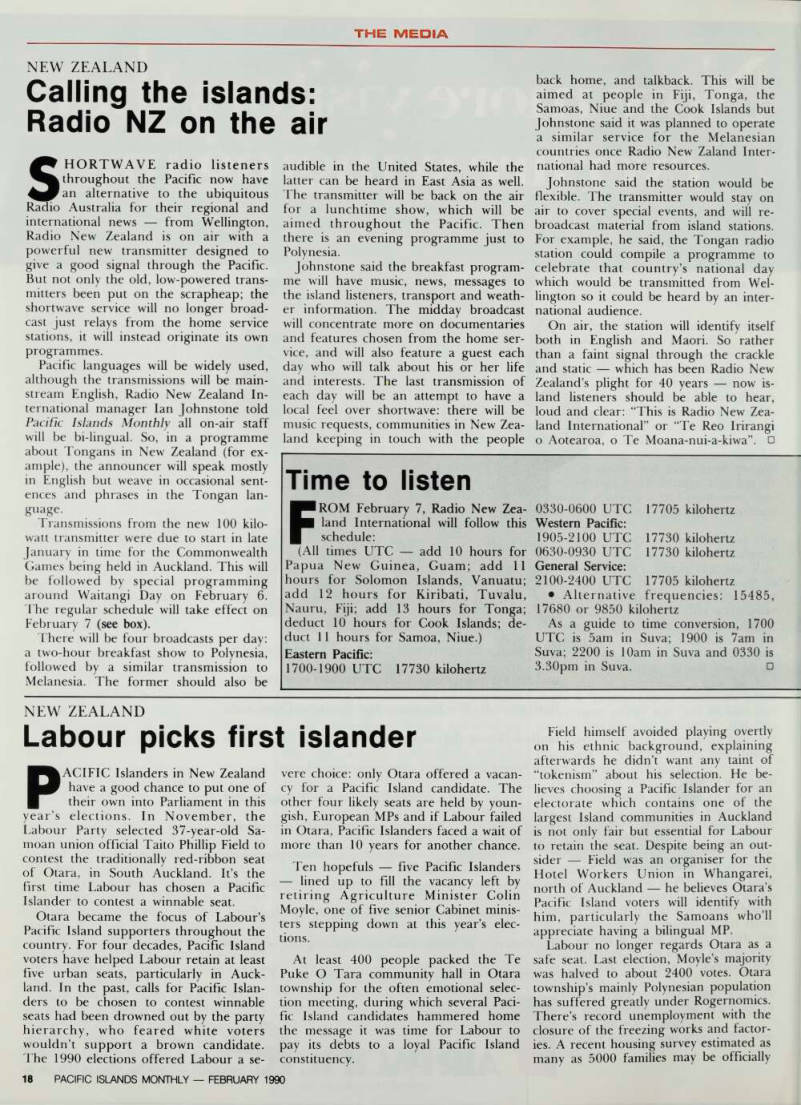
The regular schedule will take effect on February 7 (see box).
There will be four broadcasts per day: a two-hour breakfast show to Polynesia, followed by a similar transmission to Melanesia. The former should also be
audible in the United States, while the latter can be heard in East Asia as well.
The transmitter will be back on the air for a lunchtime show, which will be aimed throughout the Pacific. Then there is an evening programme just to
Polynesia.
Johnstone said the breakfast program me will have music, news, messages to the island listeners, transport and weath er information. The midday broadcast will concentrate more on documentaries and features chosen from the home ser vice, and will also feature a guest each day who will talk about his or her life and interests. The last transmission of each day will be an attempt to have a local feel over shortwave: there will be music requests, communities in New Zea land keeping in touch with the people
back home, and talkback. This will be aimed at people in Fiji, Tonga, the Samoas, Niue and the Cook Islands but Johnstone said it was planned to operate a similar service for the Melanesian countries once Radio New Zaland Inter national had more resources.
Johnstone said the station would be flexible. The transmitter would stay on air to cover special events, and will re broadcast material from island stations.
For example, he said, the Tongan radio station could compile a programme to celebrate that country’s national day which would be transmitted from Wel lington so it could be heard by an inter national audience.
On air, the station will identify itself both in English and Maori. So rather than a faint signal through the crackle and static which has been Radio New Zealand’s plight for 40 years now is land listeners should be able to hear, loud and clear: “This is Radio New Zea land International” or “Te Reo Irirangi o Aotearoa, o Te Moana-nui-a-kiwa”. □