Leodoro
pp. 15-16 · Read in the full issue
Vanuatu
Leodoro and the Vietnamese affair
By David North
Washington HAS Vanuatu offered to resettle several thousand Vietnamese refugees, now in camps in Hong Kong and elsewhere? The pre stigeful U.S. West Coast daily, the San Diego Union, wrote that this was the case. So did America’s leading Viet
namese publication Nguoi Viet.
Half a dozen affluent Vietnamese- American refugees were convinced to the extent that they planned to pay their own way to Port Vila in mid-January to check out the possibility. In at least two cases, it would have been at least the second trip to Vanuatu.
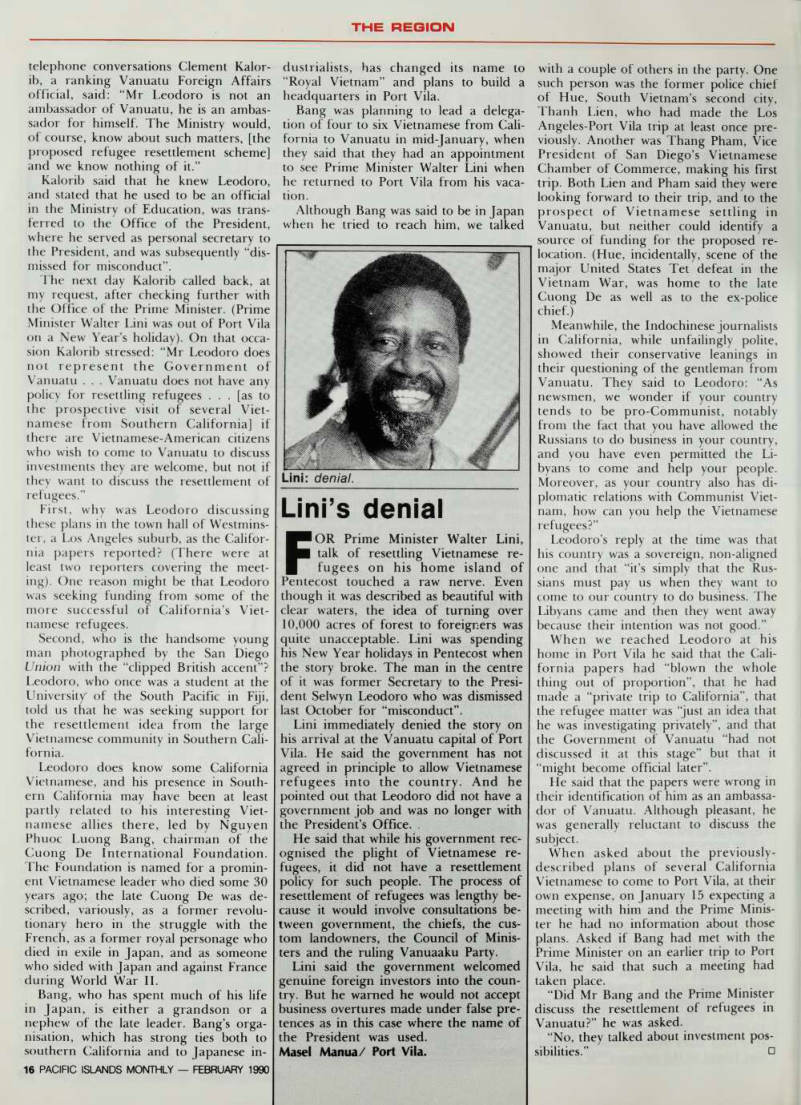
But the Vanuatu Ministry of Foreign Affairs and Prime Minister Walter Lini (see box) poured cold water on the story, telling Pacific Islands Monthly that it had no policy for the resettlement of re fugees, Vietnamese or otherwise.
If, there were to be such a resettle ment (and there are a few long-time Vanuatu residents who are Vietnamese) it would be remarkable for several reasons: • It would mark the first significant resettlement of Vietnamese in the South Pacific since the fall of Saigon in 1975; • It would represent a major change in the population mix in Vanuatu, now an almost exclusively Melanesian nation; • and it could be viewed as a major twist to the tale of the British lion (one of Vanuatu’s former colonial powers) as Walter Lini’s government showed that it was more welcoming than Margaret Thatcher’s Hong Kong. (Thatcher’s peo ple have forced some Vietnamese re fugees to return to Vietnam).
The story emerged in an unlikely loca tion, far from the South Pacific, in the columns of Nguio Viet, a California pub lication written for that state’s Viet namese population.
According to Nguoi Viet and the Un ion the subject was raised by Selwyn A.
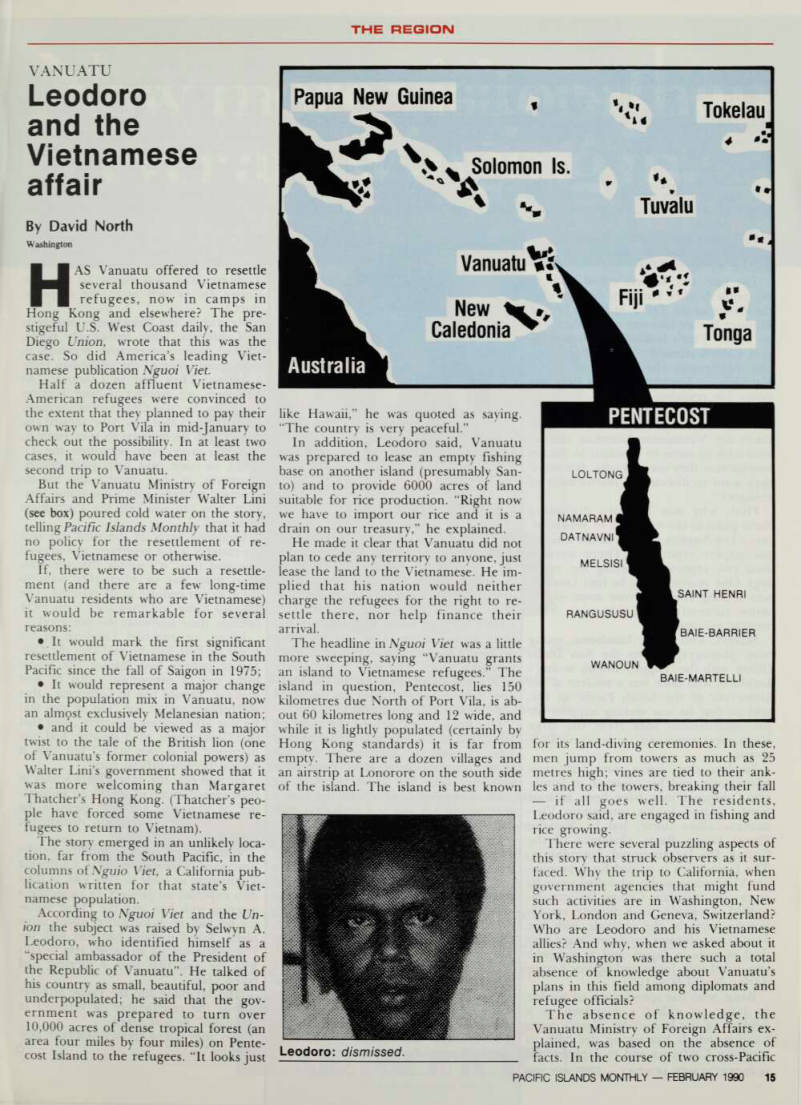
Leodoro, who identified himself as a “special ambassador of the President of the Republic of Vanuatu”. He talked of his country as small, beautiful, poor and underpopulated; he said that the gov ernment was prepared to turn over 10,000 acres of dense tropical forest (an area four miles by four miles) on Pente cost Island to the refugees. “It looks just
like Hawaii,” he was quoted as saying.
“The country is very peaceful.”
In addition, Leodoro said, Vanuatu was prepared to lease an empty fishing base on another island (presumably San to) and to provide 6000 acres of land suitable for rice production. “Right now we have to import our rice and it is a drain on our treasury,” he explained.
He made it clear that Vanuatu did not plan to cede any territory to anyone, just lease the land to the Vietnamese. He im plied that his nation would neither charge the refugees for the right to re settle there, nor help finance their arrival.
The headline in Nguoi Viet was a little more sweeping, saying “Vanuatu grants an island to Vietnamese refugees.” The island in question, Pentecost, lies 150 kilometres due North of Port Vila, is ab out 60 kilometres long and 12 wide, and while it is lightly populated (certainly by Hong Kong standards) it is far from empty. There are a dozen villages and an airstrip at Lonorore on the south side of the island. The island is best known
for its land-diving ceremonies. In these, men jump from towers as much as 25 metres high; vines are tied to their ank les and to the towers, breaking their fall if all goes well. The residents, Leodoro said, are engaged in fishing and
rice growing.
There were several puzzling aspects of this story that struck observers as it sur faced. Why the trip to California, when government agencies that might fund such activities are in Washington, New York, London and Geneva, Switzerland?
Who are Leodoro and his Vietnamese allies? And why, when we asked about it in Washington was there such a total absence of knowledge about Vanuatu’s plans in this field among diplomats and
refugee officials?
The absence of knowledge, the Vanuatu Ministry of Foreign Affairs ex plained, was based on the absence of facts. In the course of two cross-Pacific
telephone conversations Clement Kalor ib, a ranking Vanuatu Foreign Affairs official, said: “Mr Leodoro is not an ambassador of Vanuatu, he is an ambas sador for himself. The Ministry would, of course, know about such matters, [the proposed refugee resettlement scheme] and we know nothing of it.”
Kalorib said that he knew Leodoro, and stated that he used to be an official in the Ministry of Education, was trans ferred to the Office of the President, where he served as personal secretary to the President, and was subsequently “dis missed for misconduct”.
The next day Kalorib called back, at my request, after checking further with the Office of the Prime Minister. (Prime Minister Walter Lini was out of Port Vila on a New Year’s holiday). On that occa sion Kalorib stressed: “Mr Leodoro does not represent the Government of Vanuatu . . . Vanuatu does not have any policy for resettling refugees ... [as to the prospective visit of several Viet namese from Southern California] if there are Vietnamese-American citizens who wish to come to Vanuatu to discuss investments they are welcome, but not if they want to discuss the resettlement of
refugees.”
First, why was Leodoro discussing these plans in the town hall of Westmins ter, a Los Angeles suburb, as the Califor nia papers reported? (There were at least two reporters covering the meet ing). One reason might be that Leodoro was seeking funding from some of the more successful of California’s Viet
namese refugees.
Second, who is the handsome young
man photographed by the San Diego
Union with the “clipped British accent”?
Leodoro, who once was a student at the University* of the South Pacific in Fiji, told us that he was seeking support for the resettlement idea from the large Vietnamese community in Southern Cali fornia.
Leodoro does know some California Vietnamese, and his presence in South ern California may have been at least partly related to his interesting Viet namese allies there, led by Nguyen Phuoc Luong Bang, chairman of the Cuong De International Foundation.
The Foundation is named for a promin ent Vietnamese leader who died some 30 years ago; the late Cuong De was de scribed, variously, as a former revolu tionary hero in the struggle with the French, as a former royal personage who died in exile in Japan, and as someone who sided with Japan and against France during World War 11.
Bang, who has spent much of his life in Japan, is either a grandson or a nephew of the late leader. Bang’s orga nisation, which has strong ties both to southern California and to Japanese in
-16 Pacific Islands Monthly February 1990
dustrialists, has changed its name to “Royal Vietnam” and plans to build a headquarters in Port Vila.
Bang was planning to lead a delega tion of four to six Vietnamese from Cali fornia to Vanuatu in mid-January, when they said that they had an appointment to see Prime Minister Walter Lini when he returned to Port Vila from his vaca tion.
Although Bang was said to be in Japan when he tried to reach him, we talked
with a couple of others in the party. One such person was the former police chief of Hue, South Vietnam’s second city, Thanh Lien, who had made the Los Angeles-Port Vila trip at least once pre viously. Another was Thang Pham, Vice President of San Diego’s Vietnamese Chamber of Commerce, making his first trip. Both Lien and Pham said they were looking forward to their trip, and to the prospect of Vietnamese settling in Vanuatu, but neither could identify a source of funding for the proposed re location. (Hue, incidentally, scene of the major United States Tet defeat in the Vietnam War, was home to the late Cuong De as well as to the ex-police chief.) Meanwhile, the Indochinese journalists in California, while unfailingly polite, showed their conservative leanings in their questioning of the gentleman from Vanuatu. They said to Leodoro: “As newsmen, we wonder if your country tends to be pro-Communist, notably from the fact that you have allowed the Russians to do business in your country, and you have even permitted the Li byans to come and help your people.
Moreover, as your country also has di plomatic relations with Communist Viet nam, how can you help the Vietnamese refugees?”
Leodoro’s reply at the time was that his country was a sovereign, non-aligned one and that “it’s simply that the Rus sians must pay us when they want to come to our country to do business. The Libyans came and then they went away because their intention was not good.”
When we reached Leodoro at his home in Port Vila he said that the Cali fornia papers had “blown the whole thing out of proportion”, that he had made a “private trip to California”, that the refugee matter was “just an idea that he was investigating privately”, and that the Government of Vanuatu “had not discussed it at this stage” but that it “might become official later”.
He said that the papers were wrong in their identification of him as an ambassa dor of Vanuatu. Although pleasant, he was generally reluctant to discuss the subject.
When asked about the previously described plans of several California Vietnamese to come to Port Vila, at their own expense, on January 15 expecting a meeting with him and the Prime Minis ter he had no information about those plans. Asked if Bang had met with the Prime Minister on an earlier trip to Port Vila, he said that such a meeting had taken place.
“Did Mr Bang and the Prime Minister discuss the resettlement of refugees in Vanuatu?” he was asked.
“No, they talked about investment pos sibilities.” □