It started with a joke
pp. 13-14 · Read in the full issue
Fiji
By Jale Moala
FOR so long now Fiji’s Minister for Information (and now Broadcast ing, Television and Telecom munications) has been the victim of quiet jokes. One calls him the Minister of Let ters, referring to his recent habit of writ ing regularly to the country’s two daily newspapers. His letters have become common features of the dailies’ opinion columns. The Minister, Ratu Inoke Kubuabola, a political infant, is a strong critic of journalism in Fiji and the press in general.
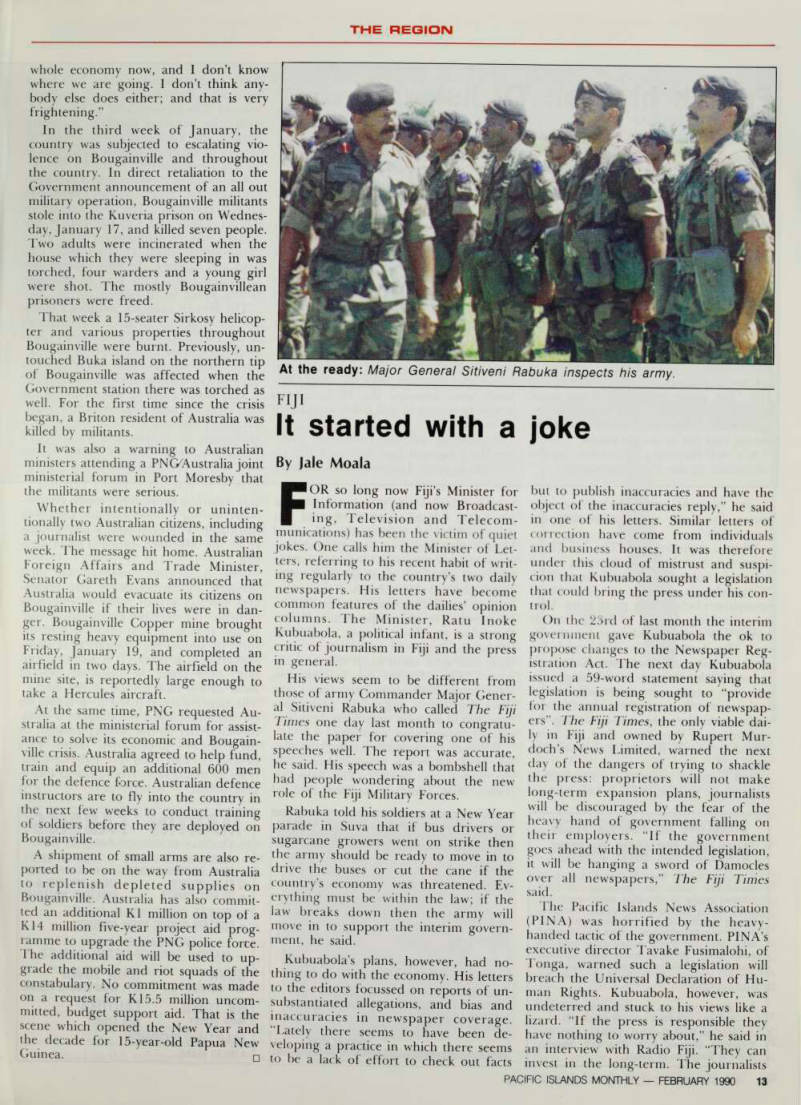
His views seem to be different from those of army Commander Major Gener al Sitiveni Rabuka who called The Fiji Times one day last month to congratu late the paper for covering one of his speeches well. The report was accurate, he said. His speech was a bombshell that had people wondering about the new role of the Fiji Military Forces.
Rabuka told his soldiers at a New Year parade in Suva that if bus drivers or sugarcane growers went on strike then the army should be ready to move in to drive the buses or cut the cane if the country’s economy was threatened. Ev erything must be within the law; if the law breaks down then the army will move in to support the interim govern ment, he said.
Kubuabola’s plans, however, had no thing to do with the economy. His letters to the editors focussed on reports of un substantiated allegations, and bias and inaccuracies in newspaper coverage.
“Lately there seems to have been de veloping a practice in which there seems to be a lack of effort to check out facts
but to publish inaccuracies and have the object of the inaccuracies reply,” he said in one of his letters. Similar letters of correction have come from individuals and business houses. It was therefore under this cloud of mistrust and suspi cion that Kubuabola sought a legislation that could bring the press under his con trol.
On the 23rd of last month the interim government gave Kubuabola the ok to propose changes to the Newspaper Reg istration Act. The next day Kubuabola issued a 59-word statement saying that legislation is being sought to “provide for the annual registration of newspap ers”. The Fiji Times, the only viable dai ly in Fiji and owned by Rupert Mur doch’s News Limited, warned the next day of the dangers of trying to shackle the press; proprietors will not make
long-term expansion plans, journalists
will be discouraged by the fear of the heavy hand of government falling on their employers. “If the government goes ahead with the intended legislation, it will be hanging a sword of Damocles over all newspapers,” The Fiji Times said.
Ihe Pacific Islands News Association (PINA) was horrified by the heavy handed tactic of the government. PINA’s executive director Tavake Fusimalohi, of Tonga, warned such a legislation will breach the Universal Declaration of Hu man Rights. Kubuabola, however, was undeterred and stuck to his views like a lizard. “If the press is responsible they have nothing to worry about,” he said in an interview with Radio Fiji. “They can invest in the long-term. The journalists
At the ready: Major General Sitiveni Rabuka inspects his army.
do not have to worry. I don’t see any reason for them to worry if they are responsible.”
When a reporter from The Fiji Times pointed out to him that licensing was a form of censorship, Kubuabola replied: “Censorship is checking out contents of newspapers before they go to print. I am
not checking before printing, merely
laying down some guidelines for accura cy.” The Australian, an influential Au stralian daily, said that what Kubuabola is “undeniably doing is establishing a sys tem that means newspapers will have to look constantly over their shoulders to make sure they are not annoying the authorities. If they do so they risk being closed down. If that is not censorship, what is?”
Will licensing improve the standard of journalism in Fiji? Will it bring about
responsibility? These were questions that journalists wanted to ask Kubuabola. But the Minister of Information distanced himself from the press and avoided hav ing to answer questions except for the interview with the state-run Radio Fiji.
Pacific Islands Monthly tried unsuccess fully to see Kubuabola before he flew to Washington to attend the annual Prayer Breakfast at White House. Australian Associated Press was told to write ques tions and send them in. It did, and the reply: “The Minister for Information, Ratu Inoke Kubuabola has advised that
since legislation regarding newspaper
registration is being drawn up, he is un able to answer your questions.”
Whether intentionally or not, the tim ing of Kubuabola’s announcement late last month was perfect. The issue re ceived little attention in New Zealand
and Australia because the media concen trated on the Commonwealth Games in Auckland. The only strong attack came from the Murdoch-owned The Austra lian.
The Australian, pointed out that
through an extraordinary visa regula
tion, Fiji has already made it “extremely difficult” for overseas journalists to visit.
It said that to impose censorship in the form of annual registration “is as short sighted as it is tragic. It is also unneces sary, even from the point of view of those in Fiji most critical of the media”.
The paper warned that Fiji “is taking on the institutionalised trappings of a dicta torship. After all the ravages wrought by the country’s ill-conceived coups, Fiji’s people with their pre-Rabuka tradi tions of democracy, freedom and intelli gent debate deserve better”. □