Counting the losses
p. 12 · Read in the full issue
The Region
Papua New Guinea
Counting the losses in a state of war
By Frank Senge
THE Governor of the Bank of Papua New Guinea, Sir Henry Toßobert, planned a nasty sur prise for his country on January 2 this year. He was going to announce the first of a series of economic measures aimed at staving off a rapid depletion of the country’s foreign reserves and to cushion off the effects of the prolonged closure of the Bougainville copper mine and de
pressed agricultural commodity prices.
Instead, Toßobert himself was shock ed, along with the rest of the country, when a personal friend and Governor General, Sir Ignatius Kilage, 48, died on New Year’s eve. Out of respect, Toßobert postponed the announcement of the economic adjustment measures.
One week later, Tuesday 9, Toßobert told the still shocked nation that the bank had adopted a recessionary monet ary policy. A zero rate credit growth target was set for 1990, down from the previous year’s 9-10 per cent credit growth. New lending would be made from banks only as existing loans were repaid except a few exempted activities including the Government itself. Indi viduals were to borrow a maximum K2OOO only.
The next day, Finance and Planning Minister, Paul Pora announced that the Kina had been devalued by 10 per cent.
Pora said the country had been living beyond its means and urged people to turn back to subsistence produce.
As the news filtered into the mostly rural illiterate population, the Govern ment announced two days later, Thurs day January 4, that the K 1.25 billion spending forecast for 1990 would be chopped back by KlOO million. All the 19 provincial departments were ordered to cut proposed spending by 10 per cent and national departments and govern ment agencies by 25 per cent.
Pora told Parliament, reconvened to discuss the state of emergency on Bougainville, that the Government would also seek wages restraint measures with trade unions. On the same day, the Government announced to Parliament that it had ceased all attempts at peace ful negotiations with militants on Bougainville. Prime Minister Rabbie Namaliu told Parliament that the Gov ernment had adopted an all-military op tion to quell the 14-month-old uprising as quickly as possible.
The Government proposed heavier penalties against terrorism and taking up arms against the state. The Opposition protested the Government action, saying it had come too late and called for a total withdrawal of the 600-strong secur ity force on the island.
But when the vote was taken January 5 for an extension of the state of emergency on Bougainville, Parliament voted 62 to 18 in favour. The security forces were given a further two months, using its new powers to try to end the crisis. Following the extension of the state of emergency Namaliu said: “We now have the greenlight from the elected representatives of the people to pursue our military option on Bougain ville, and we accept the heavy responsibi lities involved.
“The priorities of the Government are clear. First, we will rid Bougainville of this terrorist scourge. Second, we will restore peace to the island. Third, and vital, for the whole nation, we will re open the Bougainville copper mine.”
In the first two weeks of the new year, the cumulative effects of the landowner uprising on Papua New Guinea’s Bougainville island and depressed and
falling agricultural commodity and log
prices impacted on the nation all at once. Toßobert estimated that the result ing recession would last three years.
The non-mining private sector, already reeling from the shocks of Bougainville, was staggered by the Gov ernment measures. The agricultural and local manufacturing sectors, two areas targeted as potential beneficiaries of these measures, are doubtful. Cocoa growers spokesman, Roger Middleton, said: “Had the Government been sensi tive and used the Stabex funds (from the EEC) at the right time it would have taken a lot of pressure off the banking system and helped the grower.
“Now, unemployment is coming on a bigger scale. It’s going to bite into the
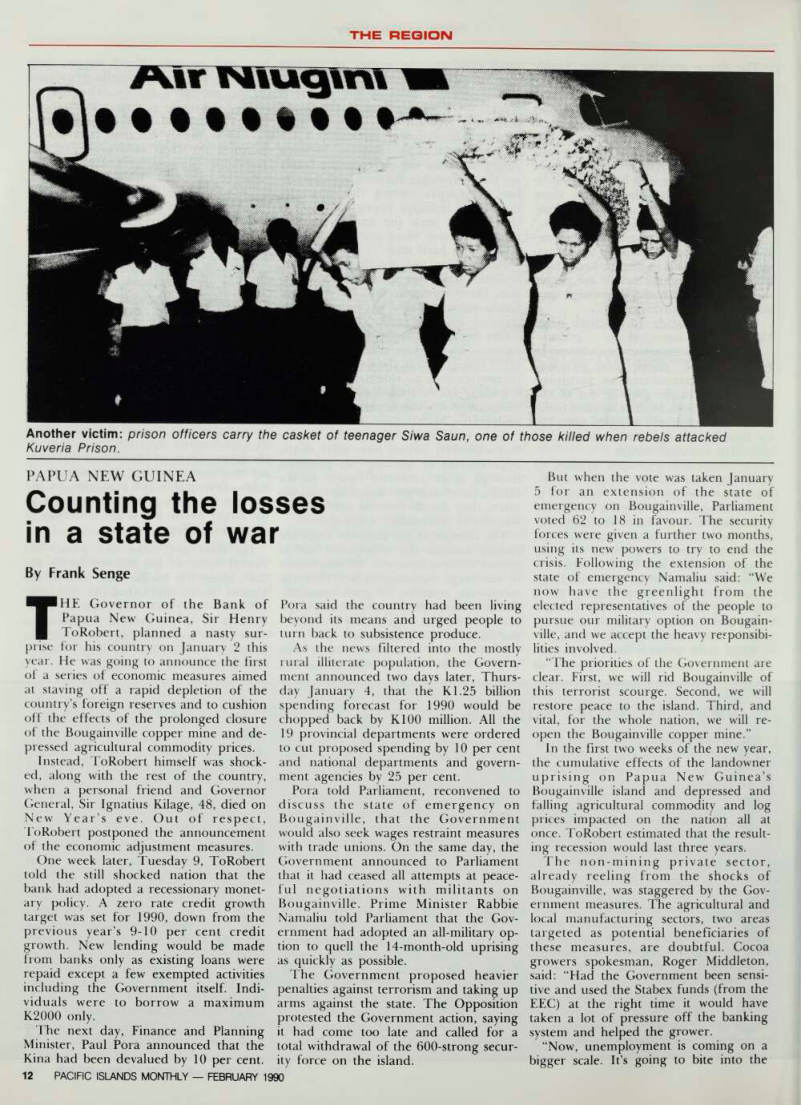
Another victim: prison officers carry the casket of teenager Siwa Saun, one of those killed when rebels attacked Kuveria Prison.