An angry man
pp. 55-57 · Read in the full issue
Pacific People
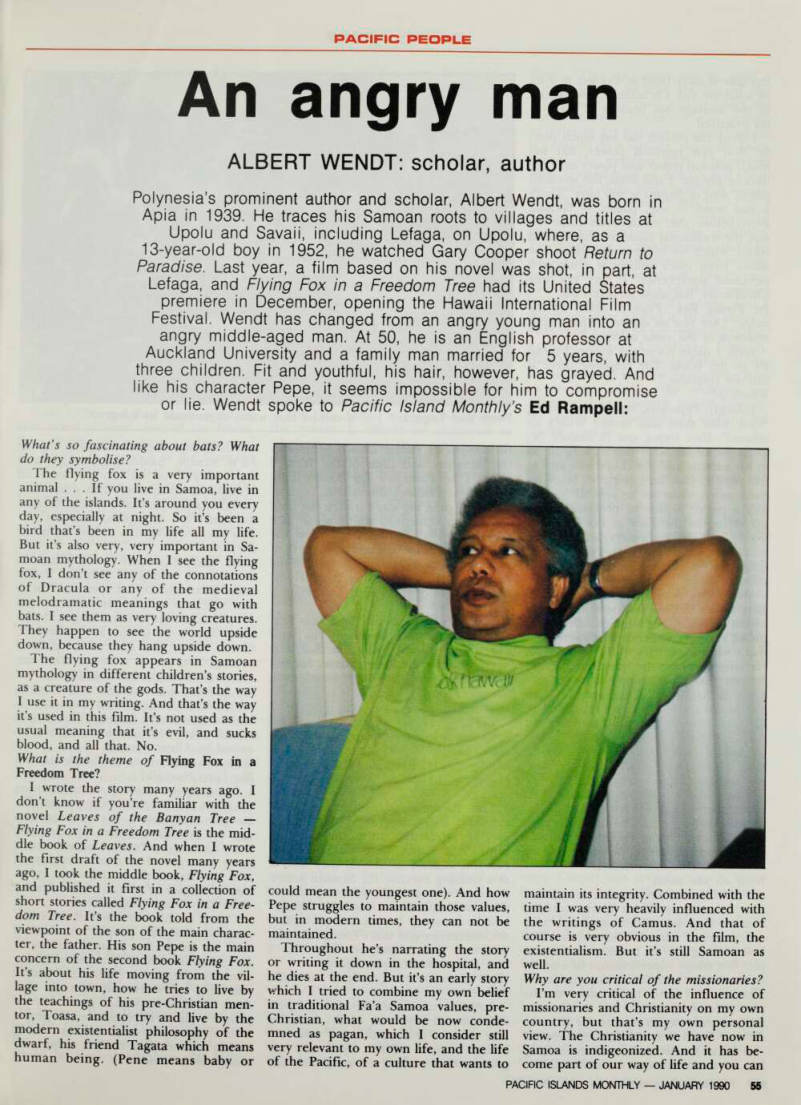
ALBERT WENDT: scholar, author Polynesia's prominent author and scholar, Albert Wendt, was born in Apia in 1939. He traces his Samoan roots to villages and titles at Upolu and Savaii, including Lefaga, on Upolu, where, as a 13-year-old boy in 1952, he watched Gary Cooper shoot Return to Paradise. Last year, a film based on his novel was shot, in part, at Lefaga, and Flying Fox in a Freedom Tree had its United States premiere in December, opening the Hawaii International Film Festival. Wendt has changed from an angry young man into an angry middle-aged man. At 50, he is an English professor at Auckland University and a family man married for 5 years, with three children. Fit and youthful, his hair, however, has grayed. And like his character Pepe, it seems impossible for him to compromise or lie. Wendt spoke to Pacific Island Monthly’s Ed Rampell:
What’s so fascinating about bats? What do they symbolise?
The flying fox is a very important animal ... If you live in Samoa, live in any of the islands. It’s around you every day, especially at night. So it’s been a bird that’s been in my life all my life.
But it’s also very, very important in Sa moan mythology. When I see the flying fox, I don’t see any of the connotations of Dracula or any of the medieval melodramatic meanings that go with bats. I see them as very loving creatures.
They happen to see the world upside
down, because they hang upside down.
The flying fox appears in Samoan mythology in different children’s stories, as a creature of the gods. That’s the way I use it in my writing. And that’s the way it’s used in this film. It’s not used as the usual meaning that it’s evil, and sucks blood, and all that. No.
What is the theme of Hying Fox in a Freedom Tree?
I wrote the story many years ago. I don’t know if you’re familiar with the novel Leaves of the Banyan Tree Flying Fox in a Freedom Tree is the mid dle book of Leaves. And when I wrote the first draft of the novel many years ago, I took the middle book, Flying Fox, and published it first in a collection of short stories called Flying Fox in a Free dom Tree. It’s the book told from the viewpoint of the son of the main charac ter, the father. His son Pepe is the main concern of the second book Flying Fox.
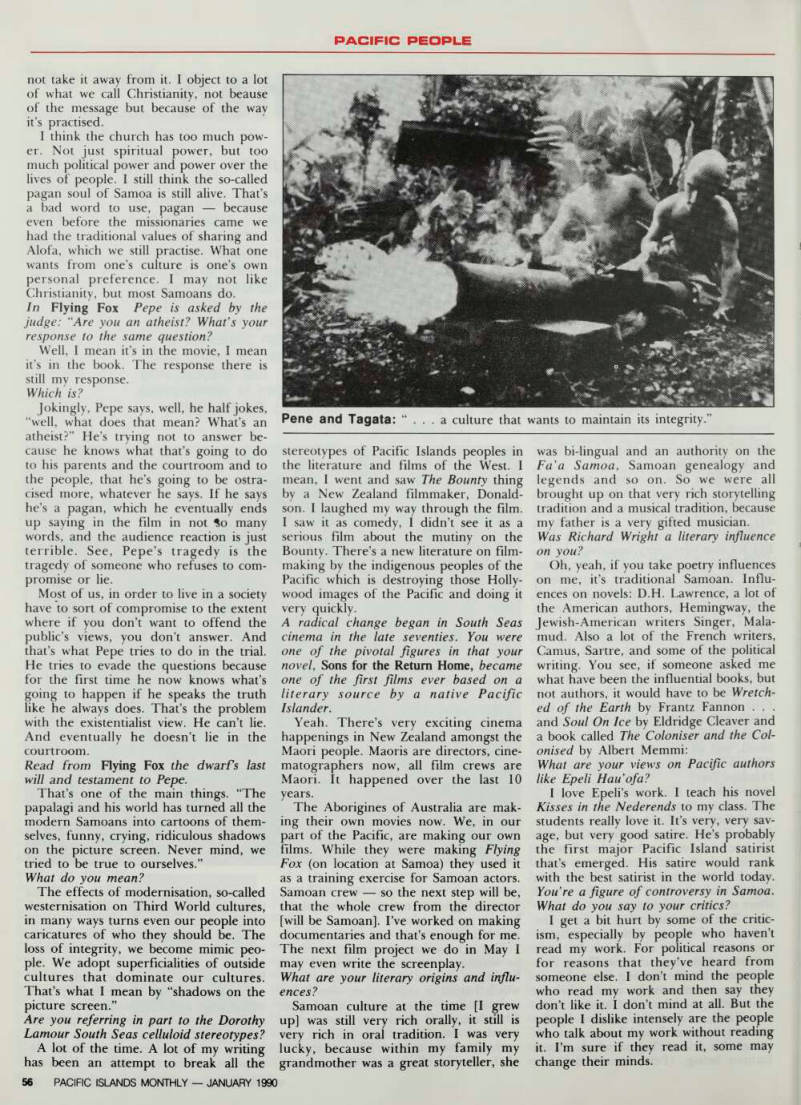
It’s about his life moving from the vil lage into town, how he tries to live by the teachings of his pre-Christian men tor, Toasa, and to try and live by the modern existentialist philosophy of the dwarf, his friend Tagata which means human being. (Pene means baby or
could mean the youngest one). And how Pepe struggles to maintain those values, but in modern times, they can not be maintained.
Throughout he’s narrating the story or writing it down in the hospital, and he dies at the end. But it’s an early story which I tried to combine my own belief in traditional Fa’a Samoa values, pre- Christian, what would be now condemned as pagan, which I consider still very relevant to my own life, and the life of the Pacific, of a culture that wants to
maintain its integrity. Combined with the time I was very heavily influenced with the writings of Camus. And that of course is very obvious in the film, the existentialism. But it’s still Samoan as well.
Why are you critical of the missionaries?
I’m very critical of the influence of missionaries and Christianity on my own country, but that’s my own personal view. The Christianity we have now in Samoa is indigeonized. And it has be come part of our way of life and you can
not take it away from it. I object to a lot of what we call Christianity, not beause of the message but because of the way
it’s practised.
I think the church has too much pow er. Not just spiritual power, but too much political power and power over the lives of people. I still think the so-called pagan soul of Samoa is still alive. That’s a bad word to use, pagan because even before the missionaries came we had the traditional values of sharing and Alofa, which we still practise. What one wants from one’s culture is one’s own personal preference. I may not like Christianity, but most Samoans do.
In Flying Fox Pepe is asked by the judge: “Are you an atheist? What’s your response to the same question?
Well, I mean it’s in the movie, I mean it’s in the book. The response there is still my response.
Which is?
Jokingly, Pepe says, well, he half jokes, “well, what does that mean? What’s an atheist?” He’s trying not to answer be cause he knows what that’s going to do to his parents and the courtroom and to the people, that he’s going to be ostra cised more, whatever he says. If he says he’s a pagan, which he eventually ends up saying in the film in not *o many words, and the audience reaction is just terrible. See, Pepe’s tragedy is the tragedy of someone who refuses to com promise or lie.
Most of us, in order to live in a society have to sort of compromise to the extent where if you don’t want to offend the public’s views, you don’t answer. And that’s what Pepe tries to do in the trial.
He tries to evade the questions because for the first time he now knows what’s going to happen if he speaks the truth like he always does. That’s the problem with the existentialist view. He can’t lie.
And eventually he doesn’t lie in the courtroom.
Read from Flying Fox the dwarfs last will and testament to Pepe.
That’s one of the main things. “The papalagi and his world has turned all the modern Samoans into cartoons of them selves, funny, crying, ridiculous shadows on the picture screen. Never mind, we tried to be true to ourselves.”
What do you mean?
The effects of modernisation, so-called westernisation on Third World cultures, in many ways turns even our people into caricatures of who they should be. The loss of integrity, we become mimic peo ple. We adopt superficialities of outside cultures that dominate our cultures.
That’s what I mean by “shadows on the
picture screen.”
Are you referring in part to the Dorothy Lamour South Seas celluloid stereotypes?
A lot of the time. A lot of my writing has been an attempt to break all the
stereotypes of Pacific Islands peoples in the literature and films of the West. I mean, I went and saw The Bounty thing by a New Zealand filmmaker, Donaldson. I laughed my way through the film, I saw it as comedy, I didn’t see it as a serious film about the mutiny on the Bounty. There’s a new literature on filmmaking by the indigenous peoples of the Pacific which is destroying those Hollywood images of the Pacific and doing it
very quickly.
A radical change began in South Seas cinema in the late seventies. You were one of the pivotal figures in that your novel, Sons for the Return Home, became one of the first films ever based on a literary source by a native Pacific Islander.
Yeah. There’s very exciting cinema happenings in New Zealand amongst the Maori people. Maoris are directors, cinematographers now, all film crews are Maori. It happened over the last 10 years.
The Aborigines of Australia are making their own movies now. We, in our part of the Pacific, are making our own films. While they were making Flying Fox (on location at Samoa) they used it as a training exercise for Samoan actors, Samoan crew so the next step will be, that the whole crew from the director [will be Samoan]. I’ve worked on making documentaries and that’s enough for me.
The next film project we do in May I may even write the screenplay.
What are your literary origins and influences?
Samoan culture at the time [I grew up] was still very rich orally, it still is very rich in oral tradition. I was very lucky, because within my family my grandmother was a great storyteller, she
was bi-lingual and an authority on the Fa’a Samoa, Samoan genealogy and legends and so on. So we were all brought up on that very rich storytelling tradition and a musical tradition, because my father is a very gifted musician.
Was Richard Wright a literary influence on you?
Oh, yeah, if you take poetry influences on me, it’s traditional Samoan. Influ ences on novels: D.H. Lawrence, a lot of the American authors, Hemingway, the
Jewish-American writers Singer, Mala
mud. Also a lot of the French writers, Camus, Sartre, and some of the political writing. You see, if someone asked me what have been the influential books, but not authors, it would have to be Wretch ed of the Earth by Frantz Fannon . . . and Soul On Ice by Eldridge Cleaver and a book called The Coloniser and the Col onised by Albert Memmi: What are your views on Pacific authors like Epeli Hau’ofa?
I love Epeli’s work. I teach his novel Kisses in the Nederends to my class. The students really love it. It’s very, very sav age, but very good satire. He’s probably the first major Pacific Island satirist that’s emerged. His satire would rank with the best satirist in the world today.
You’re a figure of controversy in Samoa.
What do you say to your critics?
I get a bit hurt by some of the critic
ism, especially by people who haven’t
read my work. For political reasons or for reasons that they’ve heard from someone else. I don’t mind the people who read my work and then say they don’t like it. I don’t mind at all. But the people I dislike intensely are the people who talk about my work without reading it. I’m sure if they read it, some may change their minds.
Pene and Tagata: “ . . . a culture that wants to maintain its integrity.”
Why are you being criticised by non islanders?
They don’t like being attacked; the very picture that they have of the Pacific that they themselves have created de liberately because of their hang-ups, the worst of their hang-ups, you know, so they look for a place where there are
happy people, happy go-lucky people,
the whole bullshit mythology of the Paci fic created by the West. When that com es under attack, people don’t like it, plus, even the so-called anthropologists and sociologists who are very serious ab out the Pacific, some of them I don’t like. I despise them more than I despise the Hollywood filmmakers.
At least the Hollywood filmmakers are
honest about what they’re doing: they’re
making good movies that will sell.
Whereas some anthropologists and
sociologists set out saying they’re serious
students of the Pacific, they’re giving a serious picture of the Pacific. No.
Some of them I find more objection able, some of their views of the Pacific.
Because they are making a judgment of the Pacific. If you look at the Margaret Mead/[Derek] Freeman debate, it’s a ridiculous debate. I mean, I support Freeman in the debate because I tend to agree with his vision of Samoa. It’s a serious debate we have two pakehas arguing, and here we are the people being debated about, sitting on the side line, not being considered at all. And the two visions under debate are these two pakeha visions, not ours of ourselves.
A lot of the people who dislike my work very much are of that so-called se rious scholars of the Pacific. Because, as
you say, for the first time, Pacific Islan ders are now telling them: “Why don’t you shut up for a while and let us say what we believe and what we think we are?” They don’t like it at all. So then when they talk to other Pacific Islanders I mean, the divide and rule thing in the colonial situation is very cleverly done.
That’s why Albert Wendt is a danger ous man you see, his views of Samoa criticises Samoans. Well, I don’t mind that at all, people do it all over the world. But at least they should be honest about what they’re doing, and admit they don’t know anything about Samoa,
despite spending years studying it. For
people who come in and say they under stand this after being there nine months like Mead, I find that absolutely objec tionable.
Your palagi and Samoan critics say you extol what you envision as being the true Fa’a Samoa lifestyle, but you don’t live it.
The Fa’a Samoa to me is the values of the system. It should be embodied in whatever way you live, whether you drive a Western car or live in a palagi house. Now what those people are saying is that I should be a purist. What I’m extolling are the values of the Fa’a Samoa, which is the sharing of the ex tended family system, the honesty which we have in our system about ourselves and other people.
Three leading Western Samoan artists Momoe Von Reiche, the poet-painter daughter of the king of Samoa, painter losua, and you all live abroad: artistic brain drain.
Only temporarily. Our heart is still in
Samoa. You see, sometimes we need a period where we can get out of the problems of our own country and the hassles in order to do our own writing, in order to get ourselves together again.
It’s easy to do it outside, physically being outside the problem itself. I mean, in New Zealand now, I don’t wake up in the middle of the night with cold sweats.
You did that in Samoa? Why?
The problems of the country. In Samoa, you can’t escape the problems, You wake up in the morning and you see it; the unemployment, what is hap pening within government, the corrup tion, the suffering of a lot of the people.
When you’re in it, it’s 24 hours. And I was involved in a lot of it, all the political stuff. And I used to get recurring ulcers, stomach ulcers, I suffered from it.
Hasn’t caused me any problems in the last six months in New Zealand because it’s another country, the problems are different, I can divorce myself from it.
My reason [for leaving] I was just fed up for a while.
What are your politics?
They’re very left wing.
What do you see as the future of the Pacific Islands?
We have enormous problems . . . eco nomic problems are quite huge. We, in cluding the American territories, most of our countries, to put it very crudely, have now become permanent welfare cases in the sense that we’re totally de pendent on foreign aid. This, of course,
has dangerous political implications for
us. It now means that foreign govern ments can influence us politically whichever way they want us to go. □
• Jan Waddy, “an experienced sports administrator” has been appointed sports director for the South Pacific Games Foundation in Papua New Guinea. Wad dy, 31, is from Christchurch. She is net ball coaching director and lecturer in physical education at the National Sports Institute at Goroka. Her part-time appointment puts her in charge of venues, programmes, accreditation, medical tests (drug tests), training of athletes, and technical officials for the 1991 South Pacific Games in Port
Moresby.
• Ali Kazak is the Palestine ambassa dor to Vanuatu. Kazak lives in Australia.
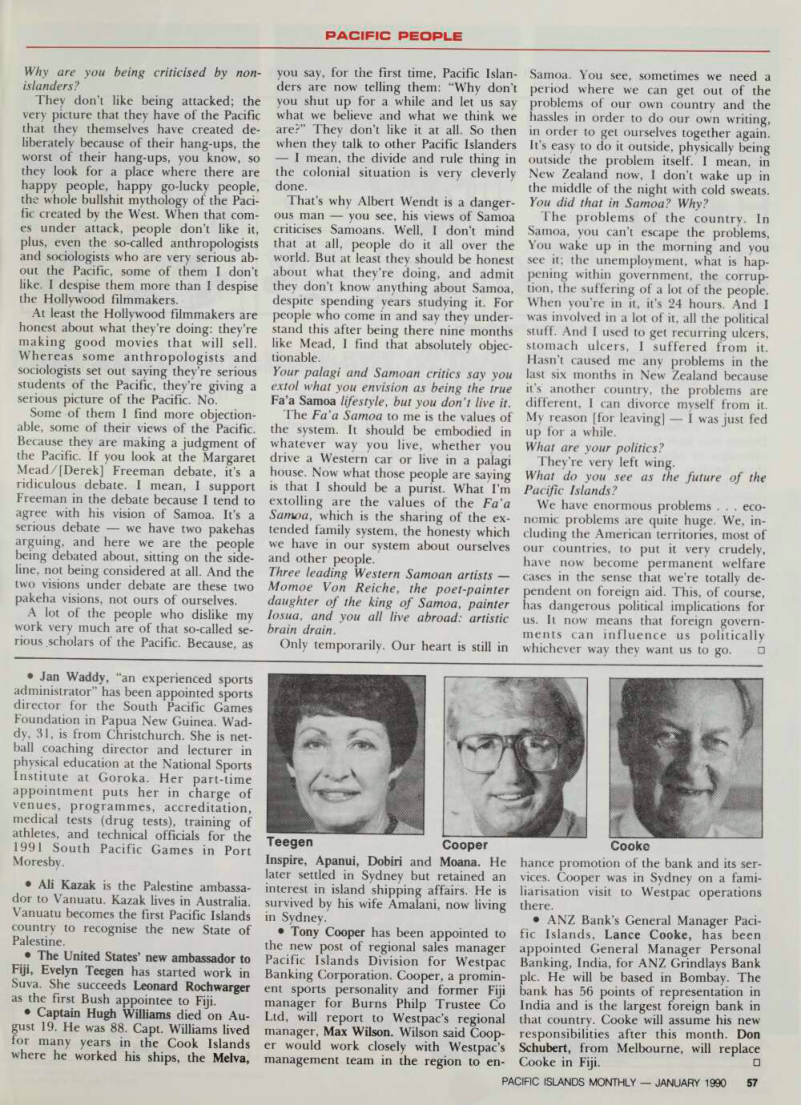
Vanuatu becomes the first Pacific Islands country to recognise the new State of Palestine. • The United States’ new ambassador to Fiji, Evelyn Teegen has started work in Suva. She succeeds Leonard Rochwarger as the first Bush appointee to Fiji. • Captain Hugh Williams died on Au gust 19. He was 88. Capt. Williams lived for many years in the Cook Islands where he worked his ships, the Melva,
Inspire, Apanui, Dobiri and Moana. He later settled in Sydney but retained an interest in island shipping affairs. He is survived by his wife Amalani, now living
in Sydney.
• Tony Cooper has been appointed to the new post of regional sales manager Pacific Islands Division for Westpac
Banking Corporation. Cooper, a promin
ent sports personality and former Fiji manager for Burns Philp Trustee Co Ltd, will report to Westpac’s regional manager, Max Wilson. Wilson said Coop er would work closely with Westpac’s management team in the region to en
hance promotion of the bank and its ser vices. Cooper was in Sydney on a fami liarisation visit to Westpac operations there. • ANZ Bank’s General Manager Paci fic Islands, Lance Cooke, has been appointed General Manager Personal Banking, India, for ANZ Grindlays Bank pic. He will be based in Bombay. The bank has 56 points of representation in India and is the largest foreign bank in that country. Cooke will assume his new responsibilities after this month. Don Schubert, from Melbourne, will replace Cooke in Fiji. □
Teegen
Cooper
Cooke