Fiji’s tuna industry
pp. 35-38 · Read in the full issue
Special Report
Fiji’s tuna industry
Three years ago the Fiji government took over the running of the Pacific Fishing Company at Levuka and quickly built a thriving industry in the old capital of Fiji. Today Pacific Fishing Company (PAFCO) is producing 80 tonnes of tuna a day, making canned tuna the third largest export of the country. Last month a PAFCO joint venture with overseas investors saw the opening of a new canning factory at Levuka.
CANNED tuna has become Fiji’s third largest export commodity af ter Pacific Fishing Company (PAF CO) increased production from 35 to 80 tonnes of tuna a day. The company sup plies canned skipjack, albacore and cat food to major overseas companies under 30 different labels.
PAFCO is largely owned by the Gov ernment, which assumed full responsibil ity for management and operation of the cannery in January 1987. Government holds 98 per cent of the shares. The rest is held by Fiji citizens. The government takeover has resulted in savings in Man agement cost and profits increased sub
sequently.
The Japan International Co-operation Agency (JICA), a voluntary organisation, has provided four Japanese advisers to help in the engineering, freezer and can nery sections. PAFCO also has a special arrangement with the FCF Fishery Co Ltd, of Taiwan, for the supply of alba core tuna using Taiwanese longliners that previously fished out of Pago Pago.
PAFCO likes to boast it sells the world’s best tuna. Why? Fiji tuna has a unique light colour, a delicate texture and a subtle flavour. “What’s more, this prized fish is caught by the traditional pole and line method, and is brought ashore fresh for hand trimming and can ning to ensure a consistently-superior product,” said a company spokesperson.
At PAFCO, the tuna is cooked soon after being caught. In other countries, the fish is stored for long periods before processing, says the company’s general manager, Mitieli Baleivanualala. “Our tuna is caught in the pure, unpolluted waters of the South Pacific by the most natural method, the pole and line,” he boasts. “The water we use during the production process is exceptionally pure and clean. It comes from a spring near the Totogo creek in a valley close to Levuka town (where the cannery is lo-
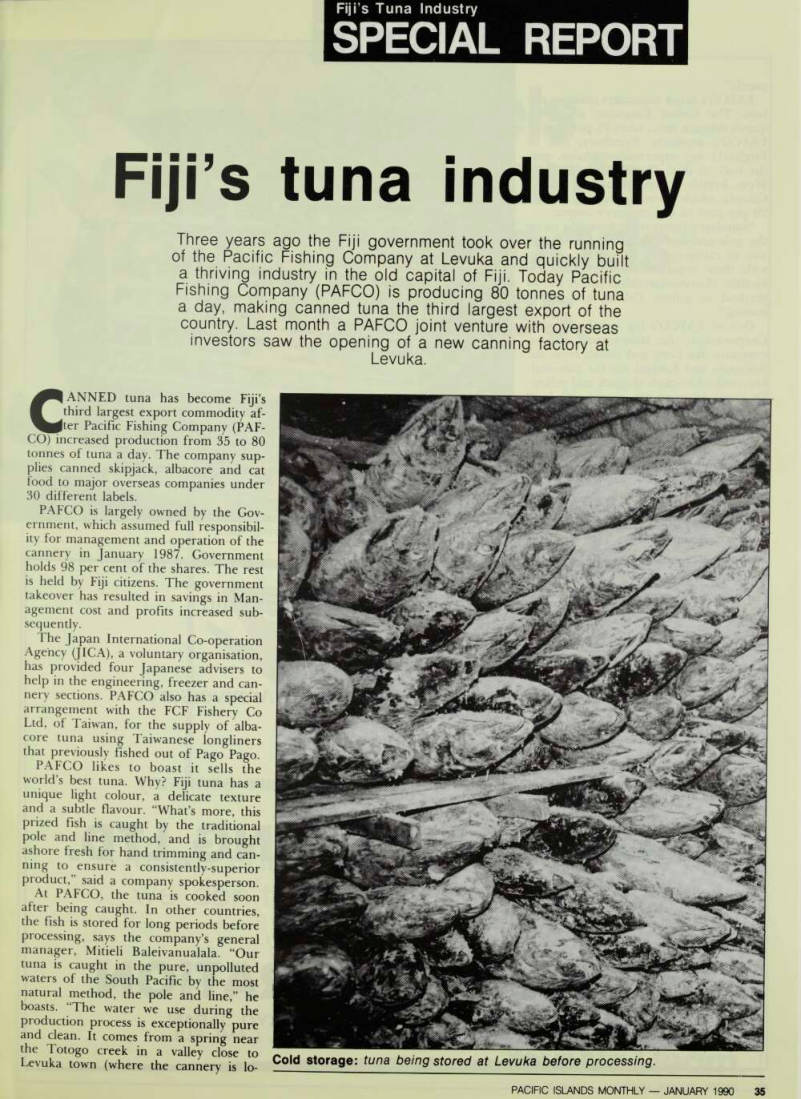
Cold storage: tuna being stored at Levuka before processing.
cated).”
PAFCO’s major customers insist on the best. The United Kingdom, which re quires skipjack tuna, takes 75 per cent of PAFCO’s products. Sainsbury, one of England’s top supermarket chains, gets the bulk of this. The rest goes to John West. British Columbia Packers Ltd, of Canada, which favours albacore, absorbs 20 per cent of the cannery’s output.
“Sainsbury insists on fish caught using
the pole-and-line method the natural way of catching fish and we comply with their requirements,” says Baleiva nualala. “Environmentalists prefer this to method to gillnet fishing and purse seining.”
One of PAFCO’s big suppliers is Ika Corporation, the state-owned fishing company. Ika Corp and vessels from the Solomons and Kiribati use the pole-and line method to catch skipjack and yellow fin tuna. Albacore are caught with long lines, and 16 Taiwanese ships supply the
company regularly.
PAFCO’s Board of Directors is con sidering the possibility of a link-up with the Ika Corporation. If this happens, Ika may eventually end up as a subsidiary of
Pafco.
“Ideally, we would like to see Ika move its head office from Suva to Levu ka,” says Baleivanualala. The Ika Cor-
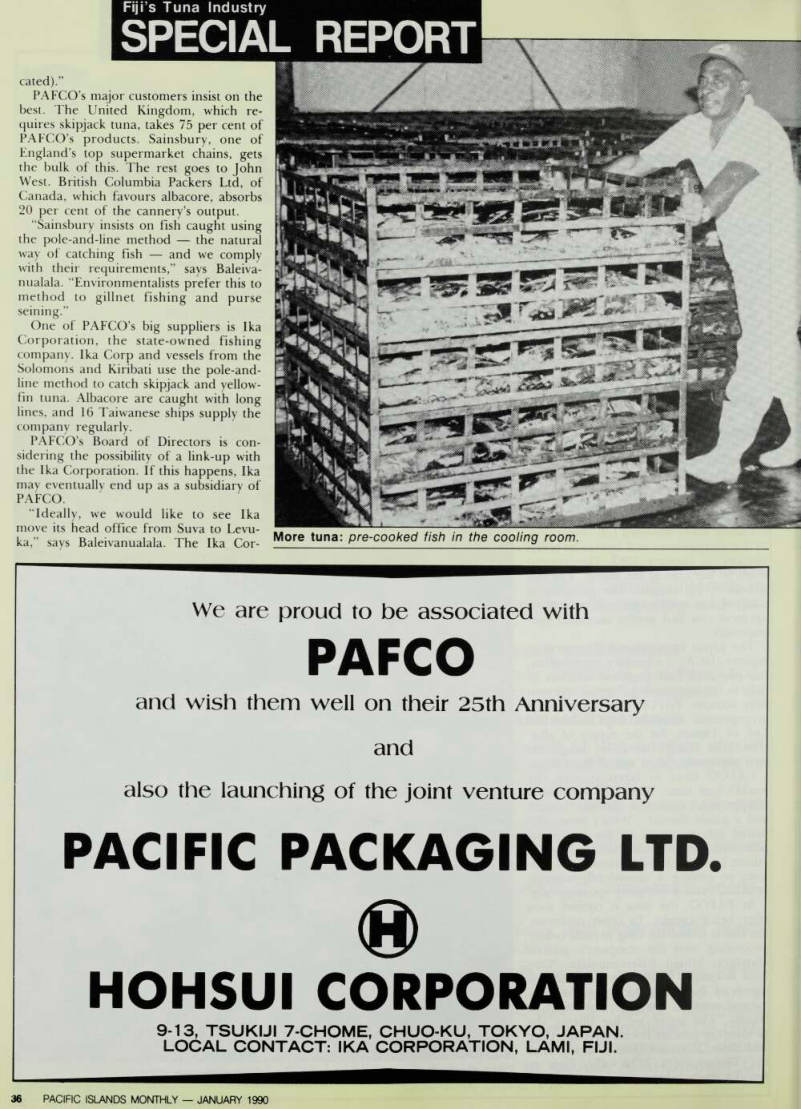
More tuna: pre-cooked fish in the cooling room.
poration was established by the Govern ment in 1975 to do commercial tuna fishing. Currently based at Lami, outside Suva, the corporation supplies PAFCO with fish for solid-pack production, Baleivanualala says PAFCO is also looking at the possibility of joint ven tures with Japanese and Taiwanese fishing companies, and there are some prospects of training Fiji crew to work on Japanese fishing boats. PAFCO is also looking into the production of sashimi or raw fish for the Japanese market. “Our new coldstore, to be built early next year through an Australian Aid Package will provide a special facility for the storage of sashimi,” Baleinaivalu says.
“At the moment we are doing a feasi bility study into the possibility of export ing the product. We are looking at prices and exploring new markets.”
Baleivanualala sees great potential for the development of the tuna industry in Fiji and is enthusiastic about plans for PAFCO. He would like to see the com pany increase its output from 15,000 tonnes to 20,000 tonnes a year, reduce overheads and increase profitability.
“At the moment the level of tuna stocks in our waters is unknown. We ex pect anything from 4-20,000 tonnes of tuna a year,” he says. “Therefore we
have to look outside to our neighbours, especially for skipjack and yellowfin tuna. This source of supply worked very well last year, so we are continuing with the system through 1990.
“Ideally, we would like to form close associations with countries such as Kiri bati, the Solomon Islands and Papua New Guinea for tuna supplies. Perhaps we can join forces with these countries.
If we work together, we’ll have a strong position in terms of pricing and produc tivity.
“With regards to albacore, Fiji is in the middle of the source and we’re now able to take advantage of this. The comple tion of our new coldstore will give us buying and selling power. The additional storage space will introduce a new facet to the business. We will be able to buy fish when prices are right and store the unprocessed tuna for export.”
With PAFCO now using two-piece can technology, Baleivanualala says there are possibilities for exporting cans to Amer ican Samoa and the Solomon Islands and perhaps New Zealand and Australia.
“Later, we can look to Asian countries, and maybe the United States,” he says.
Baleivanualala has just returned from negotiating major contracts in the Un ited Kingdom and Canada. His next
priority is to source raw materials for the company.
PAFCO has become the mainstay of the economy on the island of Ovalau, off the coast north of Suva. Levuka, its main centre, was the first capital of Fiji.
Now old and dusty, Levuka relies on PAFCO for employment.
“Without PAFCO, Levuka would be a ghost town, says local chief Ratu Kolinio Rokotuinaceva, who carries the title Tui Levuka. Ratu Kolinio says most people on Ovalau and neighbouring Moturiki island rely on PAFCO for work. “When the company makes a profit, the workers benefit through a bonus,” he says.
Ratu Kolinio recalls the days when Levuka enjoyed a brisk copra trade.
“Burns Philp and Morris Hedstrom were here at the time,” he says. “But today, the tuna industry is our only source of income. We have no other. Through PAFCO, people also have employment on the waterfront and with the Ports Au thority.”
PAFCO contributes to education and the promotion of sport on Ovalau. Says Ratu Kolinio: “The company has put aside about F$ 10,000 for education this year. I think the money will be used to sponsor students at secondary school level.” □