Sparteca rules
p. 26 · Read in the full issue
causes unease
PACIFIC Forum countries, led by Fiji, are looking for greater ac cess to the Australian and New Zealand markets. A recent meeting of Fiji-Australia and Australia-Fiji business councils in Suva called for a review of the South Pacific Regional Trade and Economic Co-operation Agreement (Sparteca).
The unease in the
region revolves
around several issues: • The coming into effect this year of the Closer Economic Rela tionship (CER) be tween Australia and New Zealand, which is feared will leave the island nations outside the new free trade area. • The rules of ori gin guidelines, which specify that goods ex ported duty-free into Australia and New Zealand must have 50 per cent local content, are too rigorous.
• The dismantling of Australia’s pro tection and tariff walls will remove much of the advantage now held by the island nations against exporters from other low-cost developing countries.
Most vocal has been Fiji’s Trade and Commerce Minister Berenado Vunibobo, who told the Suva meeting that CER would adversely affect Pacific island ex ports to New Zealand and Australia. He said all the parties to the Sparteca agreeement should discuss a new arrangement this would involve New Zealand, Australia, Fiji, Tonga, Niue, Federated States of Micronesia, Marshall Islands, Western Samoa, Vanuatu, Cook Islands, Solomon Islands, Kiribati, Tuva lu, Nauru and Papua New Guinea.
Vunibobo singled out the rules of ori gin clause in Sparteca. This requires that 50 per cent of the cost of an item must be added in one of the Forum countries, or by a combination of Forum countries.
If the goods are going into Australia, that item cannot have more than 25 per cent New Zealand content as part of the requirement, and the reverse arrange ment for exports to New Zealand.
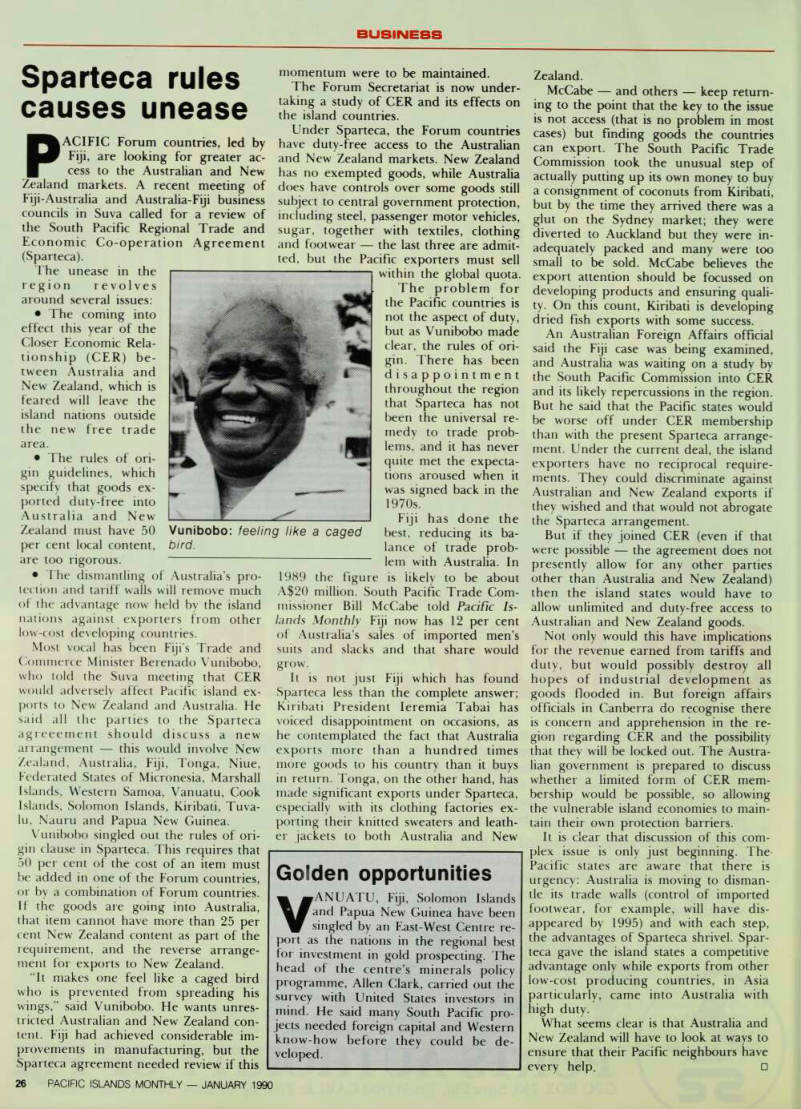
“It makes one feel like a caged bird who is prevented from spreading his wings,” said Vunibobo. He wants unres tricted Australian and New Zealand con tent. Fiji had achieved considerable im provements in manufacturing, but the Sparteca agreement needed review if this
momentum were to be maintained.
The Forum Secretariat is now under taking a study of CER and its effects on the island countries.
Under Sparteca, the Forum countries have duty-free access to the Australian and New Zealand markets. New Zealand has no exempted goods, while Australia does have controls over some goods still subject to central government protection, including steel, passenger motor vehicles, sugar, together with textiles, clothing and footwear the last three are admit ted, but the Pacific exporters must sell
within the global quota.
The problem for the Pacific countries is not the aspect of duty, but as Vunibobo made clear, the rules of ori gin. There has been
disappointment
throughout the region
that Sparteca has not been the universal re medy to trade prob lems, and it has never quite met the expecta tions aroused when it was signed back in the 19705.
Fiji has done the best, reducing its ba lance of trade prob lem with Australia. In
1989 the figure is likely to be about As2o million. South Pacific Trade Com missioner Bill McCabe told Pacific Is lands Monthly Fiji now has 12 per cent of Australia’s sales of imported men’s suits and slacks and that share would grow.
It is not just Fiji which has found Sparteca less than the complete answer; Kiribati President leremia Tabai has voiced disappointment on occasions, as he contemplated the fact that Australia exports more than a hundred times more goods to his country than it buys in return. Tonga, on the other hand, has made significant exports under Sparteca, especially with its clothing factories ex porting their knitted sweaters and leath er jackets to both Australia and New
Zealand.
McCabe and others keep return ing to the point that the key to the issue is not access (that is no problem in most cases) but finding goods the countries can export. The South Pacific Trade Commission took the unusual step of actually putting up its own money to buy a consignment of coconuts from Kiribati, but by the time they arrived there was a glut on the Sydney market; they were diverted to Auckland but they were in adequately packed and many were too small to be sold. McCabe believes the export attention should be focussed on
developing products and ensuring quali
ty. On this count, Kiribati is developing dried fish exports with some success.
An Australian Foreign Affairs official said the Fiji case was being examined, and Australia was waiting on a study by the South Pacific Commission into CER and its likely repercussions in the region.
But he said that the Pacific states would be worse off under CER membership than with the present Sparteca arrange ment. Under the current deal, the island exporters have no reciprocal require ments. They could discriminate against Australian and New Zealand exports if they wished and that would not abrogate the Sparteca arrangement.
But if they joined CER (even if that were possible the agreement does not presently allow for any other parties other than Australia and New Zealand) then the island states would have to allow unlimited and duty-free access to Australian and New Zealand goods.
Not only would this have implications for the revenue earned from tariffs and
duty, but would possibly destroy all
hopes of industrial development as goods flooded in. But foreign affairs officials in Canberra do recognise there is concern and apprehension in the re
gion regarding CER and the possibility
that they will be locked out. The Austra lian government is prepared to discuss whether a limited form of CER mem bership would be possible, so allowing the vulnerable island economies to main tain their own protection barriers.
It is clear that discussion of this com plex issue is only just beginning. The Pacific states are aware that there is urgency: Australia is moving to disman tle its trade walls (control of imported footwear, for example, will have dis appeared by 1995) and with each step,
the advantages of Sparteca shrivel. Spar
teca gave the island states a competitive advantage only while exports from other low-cost producing countries, in Asia particularly, came into Australia with
high duty.
What seems clear is that Australia and New Zealand will have to look at ways to ensure that their Pacific neighbours have every help. □
Vunibobo: feeling like a caged bird.