Foreign workers now worry Marianas
pp. 15-16 · Read in the full issue
The Region
Northern Marianas
By David North
SOME experts say that there are more foreign workers than perma nent residents in the Northern Marianas a situation which has led to long-term troubles in other parts of the world, such as Fiji and the Caribbean.
Meanwhile, the other two United States flag territories, Guam and Amer ican Samoa, have approached a similar challenge in different ways.
Government and business leaders in the Commonwealth of the Northern Mariana Islands (CNMI) say that the workers are needed to staff a booming economy, and that theirs is a temporary presence. At the moment CNMI has control over its own immigration policy, but the Mainland Congress could take over by unilaterally passing a law to that effect. And, unlike Guam and American Samoa, CNMI has no voice in the Con gress.
The CNMI immigration situation is not unique. Take a fortunately-located island, provide it with more jobs than people willing to take the jobs at the wages offered and the employers’ im mediate answer is give me foreign workers, preferably ones who are willing to work long and hard for low wages.
And, frankly, preferably workers who lack the legal rights of the indigenous
population.
The Carib Indians and the 16th Cen tury European plantation owners were the first islanders to face this situation.
The plantation owners could not per suade the Indians to work the sugar cane, so they brought in slaves instead.
The Caribs are now only a memory on islands like Barbados, Jamaica and Haiti, where the descendants of those slaves are now the majority population.
More recently was the situation in Fiji.
The sugar planters could not get
what they regarded as an adequate
workforce from the islands, so they brought in short-term Indian indentured workers; the latter stayed, multiplied, se cured economic power and sought poli tical power as well. A somewhat compa rable scenario has played out in New Caledonia.
Further, in the Caribbean, Fiji, and New Caledonia, later-day colonial rulers decided that all residents, not just the original ones should have the vote.
Mainland governments do not routinely deny the vote to immigrants, and cer tainly not to the children of immigrants.
CNMI, in contrast, makes it extremely difficult for its temporary workers to be come either permanent legal residents or
citizens.
This is the long-term historical pattern which faces CNMI, and its off-shore in vestors, but one which was discussed only in passing in the recent CNMI elec tions.
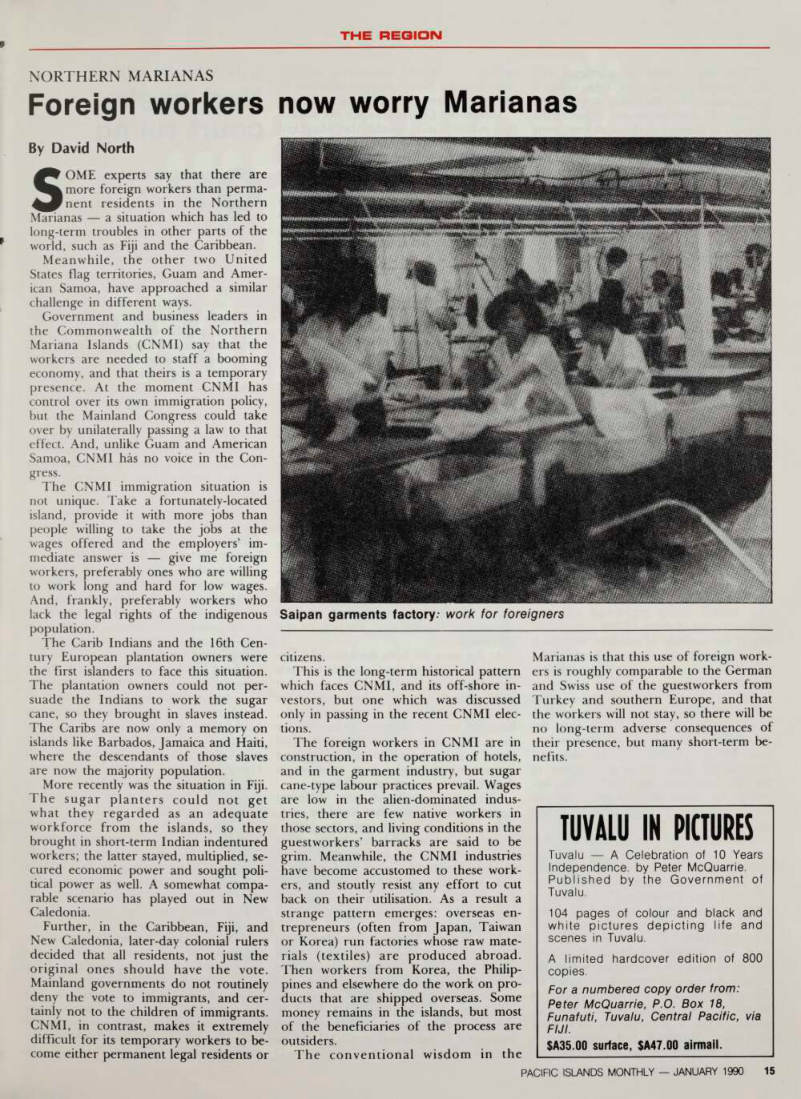
The foreign workers in CNMI are in construction, in the operation of hotels, and in the garment industry, but sugar cane-type labour practices prevail. Wages are low in the alien-dominated indus tries, there are few native workers in those sectors, and living conditions in the guestworkers’ barracks are said to be grim. Meanwhile, the CNMI industries have become accustomed to these work ers, and stoutly resist any effort to cut back on their utilisation. As a result a strange pattern emerges: overseas en trepreneurs (often from Japan, Taiwan or Korea) run factories whose raw mate rials (textiles) are produced abroad.
Then workers from Korea, the Philip pines and elsewhere do the work on pro ducts that are shipped overseas. Some money remains in the islands, but most of the beneficiaries of the process are outsiders.
The conventional wisdom in the
Marianas is that this use of foreign work ers is roughly comparable to the German and Swiss use of the guestworkers from Turkey and southern Europe, and that the workers will not stay, so there will be no long-term adverse consequences of their presence, but many short-term be nefits.
Saipan garments factory: work for foreigners
There are a couple of problems with this cheerful point of view. First, unless a government takes the brutal approach of the oil-rich Arab states and enforces the rotation of foreign workers, at least some of those workers will stay, intermarry, and have children. This certainly has been the German experience. As one European observer noted: “We sent for workers and we got people.”
Europe stopped bringing in guestwor kers in 1973, and still is struggling with their long-term consequences.
The second problem with the cheerful approach is the matter of numbers. No European nation has ever flooded its labour markets with aliens as CNMI has done. The Swiss, who have since cut back their programme, and who have an Arab-like view of the rights of foreign workers, had, at most 40 per cent of its total work force in the alien category.
The percentage in Germany never ex ceeded 10 per cent.
While the full extent of the CNMI alien work force is not known (particu larly the suspected thousands of illegal aliens), it is pretty obvious that there are many more alien workers than resident ones. For instance, the resident popula tion of the islands is about 17,000 and about 8000 people voted in the last elec tion.
In contrast, William H. Stewart, direc tor of the territorial census, recently re ported in the Marianas Variety News and Views that 82 per cent of the work ers in the private sector were aliens, and that 16,241 aliens registered with the territory, and of these 15,088 were work ers. If the number of resident workers is something like the number of voters, the alien workers outnumber them two-to one.
This situation has attracted some attention both in the islands and in Washington. We have heard that the Mainland Immigration and Naturalisa tion Service (INS) calculates that the number of alien workers is closer to 20,000 and that the INS officer-in charge on Guam has had some worried conversations with CNMI officials on this point.
Meanwhile the Commonwealth has created a special Citizens Task Force on Alien Labour and Immigration, consist ing of four natives and two aliens. One of the latter, Francisco T. Uludong, a Palauan, has written in the local press that ... it is we, not former colonisers nor the Federal Government, who cre ated the ‘foreign problem’. We must therefore find the solution ourselves. We should change our ‘open door’ policy on foreign investment and employment of aliens ... we should require the em ployer to pay a ‘privilege tax’ as is done in Guam, Marshalls and Singapore in order to employ aliens. Any money re
suiting . . . should be used to educate and train the ‘locals’ and pay expenses of the government caused by alien labour.”
Should the Commonwealth not resolve the matter, and should the Mainland Government become interested, as it did a couple of decades ago in the Virgin Islands, the Marianas may be in for a
rude awakening.
The situation in the US Virgins, a territory with about 100,000 people, was as follows. There was a boom in tourism, and private sector employers had trouble securing local workers at acceptable wage rates to build and run the new hotels.
The Virgins, being covered by Mainland
immigration laws, then used temporary alien workers under provision H-2 of that law. These workers were almost ex clusively like the native population
English-speaking Blacks from neighbour
ing (then British) islands.
The “Down Island” workers were admitted on a temporary basis, but they stayed, and after a while Washington noticed the situation and took corrective action. First, it ended the importation of new temporary workers, while allowing the ones in place to stay; secondly, the territorial schools refused to educate the children of the H-2s, on the grounds that they were not residents the US district court swiftly over-ruled the local board of education on that issue. Finally, the Congress decided that the once tem porary workers could adjust to immig rant, and later to citizen status. So what had been an underprivileged, temporary work force was converted to full citizenship. Could that happen in the Marianas?
At the moment both the Mainland Im migration Act and the Covenant between the islands and the US make it clear that immigration policy is in the hands of the CNMI government. Both provisions,
however, can be changed unilaterally by
the Congress and the President, and there is at least one powerful Mainland interest which might want to move in that direction organised labour.
There are couple of quite different parliamentary routes that could be used, either of which would upset the current situation. One would be to change either the Convent or the immigration law to give the Mainland control over immigra tion; the other would be to eliminate, or narrow, the trade provision which has allowed the garment industry to bloom
on Saipan.
The Mainland garment unions might very well ask: “Why should Saipan get a loophole in the trade laws allowing free entry of sweaters (and other garments) on the grounds that CNMI needs the jobs when the jobs are actually filled by aliens?” If the garment unions really get interested in the question, CNMI will be outgunned on Capitol Hill. □