Taking a new path
pp. 51-53 · Read in the full issue
Pacific People
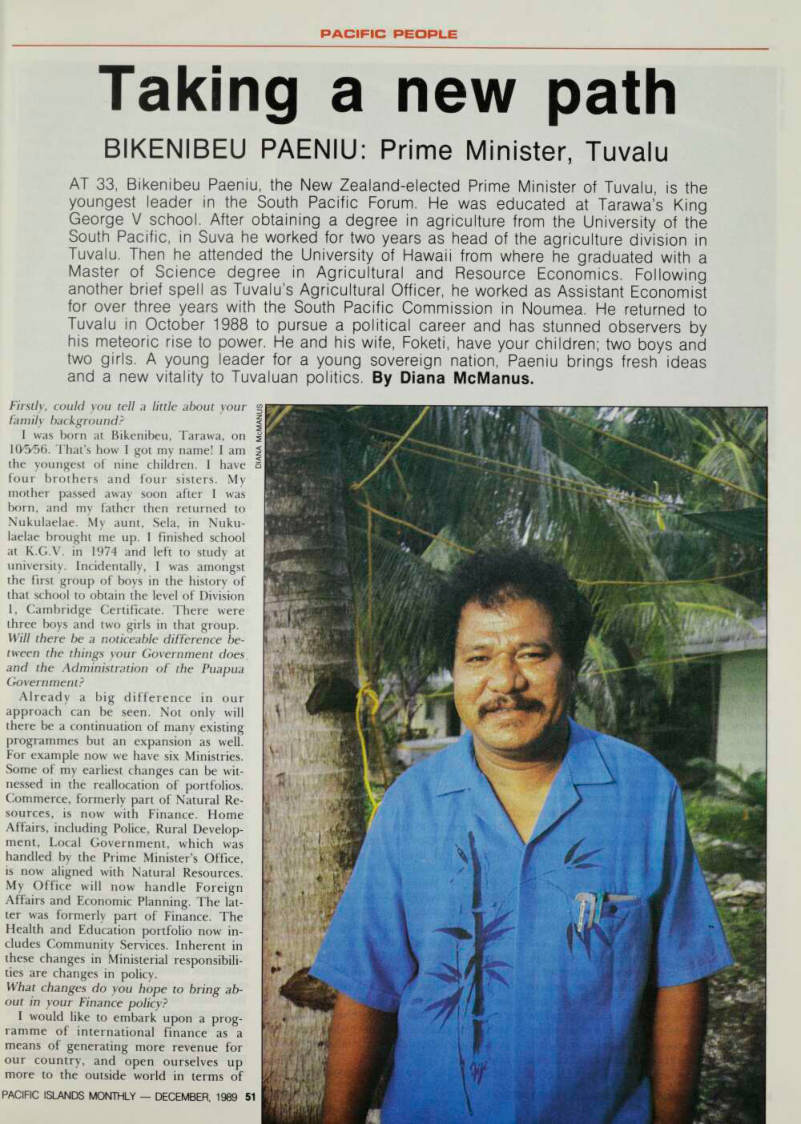
BIKENIBEU PAENIU: Prime Minister, Tuvalu
AT 33, Bikenibeu Paeniu, the New Zealand-elected Prime Minister of Tuvalu, is the youngest leader in the South Pacific Forum. He was educated at Tarawa's King George V school. After obtaining a degree in agriculture from the University of the South Pacific, in Suva he worked for two years as head of the agriculture division in Tuvalu. Then he attended the University of Hawaii from where he graduated with a Master of Science degree in Agricultural and Resource Economics. Following another brief spell as Tuvalu’s Agricultural Officer, he worked as Assistant Economist for over three years with the South Pacific Commission in Noumea. He returned to Tuvalu in October 1988 to pursue a political career and has stunned observers by his meteoric rise to power. He and his wife, Foketi, have your children; two boys and two girls. A young leader for a young sovereign nation, Paeniu brings fresh ideas
and a new vitality to Tuvaluan politics.
Firstly, could you tell a little about your
family background?
I was born at Bikenibeu, Tarawa, on 104y56. That’s how I got my name! I am the youngest of nine children. I have four brothers and four sisters. My mother passed away soon after I was born, and my father then returned to Nukulaelae. My aunt, Sela, in Nuku laelae brought me up. I finished school at K.G.V. in 1974 and left to study at university. Incidentally, I was amongst the first group of boys in the history of that school to obtain the level of Division 1, Cambridge Certificate. There were three boys and two girls in that group.
Will there be a noticeable difference be tween the things your Government does and the Administration of the Puapua Government?
Already a big difference in our approach can be seen. Not only will there be a continuation of many existing programmes but an expansion as well.
For example now we have six Ministries.
Some of my earliest changes can be wit nessed in the reallocation of portfolios.
Commerce, formerly part of Natural Re sources, is now with Finance. Home Affairs, including Police, Rural Develop ment, Local Government, which was handled by the Prime Minister’s Office, is now aligned with Natural Resources.
My Office will now handle Foreign Affairs and Economic Planning. The lat ter was formerly part of Finance. The Health and Education portfolio now in cludes Community Services. Inherent in these changes in Ministerial responsibili ties are changes in policy.
What changes do you hope to bring ab out in your Finance policy?
I would like to embark upon a prog ramme of international finance as a means of generating more revenue for our country, and open ourselves up more to the outside world in terms of
By Diana McManus.
Diana Mcmanus
strengthening and widening our links with foreign banks, in ways we will be nefit. I feel that this avenue has not been
adequately capitalised on in our foreign
affairs policy. Moreover, our taxation system ought to be reviewed, carefully. I would like to explore the potential of encouraging joint ventures with overseas
companies.
You would need a reliable communica tions system to enter the international commercial and financial scene, wouldn’t
you?
Yes. It’s vital to have an earth satellite link for the faxes and telephones, espe cially when we enter the international money market. The new earth satellite station, due to be operating in January, is a good example of the importance we accord to infrastructure development.
We realise that one of the main prob lems with our existing government is the inefficiency of our telex and telephone system.
In what other ways do you intend to expand your links with the outside world? Through tourism and trade?
We shall definitely promote Tourism and Trade appropriately. But I was thinking of aid in particular. We do have traditional donors like Australia, New Zealand, Great Britain, France, Ger many, USA, but we would like to reach out further to other potential aid donors like Japan, Canada, EEC. I’m mostly looking into the Asian industrialised na tions which are becoming rich, as possi ble donor countries we could deal with.
So you have a broader base to rely on?
Yes. You see, the concept, especially in my foreign policy, is that we become
politically independent. It’s not that we want to deprive our traditional donors but we owe it to ourselves to approach our other friends in the outside world and say: “This is what we want”, while accommodating ourselves to whatever their needs are, of course I’d like to get something for the way we see it, and for what we want; to use aid appropriately.
I thought your aim was to be economi
cally self-reliant?
It is. An aim of my government is to scrutinise very carefully the type of aid we are getting and to accept what I would see as appropriate aid. There are cases where aid comes in and is wasted.
What I have in mind, when this Govern ment is more firmly established, is to take stock of our resources and channel at least a part of our own resources into
development projects instead of having
everything totally funded from outside. I am sure this is also what donors would like to see from us.
Will your Government place more emphasis on assisting outer island de
velopment?
Exactly. That is what we hoped to make clear with the formation of the Ministry of Natural Resources and Home Affairs, that the Government would like to adopt and strengthen the concept of equal distribution of wealth to the outer islands. It will be a major priority of this Government. Appropri ate development of course. Not to the extent that it will neglect the capital but to be responsive to their development needs, justifiable within the national
objectives.
What do you see as their most pressing
needs? Are there any specific things you
can pin-point?
Many needs. Not only infrastructural, like construction of sea walls, causeways and civil service housing, but things at the grassroots level. For instance diver sifying their agricultural production like the pulaka pits or fisheries. And just small income generating projects which will enhance the quality of life for the outer islands people. That’s more or less the line we are taking. We must find out their needs as they see them. But although we will be spending money on the outer islands, we must continue the improvement of the infrastructure at Funafuti, upon which depends the de velopment of this nation.
How will you overcome islands’ jealousy of the money being spent on- Funafuti,
the capital?
It will be the aim of my government to continue to promote a sense of national identity and help our people to realise that we are Tuvaluans, not just from Nukulaelae, Nanumea, Vaitupu, etc. It is in the collective interest to have a solid base from which to work and that means we must continue to support develop ments on the capital. In helping the is lands we must be very careful not to disintegrate the nation.
Does that mean you will be embarking on some sort of national awareness prog ramme, or media approach?
Yes. I think it is very important, this idea of a national identity. The media is a relatively new element in Tuvaluan society and I would like to see Radio Tuvalu used as a forum for discussion and debate about political matters. No Government is perfect and I would wel come public criticism from my own peo ple as an instrument for improvement.
In that way we know what we do wrong and can try to amend our approach.
Are Tuvaluans, on the whole, politically aware?
Much more so now. I hope to encour age this even more by looking at the whole system of voting. As you know we don’t have a Party system here and it is all too common for people to vote for their relatives without really understand ing the ideas they stand for. In that sense, although we officially have a democracy, sometimes voting is not real ly all that democratic. I would like to see much more discussion and debate so that our people become more educated about issues and move further away from per sonality politics. I’m in favour of general
platforms being developed in the abs
ence of the party system.
Will there be any changes in your policy on education?
We’ll be opening out the training to civil servants and other members of the
public. Our only really reliable resource
ultimately is our own people. We want to
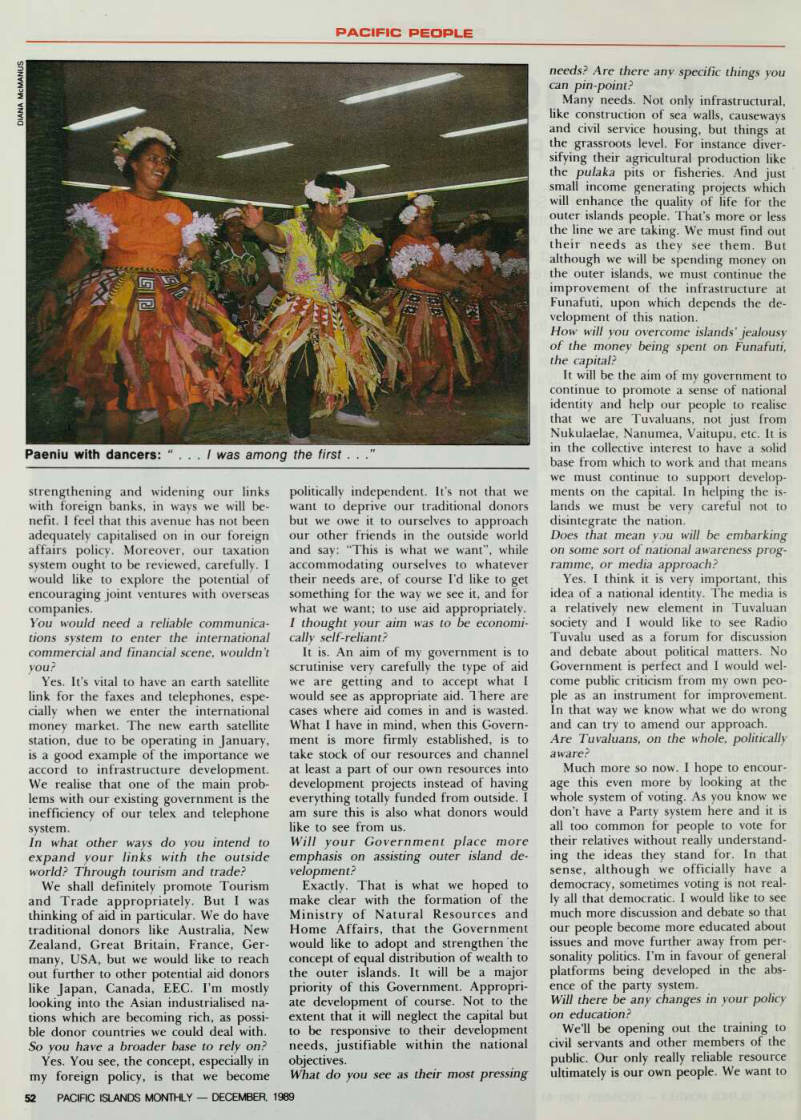
Paeniu with dancers: “... I was among the first . . .”
encourage them to develop to the levels which they achieve. With regard to post graduate studies, speaking from my own experience which has broadened my in sight into development and built up my self-confidence, I would not want to dep rive my own people of the same oppor tunities. So, this government certainly has the intention to open up the policy.
What if there are no jobs available for them after training, and educated people then leave the country?
There is always the case where our people may want to leave the country. I don’t see that as a waste of resources.
Our people are working throughout the
Pacific and a lot of Tuvalu’s income is derived from remittances. With a small country like ours I do accept the fact that people will leave, even if we train them a big change in attitude from the previous Government in this respect.
Right now staffing in the public service is very changeable. No sooner are people educated and trained for one position than they switch to another. What do you propose to do about this?
I personally would like to place offic ers in the job for which they are trained because we want to utilise those skills.
But I believe you can also be flexible and used in other areas. Take, for example, my case. I’m an economist but now I’m leading the country. The trouble is, sometimes people have gone abroad to
study on scholarships they were allo
cated, to achieve whatever qualifications they could obtain. But deep in their hearts their interests differ and so they change jobs. It’s something 1 have to
look into.
How else do you intend to improve the efficiency of the Public Service?
At this stage I would like to send ste nographers and other office staff for overseas training. As you well under stand, development is an on-going pro cess and we must cope with the changing things as we move along. For example, already it’s the computer era. Not all our typists can work on computers. That’s one of the major areas I’d like to tackle; the strengthening of office support and management services, like photocopiers, computers, etc to raise the efficiency and communication levels within the Public Service.
In the past 12 months there has been a noticeable reduction of expatriate advis ers in Tuvalu and a rapid move towards localisation of managerial positions. Is this the approach your government will also be taking?
Yes. We would like to continue this approach. Then we would draw in ex patriates as advisers responsible to the managers. But that is some way down the line. At the moment we are welcom ing the volunteers as a source of sup port. We would still rely on expatriates as advisers, especially in technical and professional matters, but 1 do feel we have adequate locals who could take up the administrative and managerial re
sponsibilities.
You ’re very young to be Prime Minister.
Others will undoubtedly comment on this. What would you say to them in this respect?
I am young and I am not all that per
feet. But, be that as it may, I trust in God for everything despite my educa tional background. My insight into the future is limited but 1 am convinced, with the guidance of God, I would be able to lead this nation in the appropri ate path.
Other important qualities which I be lieve my youth brings, is the self confidence and the desire to ensure the welfare of the people, including their opinions; to be in continuous touch with the public, in particular at grassroots level; to foster team and collabrative spirit, and, above all, to do the right and
fair thing.
What is your vision of the future for Tuvalu?
I have dreams for my beloved small nation. I won’t use the word ambition beause I think that is a dangerous emo tion resulting in wasted efforts and re sources. My dreams lead to the better ment of my people. Like right now I dream of a well constructed new airfield; of a wider base for generating revenue for Tuvalu; of having a greater degree of self-reliance for my country down to each family and individual. 1 dream of a stronger private sector development; of a place of unity, not only within Tuvalu but throughout the world as well. I could go on and on dreaming. What’s important is to try and fulfil these dreams in accordance with our priorities and resources. I’ll have the dreams and, with my support and assistance, I’ll en courage the officers in the service and so forth to make these dreams come true; to turn them into concrete, positive re sults. I dream for a better Tuvalu. □
Diana Mcmanus
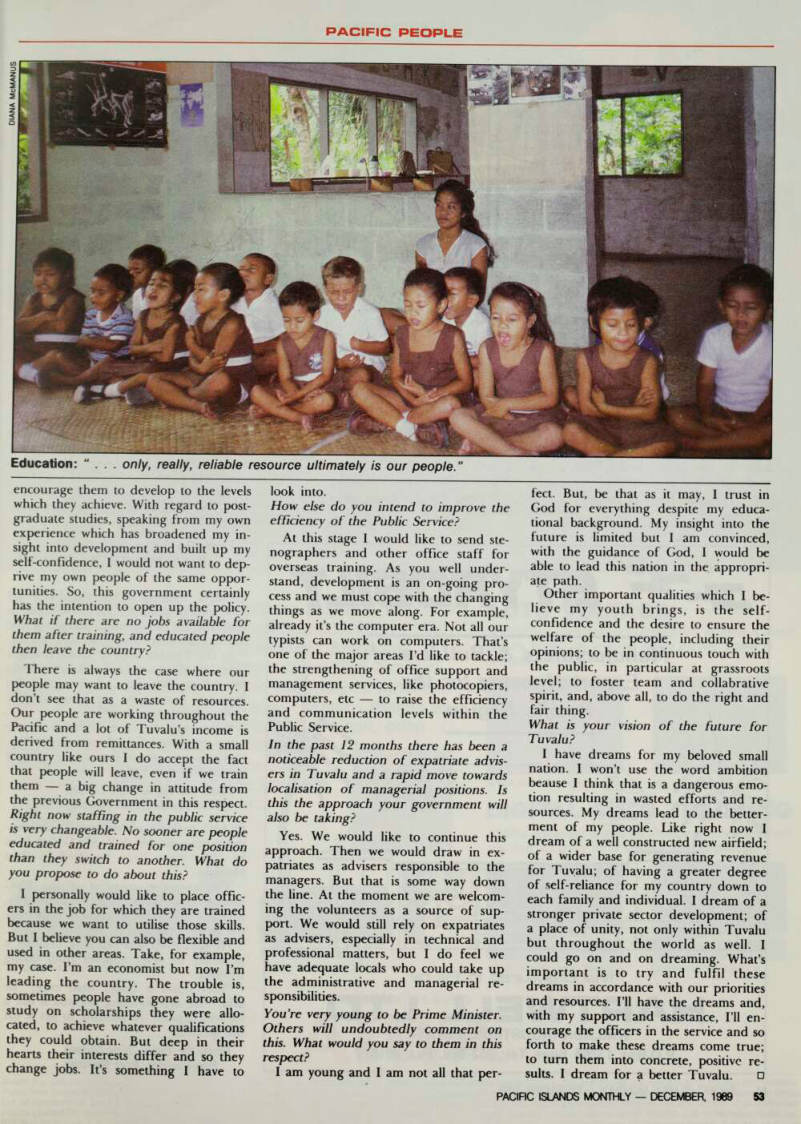
Education: "... only, really, reliable resource ultimately is our people."