Grappling with island markets
p. 33 · Read in the full issue
island markets
AFTER a year in existence, New Zealand’s South Pacific Trade Office can notch up a few succes ses but also has a better understanding of the problems it has to tackle. One of the major headaches is that many New Zealand firms which, in the past, have tried buying from various island nations have found problems with continuity of supply or quality or both and are reluctant to listen to new proposals.
The office was set up under the wing of the Ministry of External Affairs and Trade. The New Zealand government had been under pressure for several years from island leaders to set up an agency which would assist the small states gain access to its market; they were able to point to Australia where the South Pacific Trade Commission had been in existence for several years.
The director of the Auckland-based South Pacific Trade Office, Steve Houli han, came to the job from shipping, in cluding a spell as marketing manager for Pacific Forum Line. His task is to liaise with the governments and business peo ple in Fiji, Western Samoa, Tonga, Cook Islands, Niue, Nauru, Tuvalu, Kiribati, Solomon Islands, Vanuatu, Papua New Guinea, Federated States of Micronesia and the Marshall Islands. The main criterion is practical assistance, ranging from introductions to New Zealand im porters or clarifying food labelling reg ulations.
Houlihan said in the first year he could point to a few successes.
A Tongan leather apparel manufac turer, SP Leather Company, had now established itself in the New Zealand market. The Auckland agency paid for a director of the company to visit Auck land and then set up appointments with retailers. The result was orders for NZ$BO,OOO worth of leather jackets. The company hopes to double that figure in 1990.
The manager of another Tongan firm, KW International, was sponsored on a visit to the Imtec ’B9 Marine Show in Auckland to show off the company’s new fibreglass runabout. Houlihan said it looked like the company would notch up sales of NZ$3O,OOO but none of the tentative orders has been confirmed. He puts this down to two factors: first, the waterfront troubles in New Zealand re cently which both made export orders from Tonga subject to delay and held up raw materials going to the company in Tonga; secondly, there was no way the company could get a telephone call out of Tonga as the circuits were monopol ised by the South Pacific mini-games for
three weeks in late August.
However, the company has since pick ed up NZ$4O,OOO in orders for fibreglass boat components from New Zealand manufacturers. “This company could probably do $lOO,OOO worth of business here but there is that hurdle of com munications this case really brought home to me the practical difficulties Pacific Island exporters face,” said Houlihan.
An importing experiment from Kiriba ti also showed up some problems. The trade office had arranged a NZ$6OOO shipment of fresh coconuts not a great sum, but significant in the context that Kiribati’s total exports to New Zea land amounted to just $lB,OOO. Houli han told Pacific Islands Monthly one aspect of his brief was to help the smal ler countries in the region who could not afford to mount an export drive from their own resources.
But he said there was a problem with the quality of the coconuts when the container arrived in Auckland, a fact he puts down to inexperience at the Kiribati end in terms of packing fresh produce for a long sea voyage.
“Price competitiveness is not the major factor for Pacific exporters they are
more constrained by regularity of supply and quality,” he said. This type of ex perience in the past had made many New Zealand companies consider doing business in the region as “not worth the effort”, said Houlihan. “There are many problems, and I think it’s easy to get bogged down and disillusioned a lot can be overcome with exporters getting to grips with what New Zealand requires.
The opportunities are there.”
The South Pacific Trade Office gets
plenty of enquiries (including ones from
exporters of stuffed crocodiles and a propsal to train someone to make marble tombstones in Western Samoa) but most of the ones which stand the best chance involve either garment manufacture or food processing.
About 80 per cent of the office’s traf fic in the other direction that is, help ing New Zealand companies which want to set up in the Pacific nations con cern Fiji. So many garment companies have already made the move there which accounts for New Zealand’s concentra tion on the skilled, relatively cheap labour and good communications which Fiji has to offer. A long way back in second is interest in Tonga, with a scat tering of enquiries about Vanuatu or the Cook Islands.
There are jitters about political insta bility. Vanuatu was not helped by the unrest last year. But Houlihan said there was scant interest in the region’s largest and potentially fastest developing nation Papua New Guinea. Those New Zea land companies which have an export record to Papua New Guinea are doing well (in fact, they are making inroads against the Australian market share in that nation) but there is little hope of getting New Zealand firms to invest in Papua New Guinea. “There has just been so much publicity about the prob lems there most New Zealanders don’t know that Bougainville is an island hun dreds of miles from the mainland. They are extremely hesitant about investing in Papua New Guinea,” he said. □
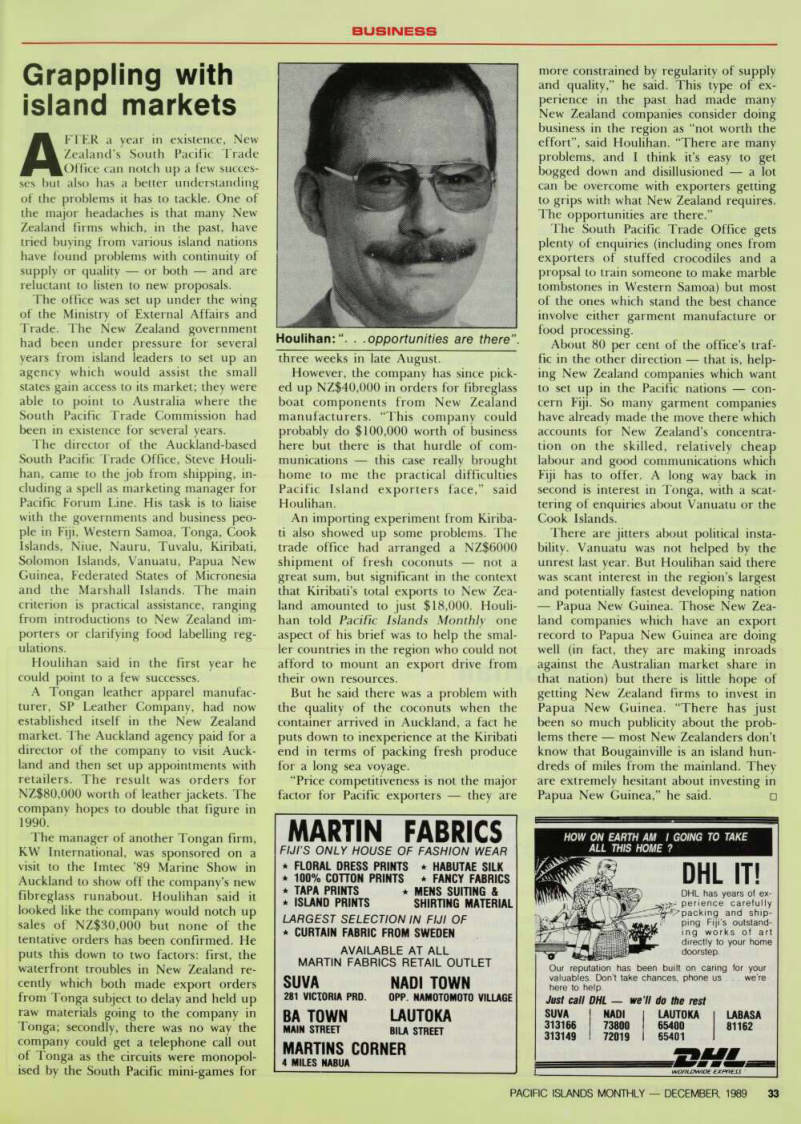
Houlihan:“. . .opportunities are there".