got Tahiti
pp. 30-32 · Read in the full issue

Takahashi’s got Tahiti
By Al Prince
Editor Tahiti Sun Press
PACIFIC empire-builder Harunori
Takahashi has not exactly be come a household name in French Polynesia. But his name took on greater significance when he became the first big Japanese hotel owner in French
Polynesia.
On September 20, the normally fast moving Takahashi concluded 20 months of work by becoming the majority stock holder in his third major French Polynesia holding within a space of only
10 days.
The first Tahiti property to become part of the Takahashi empire was .the 200-room Tahiti Beachcomber Par kroyal. The US$35-million purchase was closed on September 13. Two days later, on September 15, the $ 13.5-million purchase of the 150-room Moorea Beachcomber Parkroyal was closed.
Finally, on September 20, the $3O - purchase of the 200-room Hyatt Regency Tahiti was closed. Those three purchases cleared the way for a two
phase, $5l-million development prog
ramme for each hotel that is due to be gin before the end of this year and end by late next year or early 1991.
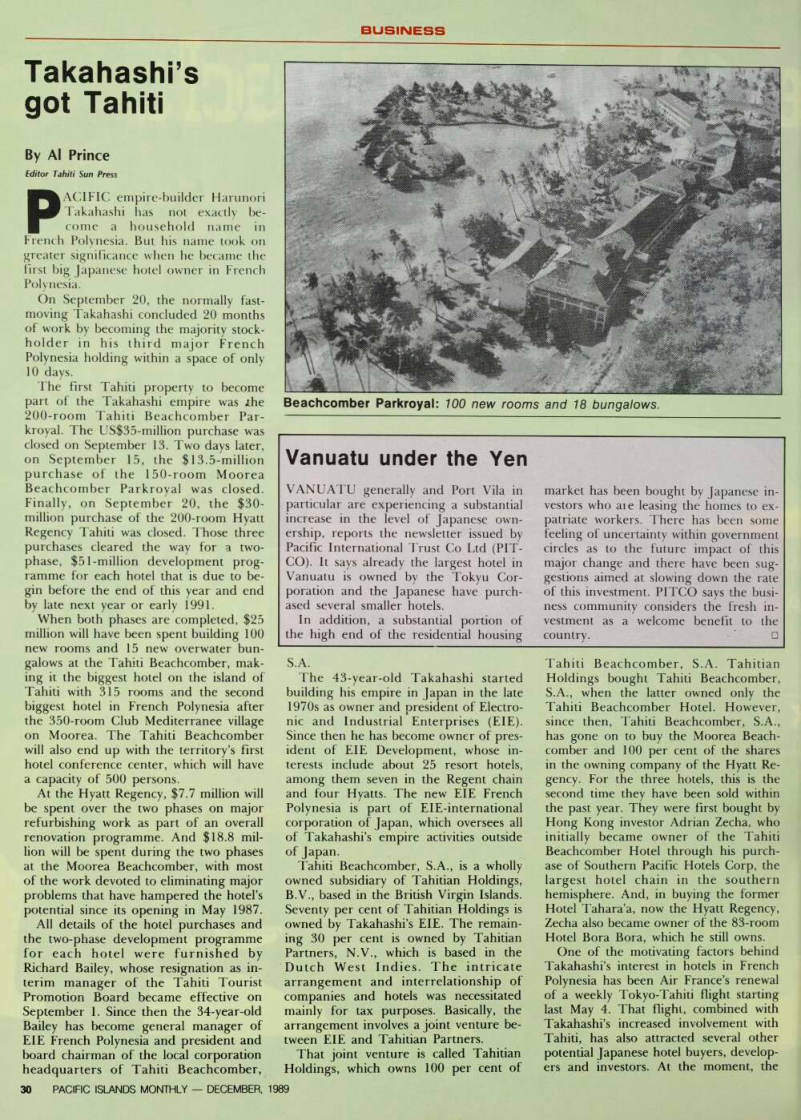
When both phases are completed, $25 million will have been spent building 100 new rooms and 15 new overwater bun galows at the Tahiti Beachcomber, mak ing it the biggest hotel on the island of Tahiti with 315 rooms and the second biggest hotel in French Polynesia after the 350-room Club Mediterranee village on Moorea. The Tahiti Beachcomber will also end up with the territory’s first hotel conference center, which will have a capacity of 500 persons.
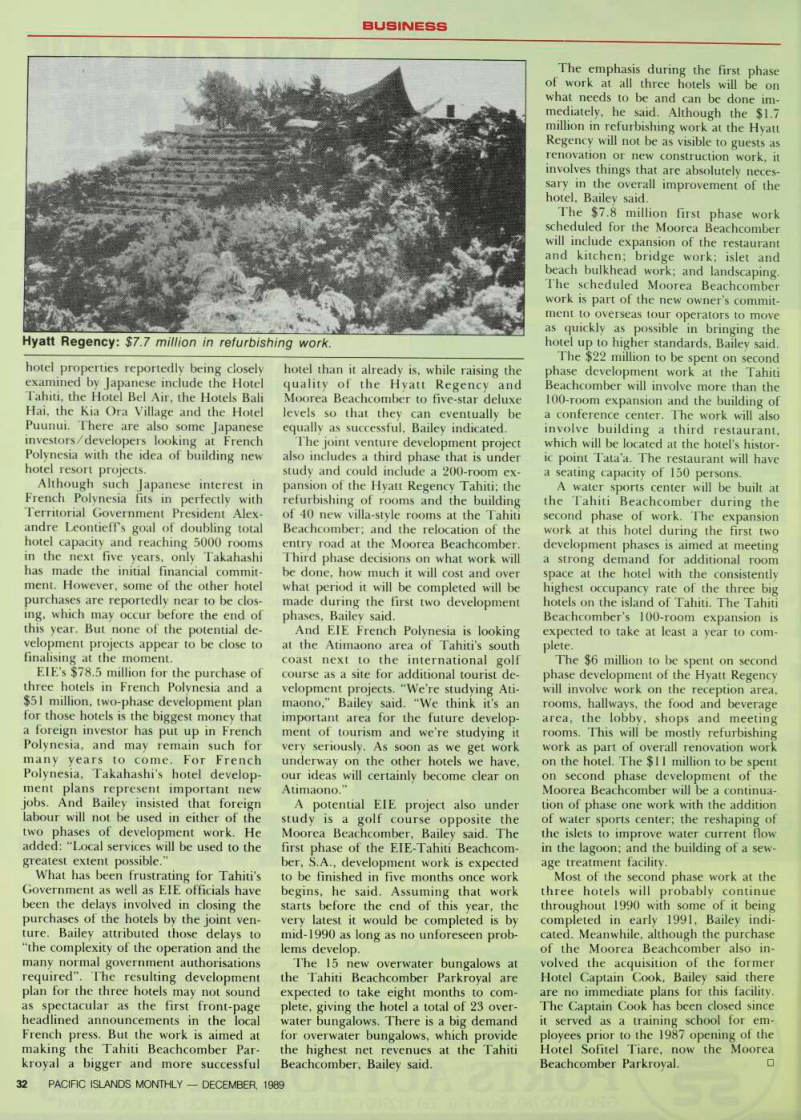
At the Hyatt Regency, $7.7 million will be spent over the two phases on major refurbishing work as part of an overall renovation programme. And $lB.B mil lion will be spent during the two phases at the Moorea Beachcomber, with most of the work devoted to eliminating major problems that have hampered the hotel’s potential since its opening in May 1987.
All details of the hotel purchases and
the two-phase development programme
for each hotel were furnished by Richard Bailey, whose resignation as in terim manager of the Tahiti Tourist Promotion Board became effective on September 1. Since then the 34-year-old Bailey has become general manager of EIE French Polynesia and president and board chairman of the local corporation headquarters of Tahiti Beachcomber,
S.A.
The 43-year-old Takahashi started building his empire in Japan in the late 1970 s as owner and president of Electro nic and Industrial Enterprises (EIE).
Since then he has become owner of pres ident of EIE Development, whose in terests include about 25 resort hotels, among them seven in the Regent chain and four Hyatts. The new EIE French Polynesia is part of EIE-international corporation of Japan, which oversees all of Takahashi’s empire activities outside of Japan.
Tahiti Beachcomber, S.A., is a wholly owned subsidiary of Tahitian Holdings, 8.V., based in the British Virgin Islands.
Seventy per cent of Tahitian Holdings is owned by Takahashi’s EIE. The remain ing 30 per cent is owned by Tahitian Partners, N.V., which is based in the Dutch West Indies. The intricate arrangement and interrelationship of companies and hotels was necessitated mainly for tax purposes. Basically, the arrangement involves a joint venture be tween EIE and Tahitian Partners.
That joint venture is called Tahitian Holdings, which owns 100 per cent of
Tahiti Beachcomber, S.A. Tahitian
Holdings bought Tahiti Beachcomber,
S.A., when the latter owned only the Tahiti Beachcomber Hotel. However, since then, Tahiti Beachcomber, S.A., has gone on to buy the Moorea Beach comber and 100 per cent of the shares in the owning company of the Hyatt Re gency. For the three hotels, this is the second time they have been sold within the past year. They were first bought by Hong Kong investor Adrian Zecha, who initially became owner of the Tahiti Beachcomber Hotel through his purch ase of Southern Pacific Hotels Corp, the largest hotel chain in the southern hemisphere. And, in buying the former Hotel Tahara’a, now the Hyatt Regency, Zecha also became owner of the 83-room Hotel Bora Bora, which he still owns.
One of the motivating factors behind Takahashi’s interest in hotels in French Polynesia has been Air France’s renewal
of a weekly Tokyo-Tahiti flight starting
last May 4. That flight, combined with Takahashi’s increased involvement with Tahiti, has also attracted several other potential Japanese hotel buyers, develop ers and investors. At the moment, the
Beachcomber Parkroyal: 100 new rooms and 18 bungalows.
hotel properties reportedly being closely
examined by Japanese include the Hotel Tahiti, the Hotel Bel Air, the Hotels Bali Hai, the Kia Ora Village and the Hotel Puunui. There are also some Japanese
investors/developers looking at French
Polynesia with the idea of building new hotel resort projects.
Although such Japanese interest in French Polynesia fits in perfectly with Territorial Government President Alex andre Leontieff s goal of doubling total hotel capacity and reaching 5000 rooms in the next five years, only Takahashi has made the initial financial commit ment. However, some of the other hotel purchases are reportedly near to be clos ing, which may occur before the end of this year. But none of the potential de velopment projects appear to be close to finalising at the moment.
ElE’s $78.5 million for the purchase of three hotels in French Polynesia and a
$5l million, two-phase development plan
for those hotels is the biggest money that a foreign investor has put up in French Polynesia, and may remain such for many years to come. For French
Polynesia, Takahashi’s hotel develop
ment plans represent important new
jobs. And Bailey insisted that foreign
labour will not be used in either of the two phases of development work. He added: “Local services will be used to the greatest extent possible.”
What has been frustrating for Tahiti’s Government as well as EIE officials have been the delays involved in closing the purchases of the hotels by the joint ven ture. Bailey attributed those delays to “the complexity of the operation and the many normal government authorisations
required”. The resulting development
plan for the three hotels may not sound as spectacular as the first front-page headlined announcements in the local French press. But the work is aimed at making the Tahiti Beachcomber Par kroyal a bigger and more successful
hotel than it already is, while raising the quality of the Hyatt Regency and Moorea Beachcomber to five-star deluxe levels so that they can eventually be equally as successful, Bailey indicated.
The joint venture development project
also includes a third phase that is under study and could include a 200-room ex pansion of the Hyatt Regency Tahiti; the refurbishing of rooms and the building of 40 new villa-style rooms at the Tahiti Beachcomber; and the relocation of the entry road at the Moorea Beachcomber.
Third phase decisions on what work will be done, how much it will cost and over what period it will be completed will be made during the first two development
phases, Bailey said.
And EIE French Polynesia is looking at the Atimaono area of Tahiti’s south coast next to the international golf course as a site for additional tourist de velopment projects. “We’re studying Ati maono,” Bailey said. “We think it’s an important area for the future develop ment of tourism and we’re studying it very seriously. As soon as we get work underway on the other hotels we have, our ideas will certainly become clear on Atimaono.”
A potential EIE project also under study is a golf course opposite the Moorea Beachcomber, Bailey said. The first phase of the El E-Tahiti Beachcom ber, S.A., development work is expected to be finished in five months once work begins, he said. Assuming that work starts before the end of this year, the very latest it would be completed is by mid-1990 as long as no unforeseen prob
lems develop.
The 15 new overwater bungalows at the Tahiti Beachcomber Parkroyal are expected to take eight months to com plete, giving the hotel a total of 23 over water bungalows. There is a big demand for overwater bungalows, which provide the highest net revenues at the Tahiti Beachcomber, Bailey said.
The emphasis during the first phase
of work at all three hotels will be on what needs to be and can be done im mediately, he said. Although the $1.7 million in refurbishing work at the Hyatt Regency will not be as visible to guests as renovation or new construction work, it involves things that are absolutely neces sary in the overall improvement of the hotel, Bailey said.
The $7.8 million first phase work scheduled for the Moorea Beachcomber will include expansion of the restaurant and kitchen; bridge work; islet and beach bulkhead work; and landscaping.
The scheduled Moorea Beachcomber work is part of the new owner’s commit ment to overseas tour operators to move as quickly as possible in bringing the hotel up to higher standards, Bailey said.
The $22 million to be spent on second phase development work at the Tahiti Beachcomber will involve more than the 100-room expansion and the building of a conference center. The work will also involve building a third restaurant, which will be located at the hotel’s histor ic point Tata’a. The restaurant will have a seating capacity of 150 persons.
A water sports center will be built at the Tahiti Beachcomber during the second phase of work. The expansion work at this hotel during the first two
development phases is aimed at meeting
a strong demand for additional room space at the hotel with the consistently highest occupancy rate of the three big hotels on the island of Tahiti. The Tahiti Beachcomber’s 100-room expansion is expected to take at least a year to com
plete.
The $6 million to be spent on second
phase development of the Hyatt Regency
will involve work on the reception area, rooms, hallways, the food and beverage
area, the lobby, shops and meeting
rooms. This will be mostly refurbishing work as part of overall renovation work on the hotel. The $ll million to be spent on second phase development of the Moorea Beachcomber will be a continua tion of phase one work with the addition of water sports center; the reshaping of the islets to improve water current flow in the lagoon; and the building of a sew age treatment facility.
Most of the second phase work at the three hotels will probably continue throughout 1990 with some of it being completed in early 1991, Bailey indi cated. Meanwhile, although the purchase of the Moorea Beachcomber also in volved the acquisition of the former Hotel Captain Cook, Bailey said there are no immediate plans for this facility.
The Captain Cook has been closed since it served as a training school for em ployees prior to the 1987 opening of the Hotel Sofitel Tiare, now the Moorea Beachcomber Parkroyal. □
Hyatt Regency: $7.7 million in refurbishing work.