New guard in Auckland
pp. 20-21 · Read in the full issue
THE guard has changed at Samoa
House in Auckland’s Karangahape Road. After five years as the city’s
leading Samoan, consul-general Afama-
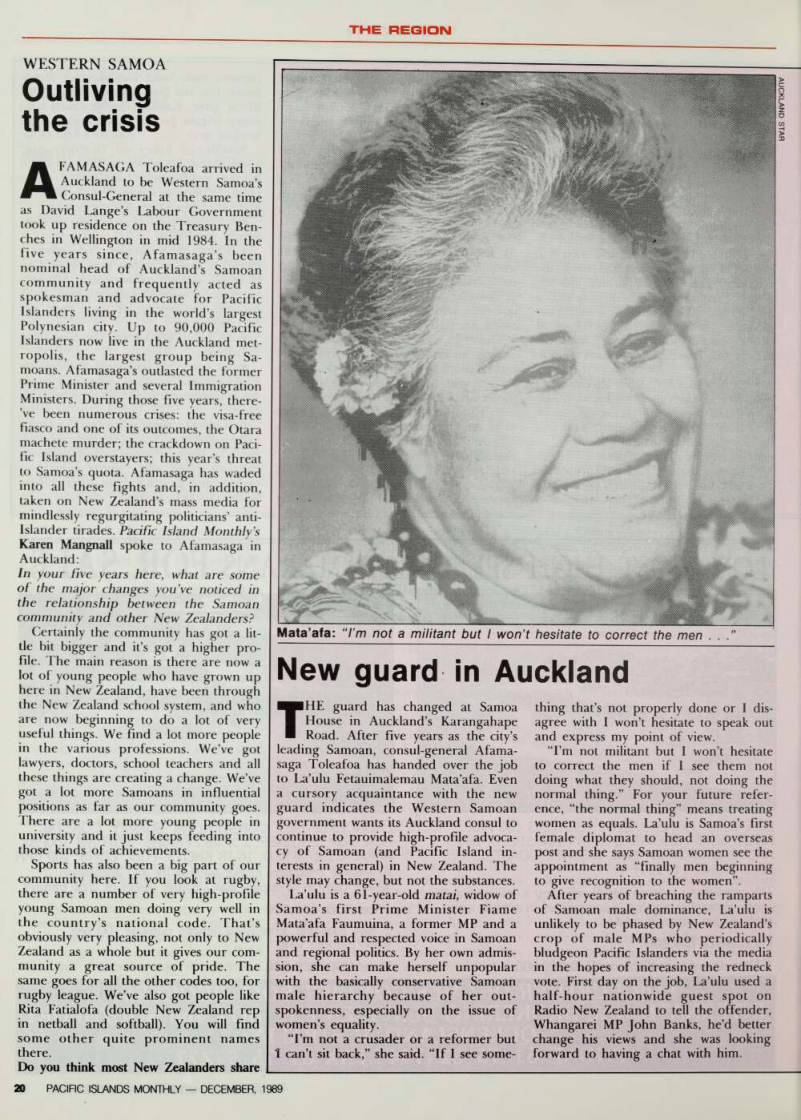
saga Toleafoa has handed over the job to La’ulu Fetauimalemau Mata’afa. Even a cursory acquaintance with the new guard indicates the Western Samoan government wants its Auckland consul to continue to provide high-profile advocacy of Samoan (and Pacific Island interests in general) in New Zealand. The style may change, but not the substances.
La’ulu is a 61-year-old matai, widow of Samoa’s first Prime Minister Fiame Mata’afa Faumuina, a former MP and a powerful and respected voice in Samoan and regional politics. By her own admission, she can make herself unpopular with the basically conservative Samoan male hierarchy because of her outspokenness, especially on the issue of
women’s equality.
“I’m not a crusader or a reformer but ‘I can’t sit back,” she said. “If I see some-
thing that’s not properly done or I dis agree with I won’t hesitate to speak out and express my point of view, “I’m not militant but I won’t hesitate to correct the men if I see them not doing what they should, not doing the normal thing.” For your future refer ence, “the normal thing” means treating women as equals. La’ulu is Samoa’s first female diplomat to head an overseas post and she says Samoan women see the appointment as “finally men beginning to give recognition to the women”, After years of breaching the ramparts of Samoan male dominance, La’ulu is unlikely to be phased by New Zealand’s crop of male MPs who periodically bludgeon Pacific Islanders via the media in the hopes of increasing the redneck vote. First day on the job, La’ulu used a half-hour nationwide guest spot on Radio New Zealand to tell the offender, Whangarei MP John Banks, he’d better change his views and she was looking forward to having a chat with him.
Mata’afa: “ I’m not a militant but I won’t hesitate to correct the men..."
She’s also ready to reiterate Western Samoa’s concerns about the trend in New Zealand immigration policy. New Immigration Minister Roger Douglas re cently indicated he’d soon revamp guide lines to give preference to skilled immig rants from declining sources such as Europe and north America. Douglas asserts his aim is to balance immigration from Europe, north America, Asia and the Pacific. But La’ulu echoes her prede cessor’s worries that New Zealand may be heading back to Whites Only im migration policy which would have a profound impact on its relations with Western Samoa.
She believes immigration will continue to be the top priority of government-to government dealings with the Western Samoans keen to clean up the overstayer
problem.
“Our government wants to promote the welfare of the people here and en courage them to be better citizens. At the same time our people come here and contribute to the welfare of this country and they should receive the benefits that New Zealanders get,” she says.
La’ulu says she’s long argued that Western Samoa doesn’t prepare its citizens adequately for life as an immig rant in New Zealand. More than 20 years ago, the Samoan National Council of Women offered, unsuccessfully, to run courses to teach emigrating Samoan women the basics of Kiwi housekeeping.
“It’s very difficult for them to come from a warm climate with large open houses and no locked doors to two or three bedrooms with many people living there. They don’t know about dusting or buying curtains or blankets on the beds or even dressing the children for the colder weather,” says La’ulu.
La’ulu says Samoans persist in seeing New Zealand as the land of milk and
honey and, quite naturally, their un
realistic expectations come crashing
down once they arrive in New Zealand.
She points out: “It’s an immediate set back or disadvantage which many don’t ever overcome. I would like to see Sa moan women becoming more comfort able with the New Zealand way of life.”
On the other hand, she believes the younger generation of Samoans born in New Zealand are successfully integrating the best of fa’a Samoa with Kiwi be haviour and attitudes. La’ulu wants to encourage more Samoans into the pro fessions and all levels of New Zealand life, particularly local and central gov ernment. “Like all immigrant groups Sa moans have a tendency to stick together,” she explains. “I would like to see our community come out a bit more and get involved with the wider com
munity.” □