she’s tougher than tough
pp. 11-13 · Read in the full issue
Baba’s obvious choice: she’s tougher than tough
TUPENI Baba was always accessible to the media. It was one reason why Radio New Zealand spoke to him last month, immediately after the death of Fiji’s deposed Prime Minister Dr Timoci Bavadra. ‘‘Radio New Zealand asked me, ‘Who is going to be the new leader’,” he remembers. “I said, ‘lf Kuini is willing to take up the leadership most of us will support her.’” Events quickly accelerated and before month’s end Kuini Bavadra, widow of the deposed leader, had been approached and had accepted the leadership of the Indiandominated National Federation Party/ Labour Coalition. Baba, the education minister in Bavadra’s ousted government, was instrumental in her rise to
power overnight.
How will Kuini lead? says Baba: “Kuini is going to be much tougher. She is not going to take some of the things some of us have accepted. She is going to stand her ground.”
Excerpts from an interview with Baba, Head of School of Humanities, University of the South Pacific: • What will the Coalition be like after Bavadra?
The Coalition after Bavadra will be no
different from the Coalition when Bavadra was the leader because the philosophy of the Coalition is based on the values which Bavadra stood for. Those are articulated as the values of the Labour Party. They were articulated in our submission to the Constitutional Review Committee. They are articulated in the UN Charter for Human Rights. It is basically about a government for the ordinary people. A Government to restore human rights, to make sure of the conditions of the ordinary people; education, health services, welfare are protected and are adequate. One of the important hallmarks of our policy has been to promote multiracialism in Fiji.
We believe in the equality of all peoples of the world and those peoples who live in Fiji. It was the kind of policy for which we were criticised because we
appeared to be treating everybody the
same. The Fijians accused us of neglecting their interests which we did not. • Which party does Mrs Bavadra lead in the Coalition which qualifies her for the leadership?
Kuini is leader of the Labour Party.
She has been nominated by the managing board of the Labour Party to be
leader of the Labour Party. That will go forward to the executive committee of the Labour and she will become leader of the Labour Party. As leader of the Labour Party she will then become a contender for the post of Leader of the Coalition. The National Federation Party has accepted her if she was nominated by the Labour Party to become leader of the Coalition. These are mere formali ties. Individually we’ve talked to the peo ple involved and they’ve okayed it. All it needs now is for the two executives of the Labour Party and the Coalition to formally install her. It’s a formality.
Already the Federation has accepted her as leader of the coalition. • Will Mrs Bavadra be able to bring the two Coalition parties closer?
I think she will. She has worked very closely with people in the parties, she has been travelling with us throughout the world, she has been speaking in the many platforms for which the Labour Party and the Coalition have been speak ing. She is a very fair person, as fair as Dr Bavadra. I think she will bring the
parties much closer together.
The guiding principles for us, really,
are the basic principles which Bavadra stood for which is really multiracialism, equality for the people of this country, and respect for human rights. • Why Mrs Bavadra?
Kuini is a very senior public servant.
Kuini is a very able woman, she has led
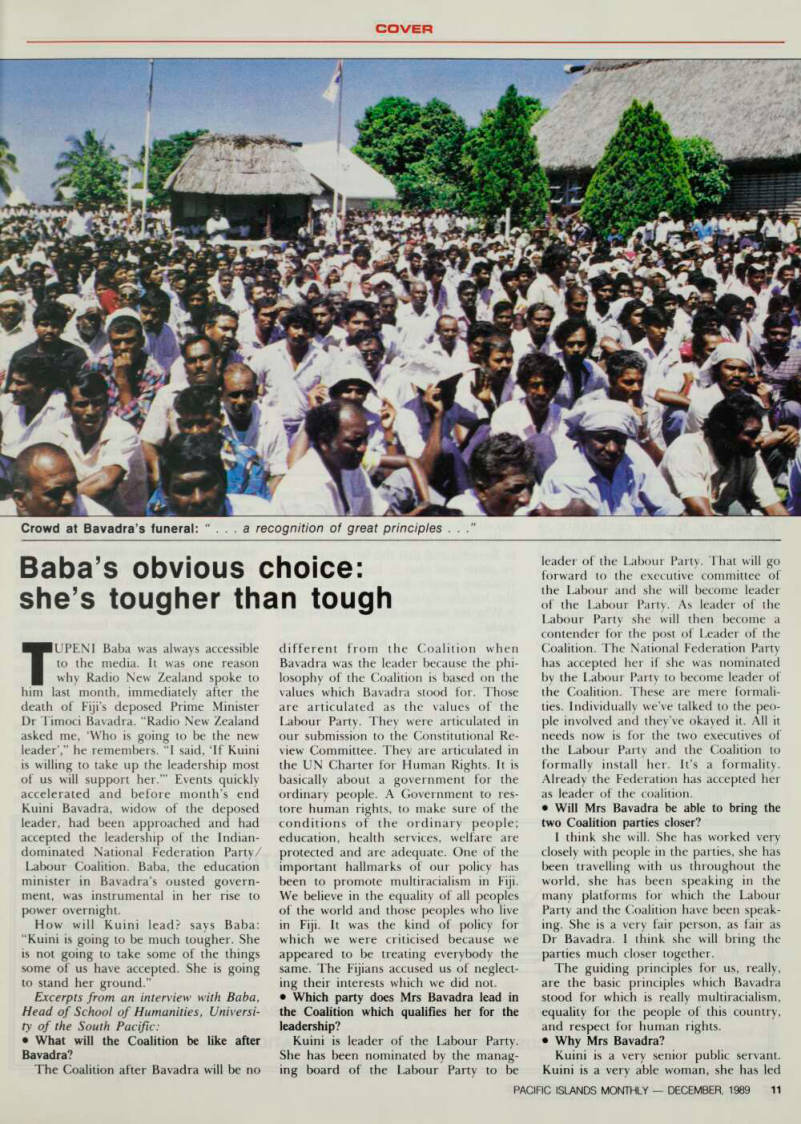
Crowd at Bavadra’s funeral: "... a recognition of great principles . .."
many Fiji delegations as a leader. She led Fiji at the United Nations End of the Decade for Women conference in Kenya. Kuini is a graduate of the Uni versity of the South Pacific. She has had post-graduate training overseas and is a very able person. Kuini in her own right is very capable and politically very astute.
Some say she is much faster than a lot of us in the past (Coalition) government in terms of perception of issues. She has attended many of the conferences that Bavadra went to as leader of the Labour Party. For example, she went to Mel bourne at the Progressive Parties confer ence and she spoke on behalf of the women, a very impressive speech. In fact Kuini has had a kind of preparation for the position of being leader. In addition, Kuini in her own right has got chiefly connection, a fairly powerful chiefly con nection. But I think the first thing really
that makes her eligible is her ability and commitment to the values that Bavadra stood for.
We do not deny that she was married to Bavadra and that she has got a Bavad ra name and that is important for the ordinary people. But in addition to that she has the right qualifications. • Why not someone from within the party ranks?
The feeling is if Kuini is willing to serve she will serve as leader very, very well. For those of us who were close to Bavadra, if pressured, will be willing to lead. But I think we don’t really regard the leadership as something to fight for because it contains major responsibilities.
The party cannot maintain too many people. We can maintain Kuini and ev erybody will have to contribute to main tain her as we did for Dr Bavadra.
So in all Kuini will be able to act as
leader, maintain the principles and keep the people together. The movement will be stronger now than say a few weeks before Bavadra died when Bavadra was very ill. • Then she is the Coalition’s alternative prime minister?
Once she becomes leader she will be come the alternative Prime Minister.
And if we have elections I have no doubt that the people of Fiji will vote her in. • Are the people of Fiji ready for a woman prime minister?
Surprisingly the people of Fiji, I think, are ready. The people of Fiji are looking for people who are capable whether they are men or women. Unfortunately the way the parties operated in the last twen ty years did not support women. This is another new dimension which must be recognised. More than fifty per cent of the people of this country are women.
Even the most Moslem country like Pakistan which puts women as second class citizens are able to vote a woman in.
In Fiji we’ve had women as chiefs, women as leaders. But most of us males, because of our own sense of insecurity, have not really given them a fair go. I think this will be a new dimension which the Coalition will offer the people of Fiji. • What advantage has she got as a woman?
Kuini will maintain a lot of dignity and will make sure the dignity is kept on utterrances and statements. Kuini will have access to both professional and political advice that most of the leaders in the interim government don’t have access to. She will get business advice, she will get academic advice, and she will get political advice. She will get legal advice. These are the kinds of advices that will be given to Kuini by most of us who are involved. • Who pushed her name through?
I am blamed for being one of the first to go on air and mention her because I’ve worked very close with Kuini, and Bavadra. She’s the obvious choice. I think if we had gone back to govern ment Kuini would have played a part in
it. She probably would have come in on a political angle, probably on a woman’s role. But because she was the wife of the Prime Minister we had to observe certain degree of ethics. She was always in the Labour Party. She was part of the women who had been involved in the labour movement. That’s Kuini all over. • Will she be tougher than her husband?
They have different styles. Dr Bavadra is quiet, firm in his own way, humble, but tough, tough enough not to crack.
At the most times of crisis, during the time of the coup and all that harassment, he was able to stand aside, be cool and assess the situation in his own way. So he is tougher in that quiet sort of way.
Kuini is going to be much tougher.
Kuini is not going to take some of the things that some of us have accepted.
She is going to stand her ground. She can take and she can give it and I think with a little experience she will be a very difficult opponent. • What sort of leadership do you expect from her?
A very similar kind of leadership.
Kuini’s own upgringing is different. She will be more prepared to speak out. She will be more prepared to take on a num ber of things that perhaps Dr Bavadra would have hesitated a little and consult some other people. • What little things?
I think when it comes to certain tradi tional criticisms, Fijian interests a few of us like Bavadra and myself would go back a little and consider it very seriously because we were commoners and we had to be very careful in the kind of replies that we gave. Kuini, being of noble birth will have views to exchange on the mat ter fairly quickly. She will be far more vocal than us in those particular issues and might even take a lot of people who want to use the position to further their
own interests far more harder than some of us. • Some say Bavadra was not tough enough Dr Bavadra was a compromiser. But when compromising it was important all the time to maintain the principles.
Bavadra would compromise on a matter of strategy. But he was absolutely un compromising on matter of principles.
For example in the recommendations of the Constitutional Inquiry and Advisory Committee, Dr Bavadra was absolutely uncompromising in his criticisms. Well before we had discussed the Manueli Re port in detail he had already made up his mind from his hospital bed in New Zealand. He reacted simply because the ethnic thing, the racial thing was not satisfying. No considerable concession had been made on that. It is a racist constitution. He abhorred racism of any sort.
Kuini, we do not know her too much in that situation, how she will respond but I think she is sharp and will be able to perceive the advantages of comprom ise solutions particularly to strategies.
She is very principled herself. She is younger than Bavadra. She’s a young woman. She’s well educated and she may react from the hip, so to say, in a num ber of issues. • How did the Bavadras survive in the time they were unemployed after the coup?
We had to contribute, people made
deductions; sugar planters, professional
people, the Movement for Democracy Overseas. We made contributions for their upkeep and we will continue to do so. Already a number of people are will ing to deduct their salaries to maintain the machinery of the party and the lead er of the party, whoever the leader of the party is. This is a mark of our sup port for the party. □
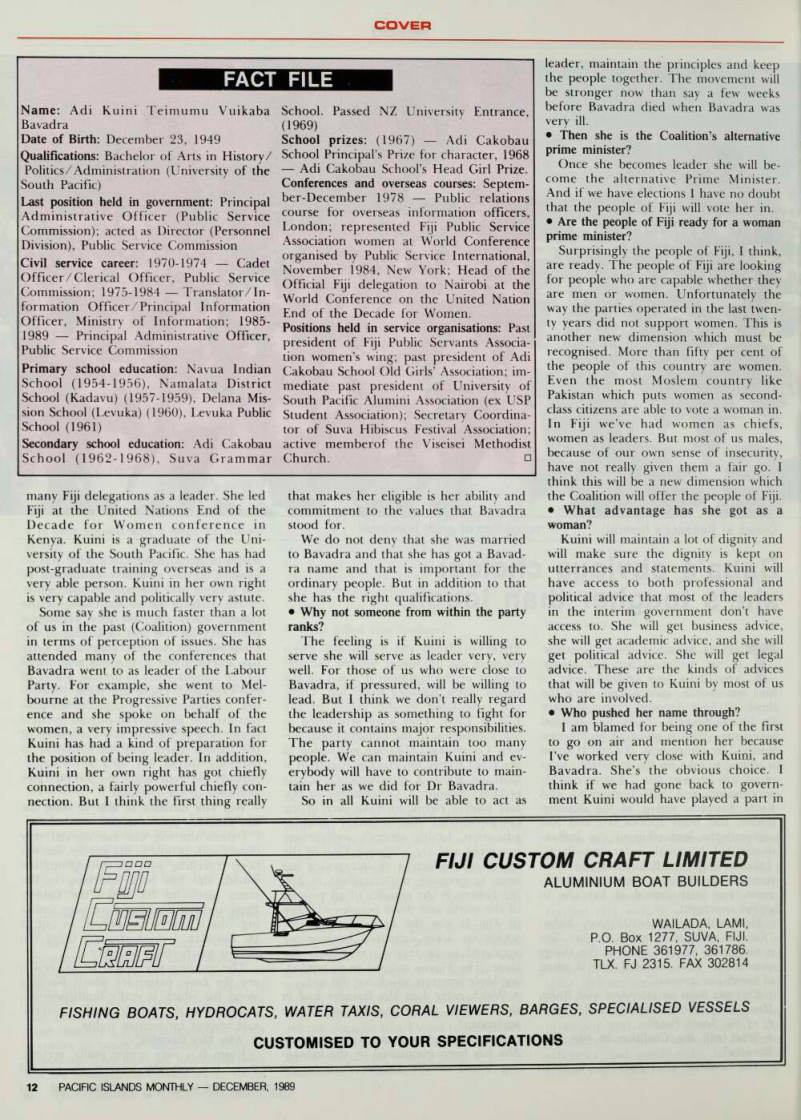
Last journey: “Bavadra was a compromiser”