Around the
Stamps
Around the world in 96 years
By John Hunter
A POSTAL cover mailed in Nukualofa almost a century ago has turned up in New York City.
The cover was cancelled in 1892 and addressed to Hamburg, Germany. It had been dispatched from Nukualofa to Apia then sent to Sydney. From there it travelled aboard North German Lloyd’s Australian Main Line ship to Brandisi, Italy, where it was forwarded to Ham burg. How it ended up in the United States 96 years later is not known.
Details of the Tongan mail services of the last century are interesting as told by the Tonga Chronicle: “The German involvement in Tonga’s postal services can be traced back to the German firm of Johann Cesar Godeffroy und Sohn, of Hamburg, which had a treaty with the Tonga Wesleyan Mission by which all natural produce was sold to the firm. In 1975, the Imperial German government signed a treaty with Samoa to authorise the North German Lloyd Steamship Co to establish a line to the South Pacific. The following year a Treaty of Friendship between Germany and Tonga was concluded.
“As a result, North German Lloyd established the Australische Hauptlinie (Australian Main Line) from Europe to Sydney and the Australische Zweiglinie (Australian Branch Line) from Sydney to Nukualofa and Apia.
“On July 4, 1886, the Imperial German Post Office Department ordered a ship ment of postal supplies for Tongatapu.
But because New Zealand feared Ger man expansion in the Pacific, Tonga took over its own postal affairs on July 30, 1886. When the steamer Lubeck ar rived on September 19, use of German stamps were prohibited and Tongan stamps were required.
“On November 3, 1888, the Post Office
Department in Nukualofa agreed that all German mail destined for Samoan and German addresses be combined and routed through the German Postal
Steamship Agency at Tongatapu. But as
the Australian Branch Line grew more and more unprofitable, it was terminated and Tongatapu’s German Postal Steamship Agency closed in June 1989.”
Catalogues THE 24th edition of the The Australian Stamp Catalogue has been released. This edition has over 2500 price changes and more than 800 new listings. The cata logue has 176 pages with all stamp illus trations in full colour. It includes all Au stralian stamps issued up to the end of 1989, Australian FDCs are listed, as are
specimen overprints, stamp packs,
annual albums maximum cards, heritage stamp books, stamp replica cards, PSEs, postal cards, letter cards, airletters and aerogrammes.
The territories’ section contains the stamp and postal stationery of Australian Antarctic Territory, Christsmas island, Cocos (Keeling) Island, Nauru, Norfolk and Papua New Guinea. The catalogue is used as a standard reference and many use its catalogue numbers as de finitive reference numbers for Australian stamps. It costs A$ 19.95 and good value for this price.
Price quoted for stamps reflect the general lower value for general material but the scarce material in early Australia
and Papua New Guinea show quite hefty price increases. For investors, this is the area to obtain your blue chip invest ments.
Shows THE New Zealand stamp show, New Zealand 1990, the World Stamp Exhibi tion, is at the Auckland exhibition centre from August 24 to September 2 next year.
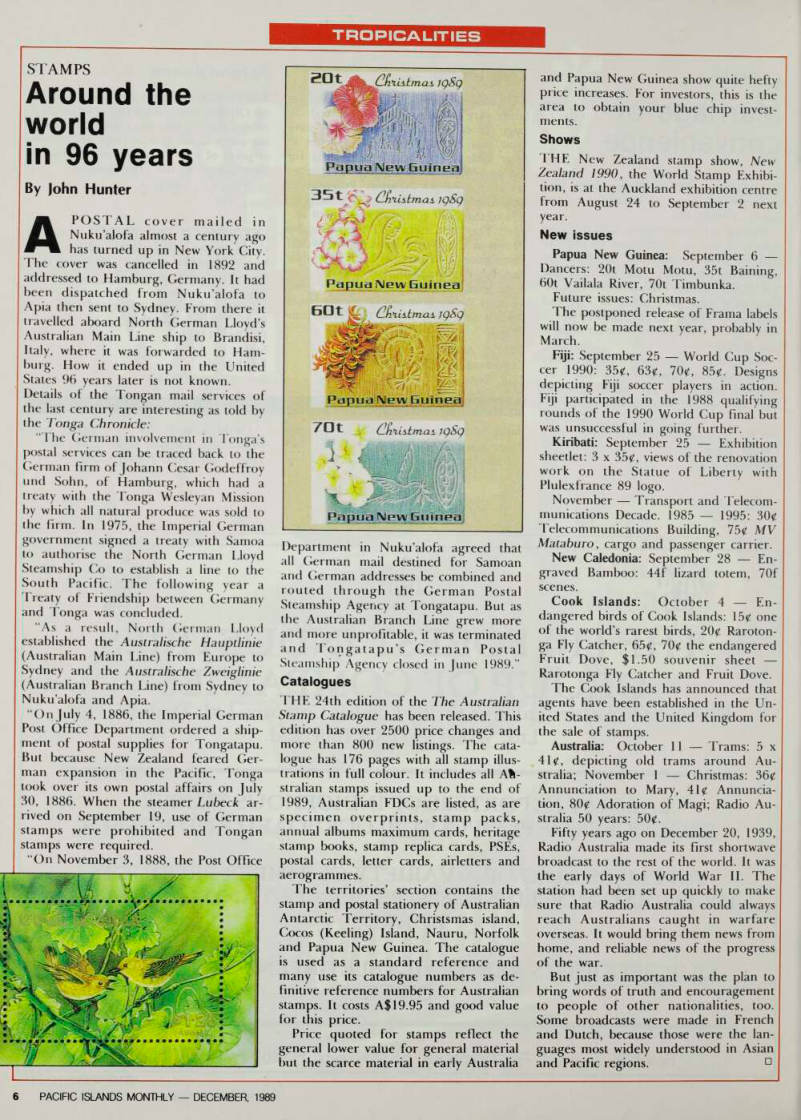
New issues Papua New Guinea: September 6 Dancers: 20t Motu Motu, 35t Raining, 60t Vailala River, 70t Timbunka.
Future issues: Christmas.
The postponed release of Frama labels will now be made next year, probably in March.
Fiji: September 25 World Cup Soc cer 1990: 35tf, 63y, 70tf, 85tf. Designs
depicting Fiji soccer players in action.
Fiji participated in the 1988 qualifying
rounds of the 1990 World Cup final but was unsuccessful in going further.
Kiribati: September 25 Exhibition sheetlet: 3 x 35tf, views of the renovation work on the Statue of Liberty with Plulexfrance 89 logo.
November Transport and Telecom munications Decade. 1985 1995: 30tf Telecommunications Building, 75tf MV Mataburo, cargo and passenger carrier.
New Caledonia: September 28 En graved Bamboo: 44f lizard totem, 70f scenes.
Cook Islands: October 4 En dangered birds of Cook Islands: 15tf one of the world’s rarest birds, 20tf Raroton ga Fly Catcher, 65tf, 70tf the endangered Fruit Dove, $1.50 souvenir sheet Rarotonga Fly Catcher and Fruit Dove.
The Cook Islands has announced that agents have been established in the Un ited States and the United Kingdom for the sale of stamps.
Australia: October 11 Trams: 5 x 41 tf, depicting old trams around Au stralia; November 1 Christmas: 36tf Annunciation to Mary, 41tf Annuncia tion, 80tf Adoration of Magi; Radio Au stralia 50 years: 50tf.
Fifty years ago on December 20, 1939, Radio Australia made its first shortwave broadcast to the rest of the world. It was the early days of World War 11. The station had been set up quickly to make sure that Radio Australia could always reach Australians caught in warfare overseas. It would bring them news from home, and reliable news of the progress of the war.
But just as important was the plan to bring words of truth and encouragement to people of other nationalities, too.
Some broadcasts were made in French and Dutch, because those were the lan guages most widely understood in Asian and Pacific regions. D